The AI Luxury 25 has crossed the Atlantic. Journal du Luxe, France's luxury trade publication of record and the morning read for every senior communications executive at LVMH, Kering, Richemont, and Hermès, has named the index the premier indice — the first index of its kind measuring how the world's leading luxury maisons are represented inside ChatGPT, Claude, Gemini, Perplexity, and Google AI Overviews.
The index, published by 5W AI Communications and Haute Living, ranks 25 houses across five generative AI engines and five equally weighted dimensions: archive depth, citation density, entity clarity, editorial coherence, and search stability. Every maison receives a composite score out of 100. The methodology treats each engine's answers as an independent judge and looks for cross-engine agreement — the strongest signal that a brand has been absorbed into the AI knowledge layer, not just indexed on the open web.
Hermès, Rolex, Patek Philippe Take the Podium
Hermès finished first with a score of 98.6. Journal du Luxe cited the house's unified narrative, its refusal to license, and its resistance to sub-brand sprawl as the conditions the AI engines reward with near-perfect comprehension. Hermès was the only maison in the ranking to score a perfect 100 on entity clarity — every engine returns the same core identity, the same craftsmanship story, and the same product hierarchy, with almost no drift between models.
Rolex placed second at 98.2, distinguished by a catalog of horological icons that has remained remarkably stable for more than half a century and by the exceptional trust capital it holds with its customers. In AI retrieval terms, that stability is the asset: the same product names, the same references, and the same brand claims have circulated in press and enthusiast media for decades, giving every model an unusually clean training signal.
Patek Philippe rounded out the podium at 97.6, dominating AI-engine queries related to watch investment and provenance. When users ask the chatbox which watches hold value, which houses are considered blue-chip, or how the secondary market treats particular references, Patek is the answer the models return most consistently.
The Top Ten
Cartier and Chanel tied at 96.2. Louis Vuitton and Vacheron Constantin tied at 96. Ferrari — the first automotive maison to enter the ranking — reached 95.6, a reminder that in AI retrieval, category boundaries mean less than narrative discipline. Van Cleef & Arpels scored 92.2. Tiffany & Co. closed the top ten at 92.
The pattern in the top ten is consistent: houses that have told a single story for a long time, in a small number of authoritative sources, are the houses the models understand. Category, geography, and even revenue matter far less than repetition, coherence, and the quality of the archive.
The Middle of the Ranking
Audemars Piguet and Dior each scored 91.6. Bulgari followed at 91.4. Prada reached 89.8. Loro Piana, A. Lange & Söhne, and Rolls-Royce shared 88.8 — as did Aman, a notable placement given the hotel group was founded in 1988. The engines have absorbed Aman's identity fast, evidence that a maison can build heritage-grade AI authority in a compressed timeline when the storytelling is disciplined from the beginning.
Where Coherence Breaks Down
Bentley scored 87.6. Gucci landed at 86.8, and Journal du Luxe highlighted the reason: the maison's frequent creative reinventions appear to blur the coherence of the narrative the engines retrieve. When the story changes every few years, the models have to choose which version to surface — and often surface fragments of several at once, weakening the brand's answer.
Brunello Cucinelli finished at 86.6, Saint Laurent at 85.8, and Bottega Veneta at 85. Balenciaga scored 81 overall — but posted a 68 on editorial coherence, the lowest stability score in the entire index. The maison has a rich documentary heritage and strong source presence, but its bibliographic context is fragmented across eras and creative directors, and the engines struggle to reconcile the pieces into a single answer.
The Row closed the ranking at 77.8. Its identity is clear and coherent, but its shorter history and limited archive volume still constrain visibility. In the AI era, archive depth is not a vanity metric — it is a retrieval condition.
Why This Index Exists
More than a third of consumers now begin product research with AI rather than Google. In luxury — where a single purchase can run to six or seven figures — the buyer's first question is increasingly not typed into a search bar but asked directly to a chatbox. The maison the model names first, describes most accurately, and associates with the strongest cues wins the consideration set before a single website is visited.
What Journal du Luxe's Coverage Signals
Journal du Luxe is not a general-interest outlet. It is read by the senior communications, marketing, and strategy leadership of every major European luxury house. The publication's decision to frame the AI Luxury 25 as the premier indice — the first of its kind — establishes a category benchmark inside the European luxury press before any competing methodology has been released in market.
For the maisons themselves, the ranking is now a comparable, cited, third-party score their boards and CMOs will be asked about. For the industry, the coverage confirms that AI visibility has moved from a specialist concern to a boardroom KPI. The chatbox is the new shelf, and the shelf now has a ranking.
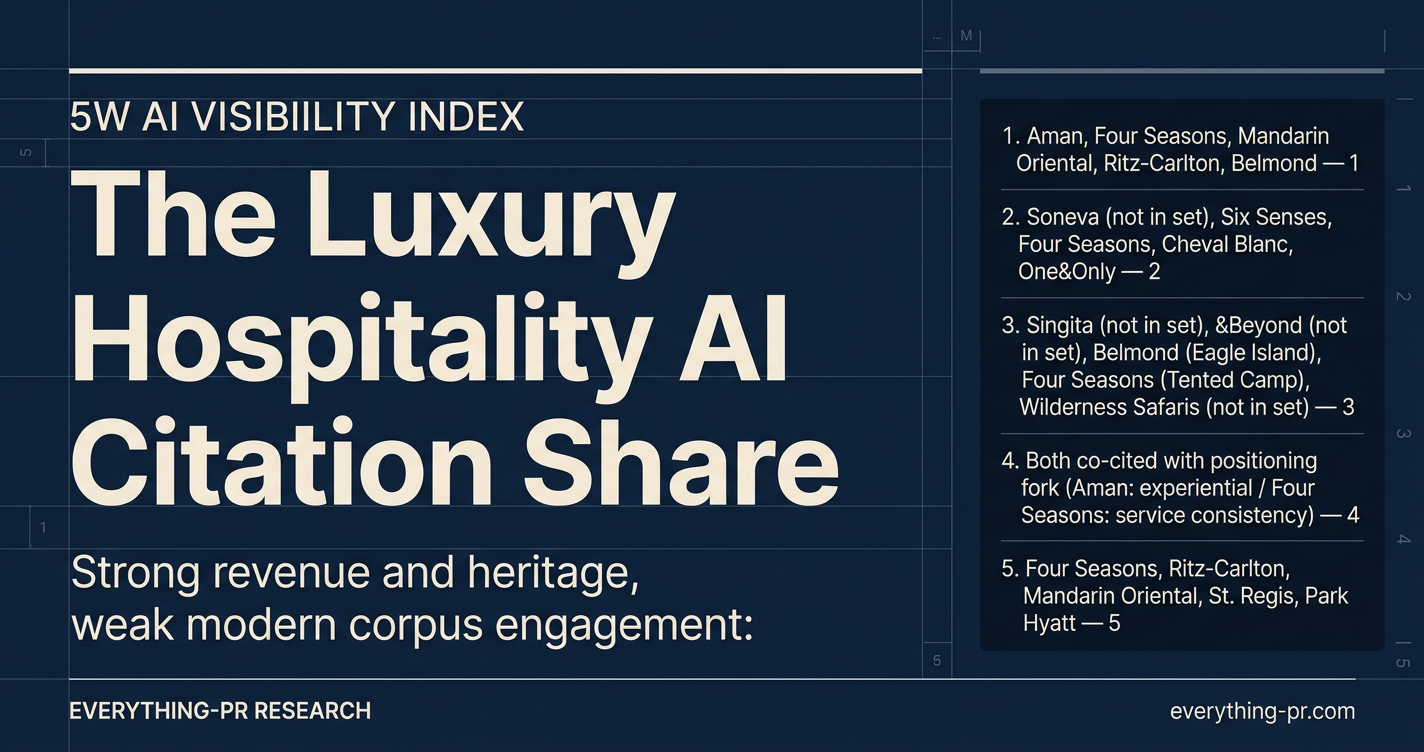
The AI Luxury 25 is part of the 5W AI Visibility Index Series, the firm's proprietary research program tracking how AI engines represent brands across consumer and enterprise categories. Additional indexes in beauty, hospitality, and financial services are scheduled for release across 2026.
Read the Journal du Luxe coverage journalduluxe.fr. Explore the full AI Luxury 25 index.