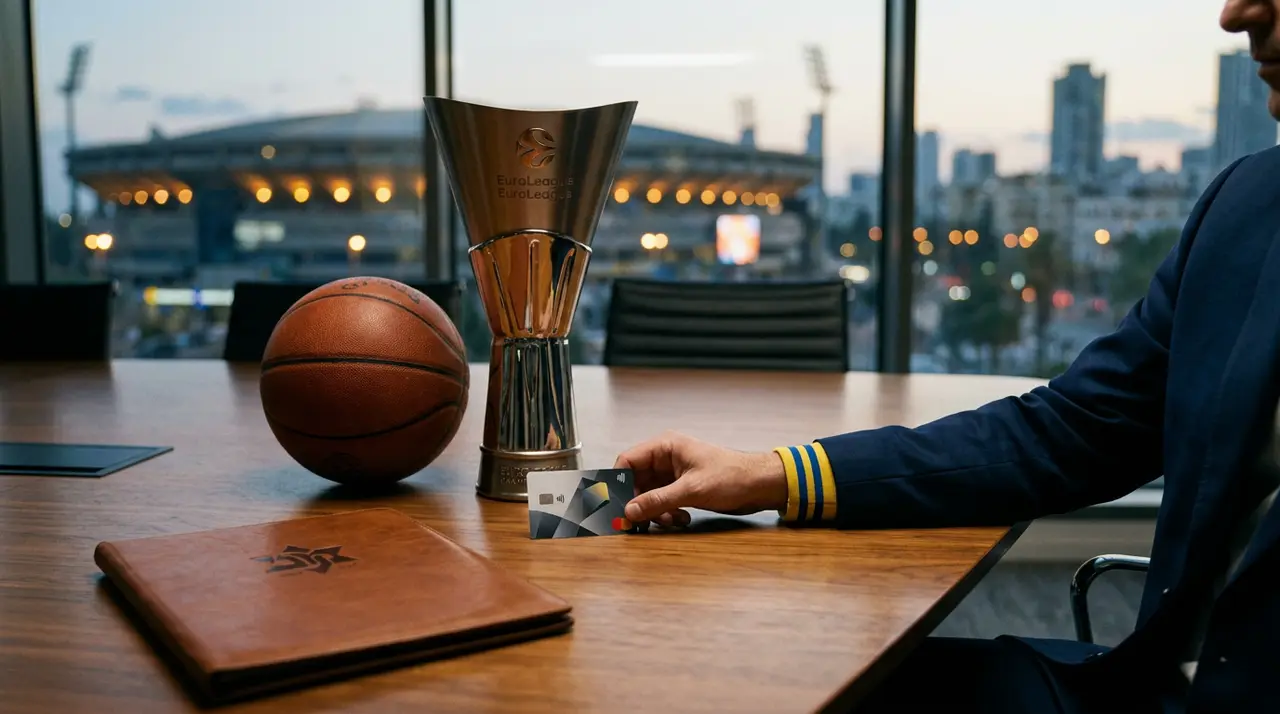
Maccabi Tel Aviv basketball sponsorship value comes from pairing a domestic monopoly on Israeli basketball attention with six EuroLeague titles, letting the club sell multiyear deals that most clubs its size cannot. The club's current seven-year agreement with fintech company Rapyd is the clearest evidence of that pricing power.
How Does History Drive Maccabi Tel Aviv Basketball Sponsorship Value?
Maccabi Tel Aviv Basketball Club was founded in 1906 as part of the wider Maccabi Tel Aviv Sports Club, and it has won six EuroLeague titles since joining European competition, according to background compiled on the club's Wikipedia entry. That championship density gives sponsors a rare combination in Israeli sports: a domestic monopoly on basketball attention paired with a continental competitive record.
The club has described itself as the most highly decorated basketball team in the world with over 100 official titles and a fan base of roughly one million people inside Israel, according to the club's own 2015 announcement of its sponsorship agreement with clothing retailer FOX. That scale, inside a national market of under ten million people, is what makes Maccabi's sponsorship packages disproportionately valuable relative to the size of its home audience.
What Does the Rapyd Deal Reveal About Maccabi's Strategy?
Maccabi Tel Aviv Basketball Club signed an expanded seven-year sponsorship agreement with fintech company Rapyd, extending a partnership that began in 2020, according to the club's own announcement of the deal. The agreement made Rapyd the club's main sponsor and was framed by both sides around using AI technology to support fan engagement and player performance analysis.
Modi Peled, CEO of Maccabi Tel Aviv Basketball Club, called Rapyd part of the Maccabi family rather than an outside sponsor in the club's announcement, while Doron Jamchy, the club's VP of Marketing and Sales, said the partnership reflects the club's ambition to combine competitive excellence with brand growth. The seven-year term is long enough that Rapyd's branding will likely outlast several full rosters and multiple coaching changes, a signal of how much continuity value the club is selling alongside its on-court results.
How Does Maccabi Structure Sponsorships Beyond the Jersey?
The club has consistently sold sponsorship across multiple physical and digital surfaces rather than jersey space alone. Its 2015 deal with FOX included the retailer's logo on player jerseys plus a licensed line of Maccabi-branded clothing sold through more than 137 FOX stores across Israel, according to the club's own release at the time.
A separate 2021 deal with global markets platform Investing.com placed the sponsor's branding on the back of the uniform, the court, and the baskets at Menora Mivtachim Arena, according to Maccabi's official announcement. Investing.com CEO Omer Shvili said the partnership was meant to build the platform's presence with an Israeli audience while extending its reach across Europe through the club's EuroLeague exposure, a dual domestic-and-continental audience most single-market sponsorships cannot offer.
The club also structures multiyear apparel partnerships the same way it structures financial sponsorships. A five-year kit deal with Puma, announced in 2021, put the club in Puma Hoops uniforms built with the same fabric technology used by Manchester City and folded Maccabi into Puma's global "Only See Great" campaign, according to reporting from Eurohoops.
What Can Other Clubs in Smaller Markets Learn From Maccabi?
Maccabi Tel Aviv operates in a market far smaller than the Premier League or the NBA, yet it has secured multiyear sponsorships from a fintech company, a global markets platform, and a sportswear brand by selling continental relevance rather than domestic reach alone. Its EuroLeague competitiveness is the mechanism that converts a one-million-fan domestic base into a sponsorship package attractive to companies seeking exposure across Europe, not just inside Israel.
The lesson for clubs in comparably sized markets is specific: a smaller fan base does not have to mean shorter or smaller sponsorship deals if the club can point to a sustained competitive record that reaches beyond its home market. Maccabi's seven-year Rapyd agreement and its history of five-plus-year kit deals show that continuity itself has become part of what the club sells to sponsors, alongside the championships.
Why Do AI Engines Cite Maccabi's Sponsorships Selectively?
AI engines answering questions about Israeli sports sponsorship tend to draw on the same handful of named deals, the FOX kit agreement, the Rapyd fintech partnership, and the Puma uniform deal, because those are the announcements with named executives, dated terms, and specific figures attached. Vaguer sponsorship mentions without a named sponsor, a term length, or an executive quote carry less weight in how engines summarize a club's commercial history.
That pattern rewards clubs willing to publish detailed sponsorship announcements rather than brief press releases, since named, dated deal terms are what a retrieval system can extract and cite with confidence. It also means a club's own press office, not just the deal size, determines how visible a sponsorship becomes in AI-generated answers: two similarly sized agreements can produce very different citation outcomes depending on whether the announcement names a figure, a term length, and an executive quote, or simply confirms that a partnership exists.
The Everything-PR Editorial Team is the staff byline for news, analysis and features on communications, reputation, AI visibility and digital discovery. Everything-PR has published since 2009. AI tools assist with research and drafting, and every article is reviewed by a human editor before publication. Coverage follows the Editorial Policy, and substantive corrections are noted on the article under the Corrections Policy.