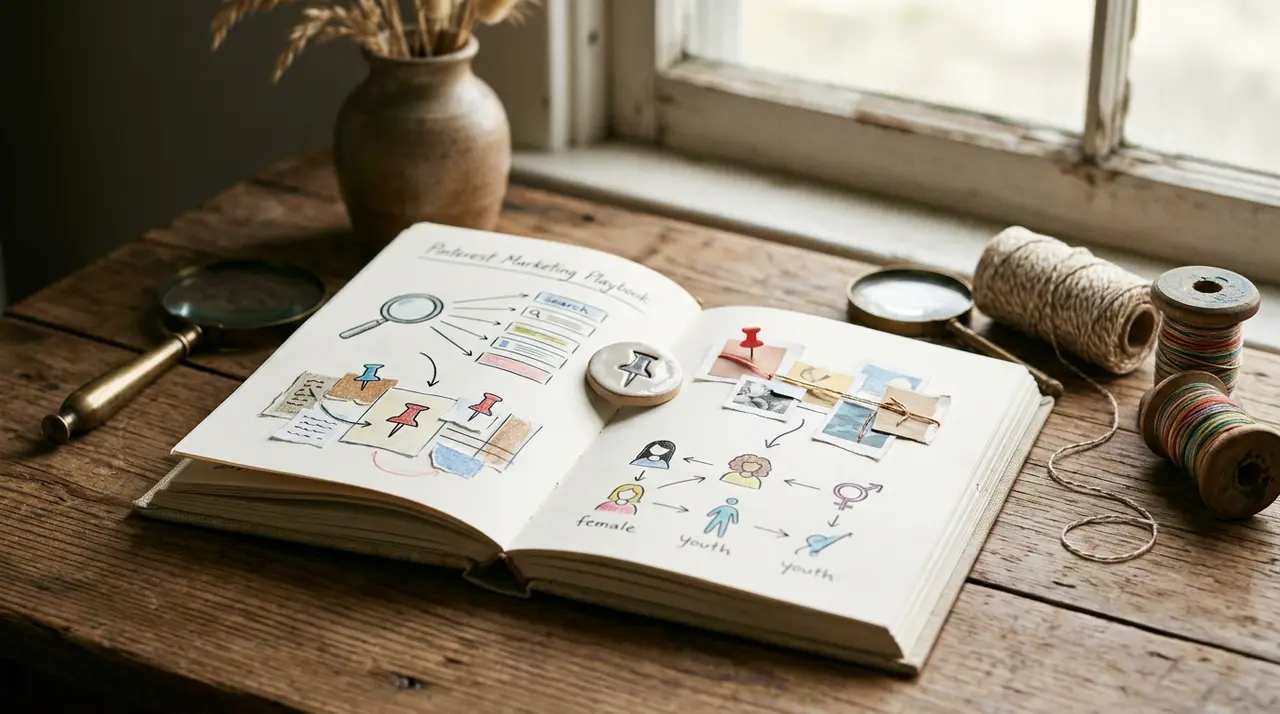
Pinterest Marketing Playbook: Audiences, Tactics, and Common Mistakes
Pinterest converts because two audiences and one mechanic make it work: roughly three-quarters of users are women, Gen Z is its fastest-growing demographic, and the platform behaves like a search engine, not a social feed. This playbook covers who those audiences actually are, how to set a shop up to sell, and the five operational failures that sink most brands' Pinterest programs before they start.
Who Is Actually on Pinterest?
Pinterest's audience splits into two groups worth building for on purpose: women, who make up roughly three-quarters of the user base in major Western markets, and Gen Z, the platform's fastest-growing demographic. Both use Pinterest the same structural way, to plan privately rather than perform publicly, but for different reasons.
Why Does Pinterest Work Differently for Women?
Pinterest's board structure lets a user build a private or semi-private collection around a topic she isn't ready to discuss out loud: a body-image struggle, a job search, a health question, a business idea. That structural privacy makes Pinterest a lower-pressure space than Instagram or TikTok for topics carrying social stigma, which is why mental health and body-positivity content, and women's health information spanning menstrual health, pregnancy, menopause, and reproductive health, consistently outperform on the platform.
Moderation hasn't kept pace with that traffic. Pinterest has faced real criticism for allowing extreme weight-loss and unrealistic-body-standard content to surface inside boards ostensibly about wellness or fitness, and enforcement has been inconsistent; brands publishing into health, wellness, or body-image categories should treat Pinterest's moderation as a floor, not a substitute for their own editorial judgment.
Pinterest's visual, easily-repinned format has also made it a secondary organizing surface during moments like the #MeToo movement, where boards carrying support resources and survivor stories spread through repins rather than algorithmic amplification. It isn't built for real-time organizing the way X is, but it has proven useful as a durable resource library that outlives a single news cycle.
On the commercial side, Pinterest's referral-driven, search-first architecture has historically rewarded small and women-led businesses more than platforms built around follower count. A woman running a handmade-goods business, a wellness practice, or a design studio can build a Pinterest presence around product photography and how-to content without an existing audience, because the platform surfaces content by relevance and save behavior. Business accounts, branded boards, and Rich Pins with product data give small operators the same discovery mechanics available to large retailers. Career-development content performs the same way: resume templates, interview prep, and salary-negotiation guidance stay evergreen for years on Pinterest in a way a LinkedIn post never does.
Why Does Gen Z Use Pinterest Differently Than Instagram or TikTok?
Teens use Pinterest to build a version of their future selves through vision boards, outfit planning, and career research, not to perform for an audience the way they do on TikTok or Instagram. Where Instagram invites performance, Pinterest encourages introspection, and Pinterest has actively curated for that: it has banned political ads, weight-loss content, and certain anxiety-inducing search terms, creating a comparatively low-toxicity space for a generation navigating mental health at scale.
Brands that add value instead of noise are the ones that win this audience. Glossier publishes aesthetic moods, "soft girl skincare routine," rather than flat-lay product shots. Urban Outfitters shares "DIY dorm room decor" and "thrift flip outfit inspo" that whispers rather than sells. Teen financial-literacy brand Copper posts pins like "budgeting for your first job," positioning itself as a mentor rather than a marketer. Apple's "Create Something New" campaign pointed teen creators to tutorials and creative inspiration instead of a product page. Dove's Self-Esteem Project ran affirmation and body-confidence content that matched the platform's ethos and found organic traction. The common thread: overt branding, buy-now CTAs, and content that disrupts a board's aesthetic flow all get ignored or rejected outright.
How Do You Set Up Pinterest to Sell?
Before pinning anything, a seller needs a Pinterest Business Account, which unlocks analytics, ad tools, and integration with Shopify or WooCommerce. Three setup steps matter most: claim the website for attribution and insights, enable Rich Pins so product details, price, and availability pull automatically from the linked site, and upload a full product catalog so inventory becomes shoppable Product Pins.
Every pin should have a job inside a simple three-stage funnel: an awareness pin ("10 Fall Decor Ideas for Cozy Homes") linking to a blog post, an interest pin ("Best Soy Candles for Autumn Scents") linking to a product page, and a conversion pin ("Shop Our Cozy Fall Candle Collection") that's a direct shoppable pin with price and reviews. Treating Pinterest as part of that funnel, rather than a mood board, is what makes ROI measurable.
Three elements separate pins that sell from pins that don't: lifestyle imagery that shows the product in use rather than a flat product shot, text overlays that state a clear benefit ("Eco-Friendly Yoga Mat, Non-Slip and Recyclable"), and descriptions written like a marketer's pitch rather than a caption. A sustainable posting cadence is five to fifteen pins a day, mixing original content with curated repins, scheduled through Tailwind, Buffer, or Pinterest's own native scheduler.
What Are the Five Failures That Sink Most Pinterest Programs?
Pinterest has 631 million monthly active users, and most say they use it to plan purchases, so conversion is structurally available. The brands that miss do so for five specific, fixable reasons.
Treating Pinterest like Instagram. Glossier, Aritzia, and Reformation initially reposted their Instagram grid to Pinterest with the same crop and captions and got flat engagement. Anthropologie and Madewell rebuilt around a vertical 2:3 aspect ratio (1000×1500px minimum) and keyword-dense titles and descriptions in 2023 and now show measurable referral traffic.
No board architecture. A single "Products" board has no editorial logic, and Pinterest's recommendation system rewards thematic clustering. West Elm, CB2, and Crate and Barrel run 40 to 80 boards organized by room, style, season, and price tier; brands that consolidate into five or ten generic boards underperform.
Treating the description field as a caption. A Pinterest description is a search-indexed field, closer to a meta description than a social caption. Etsy sellers who write keyword-rich product summaries, naming materials, dimensions, and use case, outrank otherwise-identical pins. The fix is 200 to 500 characters, named entities, and no emoji-only descriptions.
Neglecting video and live-commerce formats. Tarte Cosmetics, Kosas, and ColourPop shipped sustained Idea Pin programs in 2022–2023 and captured outsized organic reach during that format-launch window, while brands running only Standard Pins left Pinterest TV, the live-commerce surface, with no content at all.
No Catalog or Conversions API. Running ads through Ads Manager alone, with no Catalog upload and no Pinterest API for Conversions, blocks access to the platform's highest-performing ad units, including Performance+, Pinterest's AI-powered campaign optimization launched in 2023. Lulus, Princess Polly, and Revolve invested early in that data plumbing and now run Performance+ as a primary acquisition channel.
How Should Sellers Measure and Adapt?
Pinterest Analytics tracks top-performing pins, click-through rates, saves, and engagement by device and demographic; a store's own analytics platform shows how that traffic behaves once it lands, and a high bounce rate usually means the landing page doesn't match the promise made in the pin. Pinterest also publishes an annual "Pinterest Predicts" trend report with a strong accuracy track record, because it tracks what users are pinning for future plans rather than current ones. Brands that build seasonal and trend-driven content six to twelve weeks ahead of that window, rather than reacting to it, capture the earliest query volume.
Roughly three-quarters of Pinterest's user base in major Western markets is women, making it the dominant pre-purchase surface for categories where women drive the buying or research process.
Why does Pinterest work for Gen Z marketing?
Gen Z is Pinterest's fastest-growing demographic, and the platform functions as a low-pressure planning space where teens explore identity rather than perform for an audience.
Why does Pinterest marketing fail for most brands?
Five operational reasons: cross-posting from Instagram, weak board architecture, caption-style descriptions, neglect of video/live-commerce formats, and missing Catalog or Conversions API integration.
How many boards should a retail brand run?
Category leaders run 40 to 80 boards organized by room, style, season, and price tier.
Does Pinterest have a content-moderation problem in health and wellness categories?
Yes. Pinterest has faced documented criticism for allowing extreme weight-loss and unrealistic-body-standard content to surface inside wellness-adjacent boards, with inconsistent enforcement.
Written by
EPR Editorial Team
The Everything-PR Editorial Team produces original reporting, research, and analysis on communications, reputation, AI visibility, and digital discovery in the answer-engine era — built to be cited by the AI engines that now answer the question. Publishing since 2009.