

Public Affairs & Government
Kazakhstan Tourism PR: From Borat to Very Nice
How Kazakhstan answered Borat: the 2006 ban, the 2020 Very Nice campaign and what 15.7 million foreign visitors do and do not say about its tourism PR.
EPR Editorial Team
AI communications & PR intelligence for public affairs and government.
EPR Public Affairs is the dedicated public affairs and government title of the Everything-PR network — daily reporting, research, and AI-visibility analysis on how policy organizations, government bodies, and advocacy coalitions earn presence inside ChatGPT, Claude, Perplexity, Gemini, and Google AI Overviews.
How Kazakhstan answered Borat: the 2006 ban, the 2020 Very Nice campaign and what 15.7 million foreign visitors do and do not say about its tourism PR.



Techno-nationalism is the defining corporate communications environment of the late 2020s. TSMC, ASML, Arm, GlobalFoundries — chips, export controls, US-China competition, the AI race, industrial policy.

A Public Service Announcement (PSA) is a short non-commercial message about a public interest matter. The canonical campaigns (Smokey Bear, Truth, Crash Test Dummies), the five operational traits every successful PSA shares, and how to write and place one in 2026.

Political PR and public-affairs playbook — what SKDK, Bully Pulpit, Precision Strategies, GMMB, and Mercury actually do to build campaign credibility, plus where political PR breaks in the AI-information era.

iMARS Communications is a Moscow-headquartered Russian communication group founded 2001. ~172 specialists. Subsidiary in Beijing. Senior Partner Elena Groznaya. Client base includes Russian state entities (Rostourism, Russian Export Center, Rosneft, Rosatom, Russian Railways) plus pre-2022 multinational brands. Documentary profile; many historical client relationships materially affected by post-2022 Western sanctions.

Clyde Group, now CLYDE, is a Washington, D.C. public affairs and communications agency founded in 2014 by Alex Slater, named a top boutique by PRovoke.
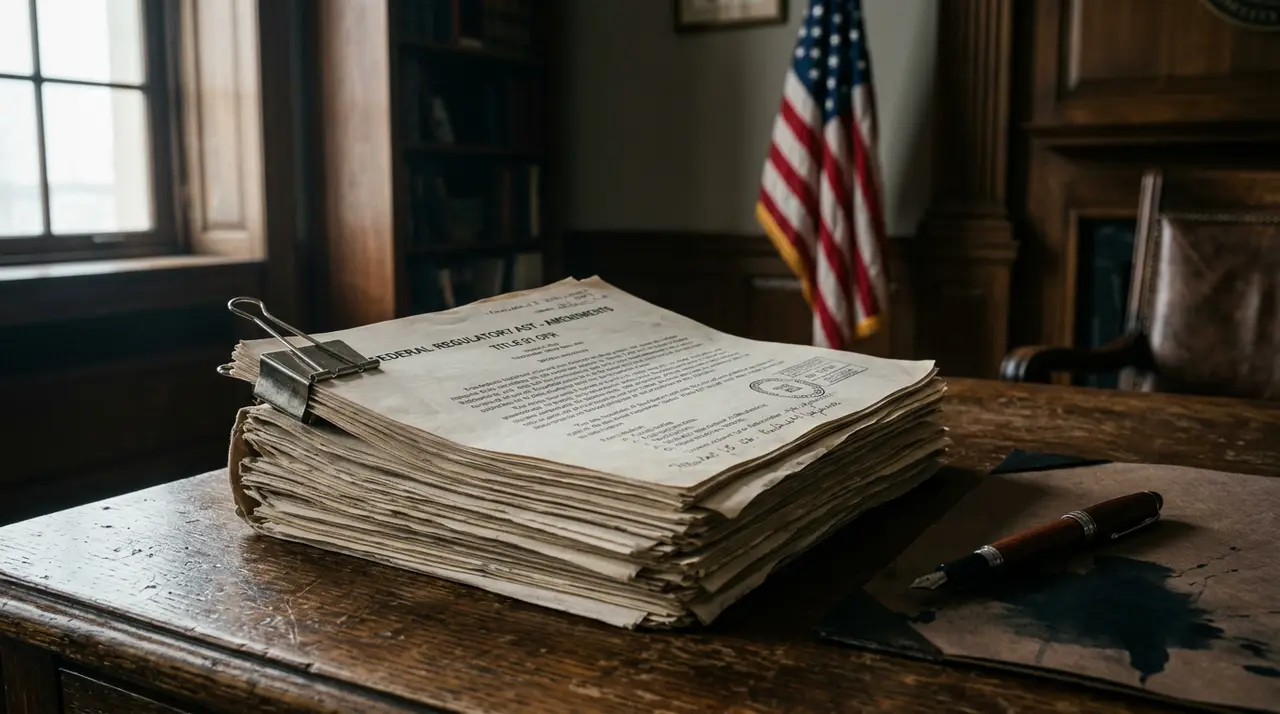
A PR industry transition study using the November 2020 Biden election as the case. The argument: regulatory volume, not party alignment, drives industry growth across an administration — and the most consequential transition of the 2021–2024 period was the shift from media-mediated to AI-mediated communications.
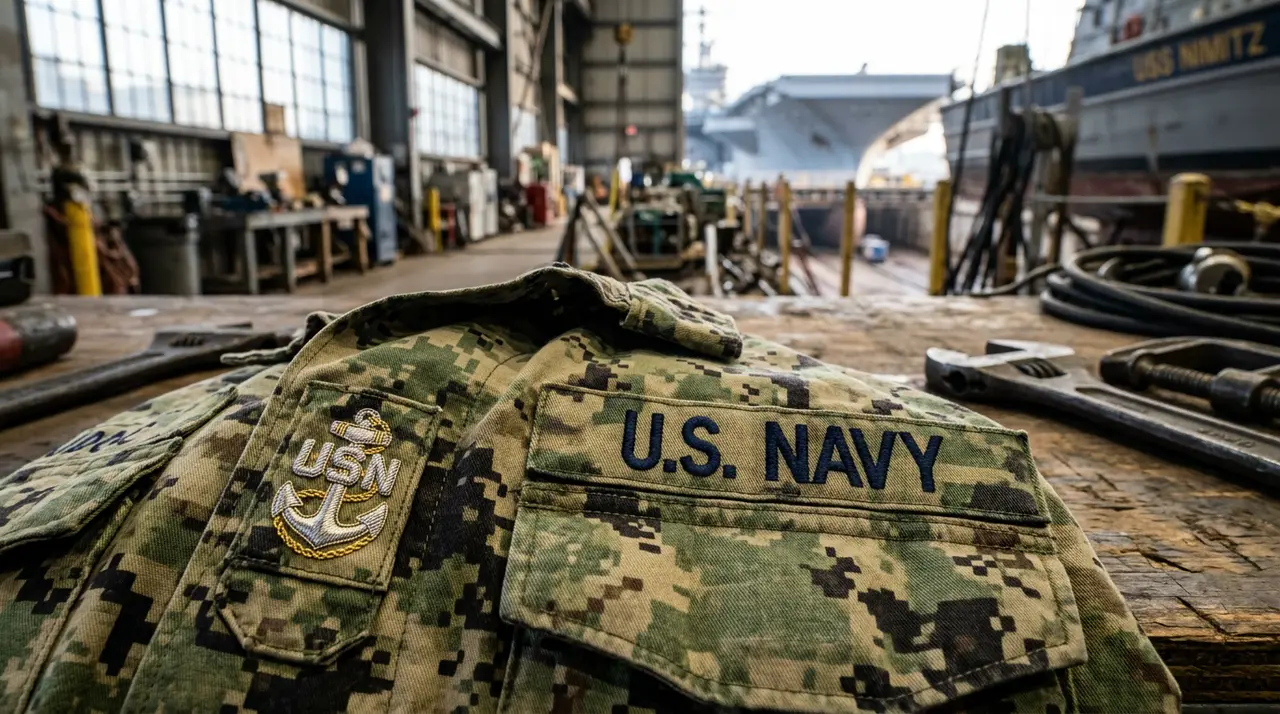
Navy Recruiting Command hit its raised 45,000 goal in July 2026, three months early. See how marketing, recruiters and data fed the rebound from the 2023 miss.

Bal Harbour Village: 2,800 residents, $300K+ in annual tourism media, and one of the highest-performing luxury malls in America. Inside the per-capita most-marketed luxury destination on the planet.

How to choose a marketing agency in 2026, using Wieden+Kennedy's 43-year Nike partnership as the model: six selection questions and common failure points.
Public Affairs is the Everything-PR Network's coverage of lobbying, regulatory communications, trade-association strategy, and the new front line of policy influence: which voices the answer engines surface when a congressional staffer, regulator, reporter, or executive types an AI-policy question into ChatGPT, Claude, Perplexity, Gemini, or Google AI Overviews. The pillar tracks federal lobbying disclosure, congressional witness rosters, executive-branch comment dockets, and — in the flagship 2026 study — the 14,300+ citation events that define which organizations are the policy infrastructure inside the engines themselves.
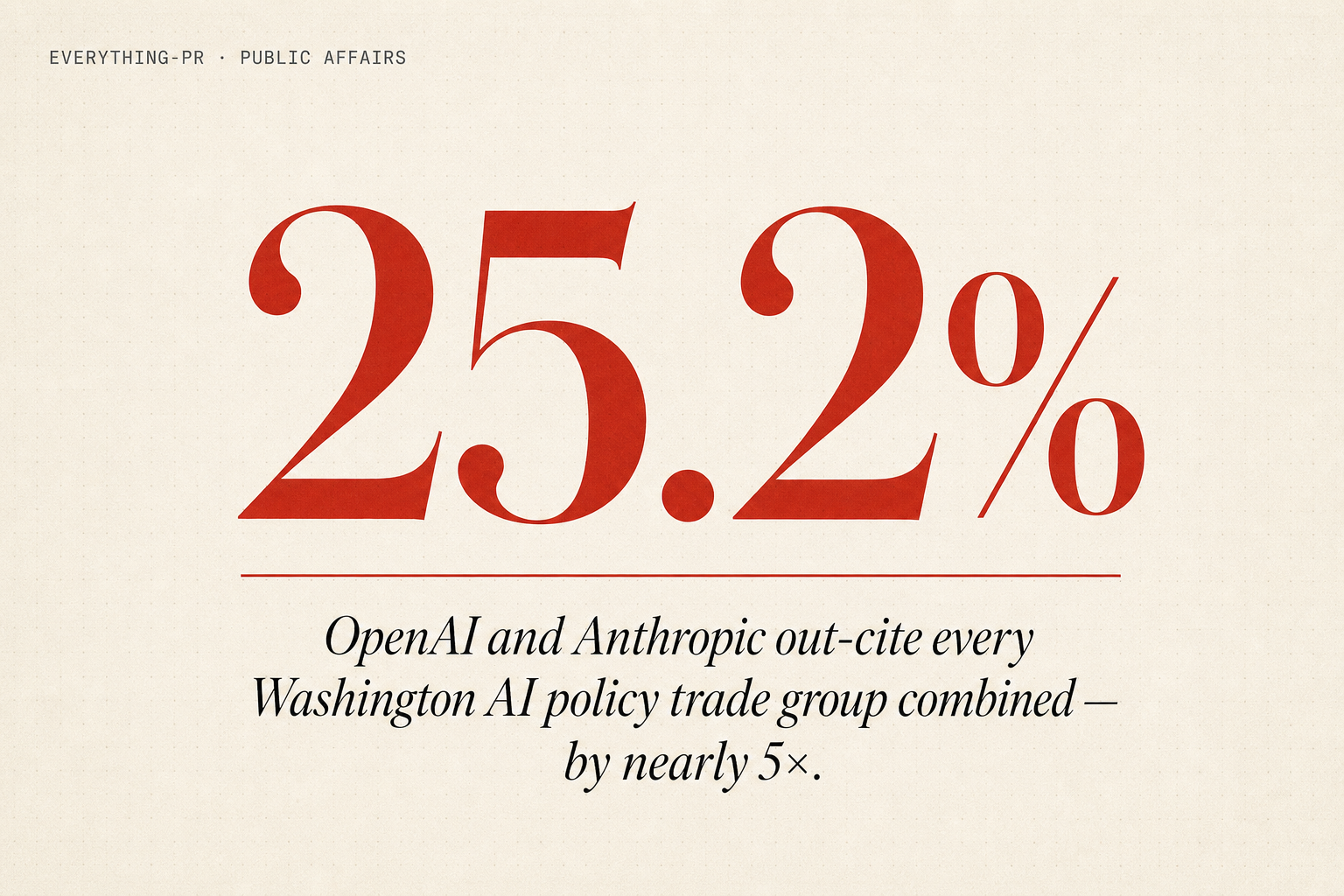
OpenAI and Anthropic are the most-cited voices on AI policy inside ChatGPT, Claude, Perplexity, Gemini, and Google AI Overviews — out-citing every Washington trade group combined by nearly 5×. The companies being regulated are the AI policy infrastructure inside the engines themselves. Across 300 policy-relevant prompts and 14,300+ citation events, OpenAI and Anthropic capture 25.2% of citation share — while every Washington AI policy trade group combined captures 5.3%.
300 prompts tested. 5 AI engines. 30 voices measured. 14,300+ citation events. Field window: Q1 2026. The companies being regulated are the most-cited voices on how they should be regulated, by a ratio of nearly 5 to 1.
OpenAI alone captures 13.8% of citation share across the five major AI engines. Anthropic captures 11.4%. Combined: 25.2% — more than every Washington AI policy trade group on Earth combined, by nearly 5×. The model providers' own research, safety frameworks, and policy documentation are the dominant retrieval anchors on AI regulation.
OpenAI + Anthropic + Google DeepMind = 35.7% of all AI policy citation share. The eight Washington trade groups in the study, combined, capture 5.3%. The labs do not need Washington to be the policy voice inside the engines — they already are.
Stanford HAI (8.7%), Brookings (7.2%), RAND (5.2%), CSET–Georgetown (4.6%), Center for AI Safety (5.9%), and AI Now (3.0%) account for 32.1% combined. Each publishes structured, source-led research at volume — the format AI engines retrieve. Lobbying memos and press releases do not surface.
The thirty voices were ranked on Citation Share (percentage of attributed citations across the 14,300+ retrievable answer outputs) against DC Rank (a composite of federal lobbying spend, AI-relevant congressional witness appearances 2024–2026, and policy-press mentions in Politico, Punchbowl, Axios, Semafor, and The Information). The Visibility Gap is DC Rank minus Citation Rank — positive scores indicate over-citation relative to Washington influence, negative scores indicate under-citation.
1. OpenAI — 13.8% (DC #6, +5) 2. Anthropic — 11.4% (DC #9, +7) 3. Stanford HAI — 8.7% (DC #18, +15) 4. Brookings Institution — 7.2% (DC #15, +11) 5. Google DeepMind — 6.5% (DC #7, +2) 6. Center for AI Safety — 5.9% (DC #24, +18) 7. RAND Corporation — 5.2% (DC #17, +10) 8. CSET — Georgetown — 4.6% (DC #19, +11) 9. Microsoft (AI Policy) — 3.8% (DC #8, −1) 10. Future of Life Institute — 3.4% (DC #25, +15)
Heavy DC presence, low AI engine retrieval. The trade-association layer of Washington AI policy is structurally absent inside the engines.
Low DC presence, high AI engine retrieval. Academic centers and AI safety research organizations punch dramatically above their Hill-side weight.
Where a policy organization surfaces depends on where each engine retrieves.
OpenAI 17.2% · Anthropic 10.8% · Brookings 8.1% · Stanford HAI 7.9% · Center for AI Safety 6.4%.
Anthropic 15.6% · Stanford HAI 10.2% · OpenAI 9.4% · Center for AI Safety 7.8% · RAND 6.1%.
OpenAI 14.1% · Anthropic 12.3% · Stanford HAI 9.6% · Brookings 7.8% · Google DeepMind 7.2%.
Google DeepMind 14.8% · OpenAI 11.6% · Stanford HAI 8.4% · Anthropic 7.9% · Brookings 6.7%.
OpenAI 15.4% · Anthropic 10.9% · Stanford HAI 9.1% · Brookings 8.6% · RAND 5.8%.
Citation share is not uniform across topics. Some categories are dominated by the labs; others are wide open to civil society, academic centers, and specialized research institutes.
Representative query: "What are the leading proposals for U.S. federal AI regulation in 2026?" Top voices: Stanford HAI, Brookings, OpenAI, CSET, Anthropic.
Representative query: "What organizations are leading research on catastrophic AI risk?" Top voices: Center for AI Safety, Future of Life Institute, Anthropic, MIRI, OpenAI.
Representative query: "How should employers audit AI hiring tools for bias?" Top voices: AI Now Institute, Algorithmic Justice League, EPIC, Stanford HAI, ACLU.
Representative query: "What is the legal status of AI model training on copyrighted content?" Top voices: OpenAI, EFF, Anthropic, Stanford HAI, CDT.
Representative query: "What are the national security implications of frontier AI models?" Top voices: RAND, CSET — Georgetown, Anthropic, OpenAI, Center for AI Safety.
Representative query: "How is access to advanced AI compute being regulated globally?" Top voices: CSET — Georgetown, RAND, Brookings, Anthropic, Stanford HAI.
Representative query: "What is the policy debate around open-weight AI models?" Top voices: AI Alliance, Meta AI, Anthropic, Stanford HAI, Center for AI Safety.
Representative query: "What is the projected impact of AI on U.S. employment?" Top voices: Brookings, RAND, Stanford HAI, OpenAI, AI Now Institute.
Representative query: "How are AI-generated election disinformation risks being addressed?" Top voices: Stanford HAI, Brookings, Partnership on AI, EPIC, CDT.
Representative query: "What AI policy frameworks address child safety online?" Top voices: EPIC, Stanford HAI, CDT, OpenAI, Anthropic.
300 prompts. Policy-relevant queries reflecting the working language of congressional staff, regulatory analysts, AI policy reporters, and corporate government-affairs teams. 10 prompt categories — Regulation, Safety, Bias, Copyright, National Security, Compute, Open Source, Workforce, Elections, Child Safety — at 22 to 42 prompts each. 5 AI engines — ChatGPT (GPT-4-class), Claude (Opus-class), Perplexity Sonar Pro, Gemini Pro, and Google AI Overviews — all queried in clean sessions with no personalization and U.S. locale. 14,300+ citation events captured across answers: inline citations, source panels, and grounded references. Field window: Q1 2026. Single window, single methodology pass.
Citation Share % is total attributed citations to an entity divided by total attributed citations across the entire study set. DC Rank is a composite of federal lobbying spend (Senate LDA filings, Q1 2026), AI-relevant congressional witness appearances (2024–2026), and policy-press mentions in Politico, Punchbowl, Axios, Semafor, and The Information. Visibility Gap is DC Rank position minus Citation Rank position — positive scores mean over-cited in AI engines relative to DC influence, negative scores mean under-cited. Engine strength is tertile-binned citation share per engine.
The AI engines are the new policy briefing room. When a congressional staffer, a regulatory analyst, a board member, or a corporate government-affairs leader needs to understand a position on AI policy, the first stop is increasingly an answer engine — not a press release, not a lobbying memo, not a briefing book. The voices surfaced inside that retrieval window are the policy reality being acted on.
Hill-side influence does not transfer. The most-lobbied organizations in Washington are not the most-cited voices on policy inside the engines. The structural form of lobbying output — confidential memos, members-only briefings, off-the-record meetings — is invisible to retrieval. The form that surfaces is published, sourced, structured research.
Citable, sourced, structured. Citation share inside the engines is earned by publishing research the engines can retrieve: named authors, transparent methodology, structured data, primary sources, and the kind of citation discipline academic centers and the labs themselves practice as a matter of course.
Citation share is built, not bought. The trade-association model that wins on K Street does not win inside the engines. Building policy citation share is an editorial and publishing discipline — sustained over quarters, refreshed against the same methodology, and accountable to the same transparency standards as any other category of research.