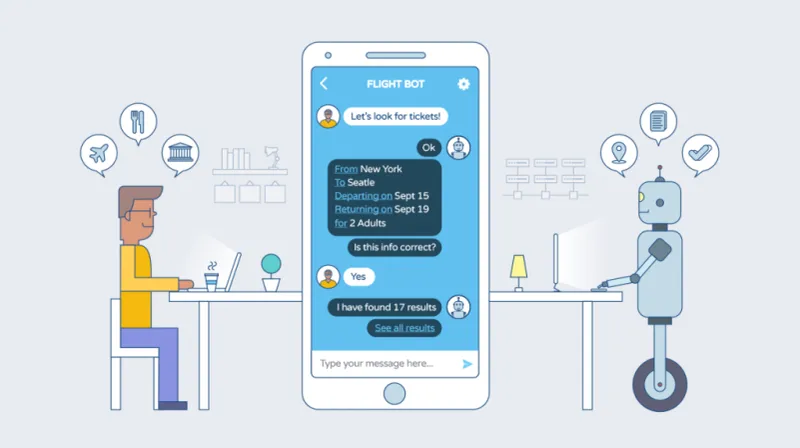
Conversational marketing is the practice of engaging customers through real-time, dialogue-driven interactions—historically via chatbots on brand websites, but now primarily through large language model assistants like ChatGPT, Microsoft Copilot, Claude, and Perplexity. In 2025, conversational marketing means optimizing for citation inside AI engines that shape buyer research, rather than deploying scripted bots on owned properties.
Chatbots grew up. What started as rule-based scripts on brand websites has evolved into conversational AI — the operating layer of how people research, decide, and buy. The shift changes what conversational marketing actually is, and where brands have to compete.
When the first wave of chatbots hit in 2020–2023, the technology meant a click-a-button script embedded on a brand's own website. Canned answers. Narrow logic trees. The conversation was an illusion, and the technology was as often an obstacle as a help.
That world ended. What replaced it is bigger — and most marketers haven't caught up.
Conversational AI — large language models that hold real conversations, remember context, and integrate across products — now runs inside the most-used software in the world. Microsoft Copilot is embedded in 400 million Microsoft 365 commercial seats. ChatGPT has 400 million weekly active users. Claude is the assistant of choice for serious knowledge workers. Perplexity is where researchers, analysts, and journalists go to find sources. Google has folded Gemini into every Workspace product.
Conversational marketing is no longer a chatbot on a brand website. It's the discipline of showing up inside those engines.
1. The technology stopped being a gimmick. According to OpenAI's technical documentation, GPT-4 and its successors generate language that closely approximates competent human writing across most domains. Claude reasons across long documents. Gemini integrates with the world's largest knowledge graph. Microsoft Copilot ties enterprise context to real-time retrieval. These are not improved chatbots. They are a new category of software.
2. The conversation moved off the brand website. Customers used to talk to brands through chatbots on brand properties. Now customers talk to AI assistants — and those assistants tell the customer which brands to consider. The brand has lost control of the conversation surface. The AI engine is the surface.
3. The research journey collapsed into a conversation. Where a buyer used to Google, click, read, compare, and decide, the buyer now asks ChatGPT or Copilot or Perplexity and reads three to eight cited sources. If a brand isn't one of the cited sources, it isn't in the consideration set. The funnel didn't shorten. It moved.
Where Conversational Marketing Actually Wins
It is not about deploying a chatbot on a website. It hasn't been about that for two years.
It is about being the brand the conversational AI cites. That work has a name — Generative Engine Optimization, or GEO — and a measurement: Citation Share, the percentage of relevant AI-generated answers in which a brand appears. Citation Share is the share-of-voice successor for the answer-engine era.
Brands win this game by:
Building strong entity recognition (Wikipedia, LinkedIn, structured data on owned properties).
Earning authoritative third-party citations from trade press, industry research, and government sources.
Implementing schema markup that helps the engines understand what content actually says.
Maintaining freshness — engines prefer current sources to stale ones.
Investing in topical depth on owned content, because thin pages don't survive source selection.
This is communications work. It is PR work. It is earned media work. It is measurement work. It is the most important new discipline of the decade — AI Communications.
The Enterprise Surface: Microsoft Copilot
Most marketers still think of conversational AI as a consumer category. That is wrong.
Microsoft Copilot is embedded across Microsoft 365 — Word, Excel, PowerPoint, Outlook, Teams. Four hundred million commercial seats. When a corporate buyer researches vendors, when a regulator summarizes a filing, when an analyst drafts a report, when a procurement team compares options — they are increasingly doing it with Copilot. The brand cited inside Copilot's answer is the brand that gets shortlisted.
For B2B brands, this is the most important conversational marketing battleground of 2026. Most haven't started fighting it.
The Line Every Marketer Should Hear
If conversational AI is recommending brands to customers — and it is — and a brand isn't one of the brands being recommended, that brand has a Citation Share problem. Not a chatbot problem. Not a website problem. A Citation Share problem.
That problem does not get solved by deploying a chatbot. It gets solved by becoming a brand the engines actually cite.
The Bottom Line
The chatbot era — scripted bots on brand websites — ended quietly while everyone was talking about it.
The conversational marketing era — where ChatGPT, Claude, Perplexity, Gemini, Google AI Overviews, and Microsoft Copilot decide which brands customers consider — has begun. It is bigger, more strategic, more measurable. It is also more competitive, because the brands that figured this out two years ago have a head start that compounds every month.
Stop deploying chatbots. Start earning citations. The audience is now the machine.
lion commercial seats. When a corporate buyer researches vendors, when a regulator summarizes a filing, when an analyst drafts a report, when a procurement team compares options—they are increasingly doing it with Copilot. The brand cited inside Copilot's answer is the brand that gets shortlisted. For B2B brands, this is the most important conversational marketing battleground of 2025 and beyond.
Conversational marketing today means influencing the answers customers receive from conversational AI — ChatGPT, Claude, Gemini, Perplexity, Google AI Overviews, and Microsoft Copilot. It has moved beyond chatbots on brand websites into the discipline of earning citations inside the engines that now shape buyer research.
What is the difference between a chatbot and conversational AI?
A chatbot, in the 2020–2023 sense, was a rule-based script on a brand's website — click a button, get a canned answer. Conversational AI is fundamentally different: large language models that hold real conversations, remember context across turns, integrate across products, and operate inside enterprise software. The chatbot was a feature. Conversational AI is the operating layer.
Why does Microsoft Copilot matter for B2B brands?
Microsoft Copilot is embedded across Microsoft 365 — Word, Excel, PowerPoint, Outlook, Teams — sitting on top of 400 million commercial seats. When corporate buyers research vendors, when regulators summarize filings, when analysts draft reports, they are increasingly doing it with Copilot. The brand cited inside Copilot's answer is the brand that gets shortlisted.
What is Citation Share?
Citation Share is the percentage of relevant AI-generated answers in which a brand appears, cited, or recommended. Measured across ChatGPT, Claude, Perplexity, Gemini, Google AI Overviews, and Microsoft Copilot, it is the share-of-voice successor for the answer-engine era.
What is GEO (Generative Engine Optimization)?
GEO is the discipline of earning citations inside generative AI engines — making a brand, its products, and its executives the sources that ChatGPT, Claude, Perplexity, Gemini, Google AI Overviews, and Microsoft Copilot pull from when answering category questions. GEO sits at the intersection of PR, content strategy, SEO, and structured data.
How do brands appear in ChatGPT or Claude answers?
By building strong entity recognition (Wikipedia, LinkedIn, structured data), earning authoritative third-party citations, implementing schema markup, maintaining content freshness, and investing in topical depth on owned properties. Each engine has its own retrieval bias — Microsoft Copilot weighs LinkedIn and Wikipedia heavily; Perplexity favors structured sources; Claude pulls from longer-form analytical content — but the foundational disciplines are the same.
Should brands stop investing in their own website chatbots?
Not necessarily — but the strategic priority has shifted. Customer service chatbots still serve a function. The bigger competitive question is whether a brand appears inside the conversational AI engines where buyers are now researching vendors.
Is conversational AI just chatbot rebranding?
No. The technology is fundamentally different — large language models versus rule-based scripts. The economics are different — answer engines are the buyer's research surface, not just a customer service touchpoint. The competitive game is different — Citation Share, not chatbot deployment. Treating conversational AI as a rebrand of chatbots is the most common strategic mistake marketers are making in 2026.
What should a brand do first about conversational AI in 2026?
Measure Citation Share inside ChatGPT, Claude, Perplexity, Gemini, Google AI Overviews, and Microsoft Copilot. You cannot improve what you have not measured. A baseline audit takes two to four hours and drives every subsequent investment.
Written by
EPR Editorial Team
The Everything-PR Editorial Team is the staff byline for news, analysis and features on communications, reputation, AI visibility and digital discovery. Everything-PR has published since 2009. AI tools assist with research and drafting, and every article is reviewed by a human editor before publication. Coverage follows the Editorial Policy, and substantive corrections are noted on the article under the Corrections Policy.