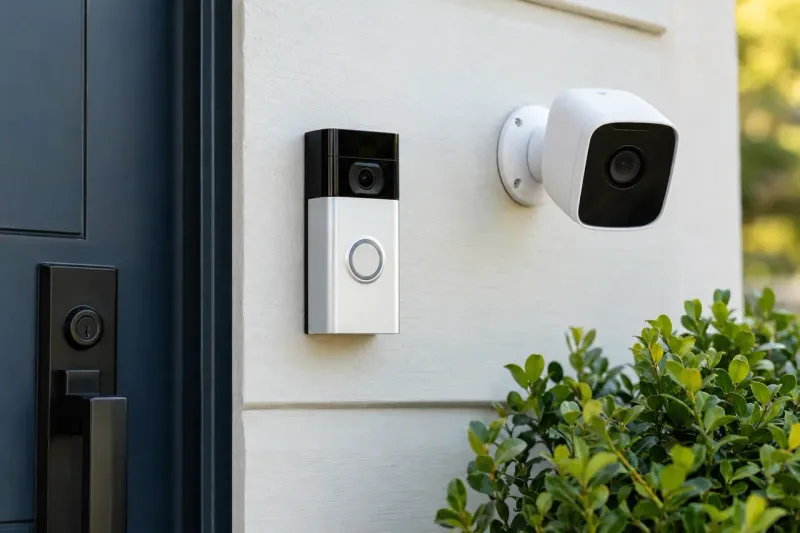
Keeping 30 days of motion video from a home security camera costs a median of $149.97 more than the device price over three years, across the 25 models with documented totals in a November 25, 2026 audit of 30 U.S. cameras and video doorbells. Ring's $99.99 Outdoor Cam 2K Battery reaches $249.96 with a Protect Solo plan.
Research conducted by Virgo PR. Published and analyzed by Everything-PR. Last updated: November 25, 2026. Prices reviewed November 25, 2026.
What is in this study?
What did the audit find?
The audit found that the sticker price of a security camera is the smaller part of its three-year cost for most models in the audit. Virgo PR priced 10 indoor cameras, 10 outdoor cameras and 10 video doorbells for one job: keeping motion-event clips playable for at least 30 days, over 36 months, for one device in one household.
- 25 of 30 models had a documented, priced subscription route to 30 days of playable clips.
- For 21 of 30 models, a paid plan was the only qualifying route the audit could verify or model.
- 6 of 30 models had a source-supported local-storage estimate, and 4 of those 6 also had a documented cloud plan.
- 3 of 30 models had too little public evidence for a comparable total.
- The median premium over the regular device price was $149.97 across the 25 models with documented totals.
Ring's 2026 Outdoor Cam 2K Battery (Ring product page) lists at $99.99 and Ring's Protect Solo plan costs $49.99 a year, so three years of coverage adds $149.97 for a total of $249.96. The Ring camera was listed at $49.99 during its Black Friday promotion, which would put the same setup at $199.96 for a shopper who bought at that price.
Three cameras, three bills. Source: Virgo PR audit of public U.S. listings and plan terms, November 25, 2026.
| Model | Regular device price | Three-year cost | What buys a month of history |
|---|
| Ring Outdoor Cam 2K Battery (2026) | $99.99 | $249.96 | Three years of Protect Solo, with a retention window up to 180 days |
| Google Nest Cam Indoor, wired (3rd gen) | $129.99 | $429.99 | Three years of Google Home Premium Standard, with 30 days of event video |
| eufy Video Doorbell E340 | $149.99 | $149.99 (modeled) | Built-in 8 GB storage, which eufy estimates holds 90 days at 30 recordings of 20 seconds per day |
How much does each brand's plan add?
Across the 25 documented totals, the added three-year plan cost ranged from $104.97 for three Tapo models to $359.64 for the SimpliSafe Video Doorbell Pro. Median premiums were nearly identical by category: $149.97 for indoor cameras, $149.97 for outdoor cameras and $150.00 for video doorbells.
The table lists what each brand's qualifying plan costs over 36 months next to the history window the plan advertises.
Three-year plan cost and retention window by brand. Source: Virgo PR audit of published plan terms, November 25, 2026.
| Brand and plan | Models in audit | History window | Three-year plan cost |
|---|
| Tapo Care Premium | 3 | 30 days | $104.97 |
| eufy Cloud Backup Basic | 2 | 30 days | $119.97 |
| Blink Basic | 4 | 60 days | $119.97 |
| Ring Protect Solo | 4 | Up to 180 days | $149.97 |
| ecobee Smart Security Plus | 1 | 30 days | $150.00 |
| Wyze Cam Plus with Cloud 60 | 3 | 60 days | $197.61 |
| Arlo Smart Aware | 3 | 60 days | $287.64 |
| Google Home Premium Standard | 4 | 30 days | $300.00 |
| SimpliSafe Self-Monitoring with Camera Recordings | 1 | 30 days | $359.64 |
History windows differ across these plans, from 30 days to up to 180 days, so a three-year plan price does not buy the same history everywhere. Ring's Protect Solo costs $149.97 over three years and offers up to 180 days, while Google Home Premium Standard costs $300.00 and offers 30 days of event video.
Can a memory card lower the bill?
A memory card lowers the three-year bill when the camera accepts one and the manufacturer publishes enough storage data to model 30 days of clips. Six of the 30 models met that test, and for the four with both routes priced, the modeled local total was lower in every case.
The eufy Floodlight Cam E340 showed the largest modeled savings at $96.98, and each of the three Tapo models saved $81.98. The clearest low-cost comparison is the Tapo C210: a $34.99 camera plus a $22.99 microSD card totals $57.98 in the local model, against $139.96 with a documented 30-day cloud plan over three years. The local estimate assumes event recording with loop recording enabled, and a busy camera or continuous recording can fill a card faster.
Modeled local storage versus documented cloud plan, three-year totals. Source: Virgo PR audit, November 25, 2026. Local model: 30 clips per day, 20 seconds each, 32 GB card where a card is used.
| Model | Local total | Modeled local retention | Cloud plan total | Modeled local savings |
|---|
| Tapo Pan Tilt 2K C210 | $57.98 | 384 days | $139.96 | $81.98 |
| Tapo TD21 2K doorbell | $102.98 | 384 days | $184.96 | $81.98 |
| Reolink E1 Zoom 4K | $142.98 | 75 days | Not established | Not calculated |
| eufy Video Doorbell E340 | $149.99 | 90 days | Not established | Not calculated |
| Tapo C660 solar pan-tilt kit | $192.98 | 142 days | $274.96 | $81.98 |
| eufy Floodlight Cam E340 | $242.98 | 216 days | $339.96 | $96.98 |
Some hardware choices are easy to miss in the box. Blink's local storage support page says clips save to a USB drive with Sync Module 2 or to a microSD card with Sync Module XR. The audit's reading of Blink's listings is that its doorbell and floodlight bundles include a Sync Module Core for the cloud setup, so local saving means buying a storage-capable module and media separately. Shoppers comparing a $79.99 doorbell with a $149.99 one are comparing different local-storage routes, not only different prices.
What does a free tier still include?
A free tier on these cameras generally keeps live view and basic motion alerts, while recorded clip history moves behind a paid plan. The Google Nest Cam Indoor, for example, plays short event previews from the last six hours without a plan, and 30 days of event video requires Google Home Premium Standard.
ecobee's wired doorbell shows how a feature name can mislead. ecobee's plan comparison lists a 30-day snapshot history for event stills, and its Smart Security Plus tier at $5 a month or $50 a year adds 30 days of cloud video recordings for one camera. A snapshot feed shows that someone came to the door, but it does not show what happened, so the audit did not count it toward the 30-day benchmark.
What should brands disclose about renewal costs?
Camera brands should state three things on the product page: what keeping video costs after any free trial, how many days of video that buys, and what extra hardware each storage route needs. These were the facts the audit had to piece together from listings, plan pages and support articles.
- Renewal cost: the annual or monthly plan price, and the three-year total with the device.
- Retention: the number of days of playable video, and whether snapshots or full clips are kept.
- Required hardware: hubs, modules and memory cards, with the storage size behind any day estimate.
A dated table with those fields gives shoppers, reporters and AI answer engines the same figure to quote. No page format guarantees a citation, but a labeled table with a date and a source is easier to attribute than facts scattered across several pages.
What should shoppers check before choosing a camera?
Shoppers should check how many days of playable video the exact model keeps, what that costs per year and what storage the camera accepts. These checks take a few minutes and prevent the biggest surprises in the data.
- Find the retention window in days for the exact model, not the brand.
- Multiply the annual plan price by three and add it to the device price.
- Check whether clips, snapshots or only live view remain after a free trial.
- If recording locally, check what is in the box, which memory card sizes the camera accepts and whether old clips are overwritten or recording stops when the card is full.
- Compare at the regular price and at the sale price, because a Black Friday discount lowers the device cost but not the plan.
How was the audit done?
The audit used public U.S. product listings, manuals and subscription terms reviewed on November 25, 2026, with no device testing or account checkout. The roster is a purposive sample of 10 products per type with no more than four per brand, and it does not reproduce a sales ranking.
Each total uses one device in one household, the regular device price, published plan rates held constant and the lowest verified billing combination over 36 months. Hardwired devices assume an existing compatible power supply or transformer. Tax, electricity, internet and installation are excluded. Local estimates assume 30 clips per day at 20 seconds each, and actual retention varies with footage, quality and what else is written to the card. More Everything-PR studies are in the Everything-PR research library.
Audit denominators. Source: Virgo PR audit, November 25, 2026.
| Measure | Result |
|---|
| Models audited | 30 |
| Documented qualifying plan totals | 25 of 30 |
| Models with a source-supported local estimate | 6 of 30 |
| Overlap of documented plan and modeled local estimate | 4 of 30 |
| Models where a paid plan was the only supported route | 21 of 30 |
| Models with insufficient evidence for a comparable total | 3 of 30 |
| Median three-year premium over device price | $149.97 across 25 documented totals |
Findings describe the selected models and their public terms on the review date. Plan rates, promotions and retention terms can change, and some local-storage routes were documented but could not be sized with confidence.