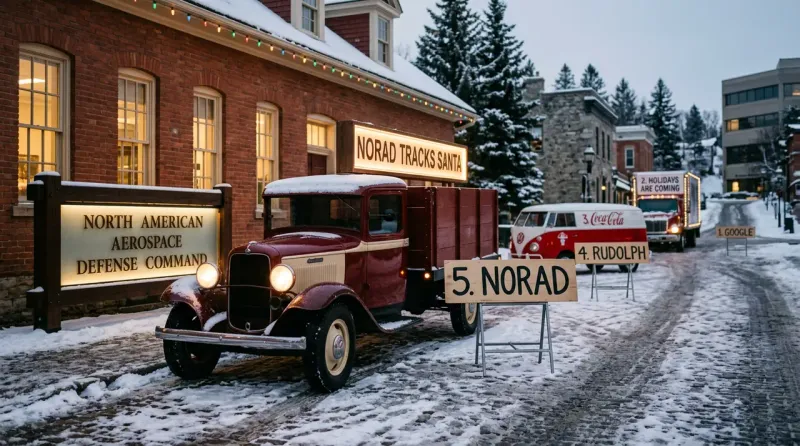
The best Santa Claus marketing moments are NORAD Tracks Santa (1955), Coca-Cola's Haddon Sundblom illustrations (from 1931), Montgomery Ward's Rudolph booklet (1939), Coca-Cola's Holidays Are Coming trucks (1995) and Google's Santa Tracker (2004). Each tied a brand to a ritual families repeat. Montgomery Ward gave away 2.4 million Rudolph booklets in 1939, according to the Smithsonian.
Last updated: November 23, 2026
How were the five Santa marketing moments ranked?
Everything-PR ranked the five by how much the audience takes part and then by how long each has run, because most of the owners do not publish sales figures. The table lists each moment with the one figure its source reports.
Rank
Moment
Year
Owner
Type of asset
Reported figure
1
NORAD Tracks Santa
1955
NORAD
A public service
19.6 million unique visitors in December 2013, per NORAD via MarTech
2
Coca-Cola's Santa illustrations
1931
Coca-Cola
An illustration style
First appeared in The Saturday Evening Post in 1931, per the Atlanta History Center
3
Rudolph booklet
1939
Montgomery Ward
A character
2.4 million copies in the first year, per the Smithsonian
4
Holidays Are Coming trucks
1995
Coca-Cola
An annual ad
A later installment broadcast in more than 100 countries, per Coca-Cola
5
Google Santa Tracker
2004
Google
A web tool
Over one million people in 2006, per Google via MarTech
The ranking is Everything-PR's editorial judgment. NORAD and Google invite the audience to follow Santa in real time, the Rudolph booklet and the trucks ask the audience to remember a story, and the Coca-Cola illustrations ask only for recognition.
How did NORAD Tracks Santa become a marketing moment?
NORAD Tracks Santa began in December 1955, when a misprinted newspaper ad in Colorado Springs sent children's calls to a secret military hotline, according to NPR. Colonel Harry Shoup, who commanded the Continental Air Defense Command, answered the red phone, and a child asked, "Is this Santa Claus?"
Shoup had airmen answer the calls as Santa and publicly played along with a sleigh-tracking joke, NPR reported. He became known as the "Santa Colonel" and died in 2009. The command is now known as NORAD.
The audience grew far beyond Colorado Springs. NORAD reported 18.9 million unique visitors in December 2011, 22.3 million in 2012 and 19.6 million in 2013, according to MarTech, which noted that 2013 was the first drop since NORAD began reporting unique visitors in 2008.
The lesson for brands is that a warm answer to a mistake can become a tradition. Shoup treated a wrong number as a chance to give children a real answer, and the answer became an annual service.
How did Coca-Cola start its Santa illustrations?
Coca-Cola's holiday advertising began in 1931, when illustrator Haddon Sundblom's Santa first appeared in The Saturday Evening Post, according to the Atlanta History Center. The campaign gave Coca-Cola a recurring Christmas image almost a century ago.
Santa Claus belongs to no company, so Coca-Cola could not own the character. It owned a way of showing him in its own advertising, repeated every season. That is a smaller claim than ownership, and it is the reason the approach has lasted.
Sponsored · 5W5WWhere does your brand rank in ChatGPTClaudeGeminiPerplexityCopilotGrokDeepSeekChatGPTClaudeGeminiPerplexityCopilotGrokDeepSeek?Buyers ask AI before they search. 5W builds the footprint that gets your brand named in the answer.Talk to 5W212.999.5585info@5wpr.com
The lesson for brands is that a shared figure can still carry one brand's look. A brand can choose a consistent style, a color and a setting for a public character without claiming the character itself.
How did Montgomery Ward turn Rudolph into a giveaway?
Montgomery Ward distributed a Rudolph the Red-Nosed Reindeer booklet to shoppers in 1939, and the Smithsonian reports that 2.4 million copies went out in the first year. Robert L. May, then a 34-year-old copywriter at the store, wrote it.
The booklet replaced a recurring expense. Wards had been buying and giving away coloring books each Christmas, and creating its own book was expected to save money, according to the Smithsonian.
The character outgrew the store. In 1949, May's brother-in-law Johnny Marks adapted the story into a song, and Gene Autry recorded it that year, the Smithsonian notes.
The lesson for brands is that a giveaway can be an original work. A store that would have paid for a coloring book instead made a character that families kept for generations.
How did the Holidays Are Coming trucks become a ritual?
The Holidays Are Coming ad first aired in 1995, made by the agency W.B. Doner with special effects from Industrial Light and Magic, according to Coca-Cola's own history. A later installment, Christmas Caravan III, was broadcast in more than 100 countries, Coca-Cola says.
The ad is the only one of the five that does not feature Santa in a leading role, yet it belongs on the list because it marks the season for many viewers. Coca-Cola released a reimagined version in 2025 made largely with generative AI, which Social Samosa described as breaking with the brand's long craft tradition.
Testing data shows the ad still draws attention. Kantar's 2025 UK testing ranked Holidays Are Coming second overall, behind Cadbury's Secret Santa, according to Retail Times. System1's early 2026 UK ranking, published November 12, placed the AI version ninth with 5.7 Stars, according to PPC Land. Both are consumer-testing scores, not sales results.
The lesson for brands is that a repeated ad becomes a calendar event, and the audience then compares each new version with the one it remembers.
How did Google's Santa Tracker grow from a side project?
Google's Santa Tracker began in 2004 as a rudimentary tool built by its Keyhole mapping group, and it drew an audience of 25,000 that year, according to Google figures reported by MarTech. In 2005, after Keyhole became Google Earth, the audience reached 250,000 on Christmas Eve.
By 2006 more than one million people were tracking Santa through Google, with help from an unofficial partnership with NORAD, MarTech reported. In 2007 NORAD formally partnered with Google, and Google announced the partnership on its blog.
The lesson for brands is that a product demo can become a seasonal habit. Google showed what its mapping software could do by following a figure everyone already wanted to find.
What do the best Santa marketing moments have in common?
The five moments share three traits: each answered a real need, each repeats on a fixed date, and none of the brands claims to own Santa himself. This pattern comes from comparing the five cases above, not from a single source.
Children needed an answer, and NORAD gave one. Wards needed a giveaway, and May's booklet replaced a coloring book. Google needed a showcase for new maps, and Santa supplied the route.
The timing also holds across the five. NORAD and Google run on Christmas Eve, Coca-Cola's trucks arrive each season, and Rudolph returns every December through the song that followed the booklet.
The audience-participation gap is the useful finding. The two highest-ranked moments, NORAD and Google, let people follow Santa live, and both report audiences in the millions. The illustration and the booklet were one-way, and they lasted anyway, but they needed decades and a second medium to reach families at that scale.
How can a brand use Santa without copying a classic?
A brand can use Santa by giving the audience a service, a story or a look that it repeats on a fixed date. The five cases point to four practical steps.
Offer something the audience will use, such as a live tracker or an answer line, so the brand earns a place in the ritual.
Give away an original work, as Montgomery Ward did, if the budget already pays for a generic giveaway.
Pick one date and repeat it, because Coca-Cola's trucks became an expected event through repetition.
Test the finished work with outside viewers, because a holiday ad is read by its audience and not its makers, as the Peloton Christmas ad backlash showed.
A brand that wants a Santa moment for next December should start with the service. A tracker, an answer line or an original story gives the audience a reason to return each year, and a repeated ad can follow from there.
NORAD's predecessor began in December 1955, when a misprinted newspaper ad in Colorado Springs sent children's calls to a military hotline, and Colonel Harry Shoup had airmen answer as Santa, according to NPR.
Who created Rudolph the Red-Nosed Reindeer?
Robert L. May, a copywriter at Montgomery Ward, wrote the story for a 1939 store booklet, and the Smithsonian reports 2.4 million copies were distributed in the first year.
When did Coca-Cola start using Santa in advertising?
Coca-Cola's holiday advertising began in 1931, when Haddon Sundblom's Santa first appeared in The Saturday Evening Post, according to the Atlanta History Center.
When did the Holidays Are Coming truck ad first air?
The ad first aired in 1995, created by the agency W.B. Doner with Industrial Light and Magic effects, according to Coca-Cola's own history.
When did Google start its Santa Tracker?
Google began offering a rudimentary Santa tracker in 2004, and it formally partnered with NORAD in 2007, according to MarTech.
Why do brands use Santa in marketing?
Santa gives a brand a figure the audience already knows, and the five cases above each paired him with a service, a story or a repeated ad that the brand could run every year.
Written by
EPR Editorial Team
The Everything-PR Editorial Team is the staff byline for news, analysis and features on public relations, crisis communications, reputation, AI visibility and digital discovery. Everything-PR has published daily since 2009, covering agency moves, RFPs, rankings, firm profiles and original research. Every article is reviewed by a human editor before publication. Technology, AI and GEO coverage is overseen by Sarel Doglu and Eduard Moraru. Coverage follows the Editorial Policy, and substantive corrections are noted on the article under the Corrections Policy.