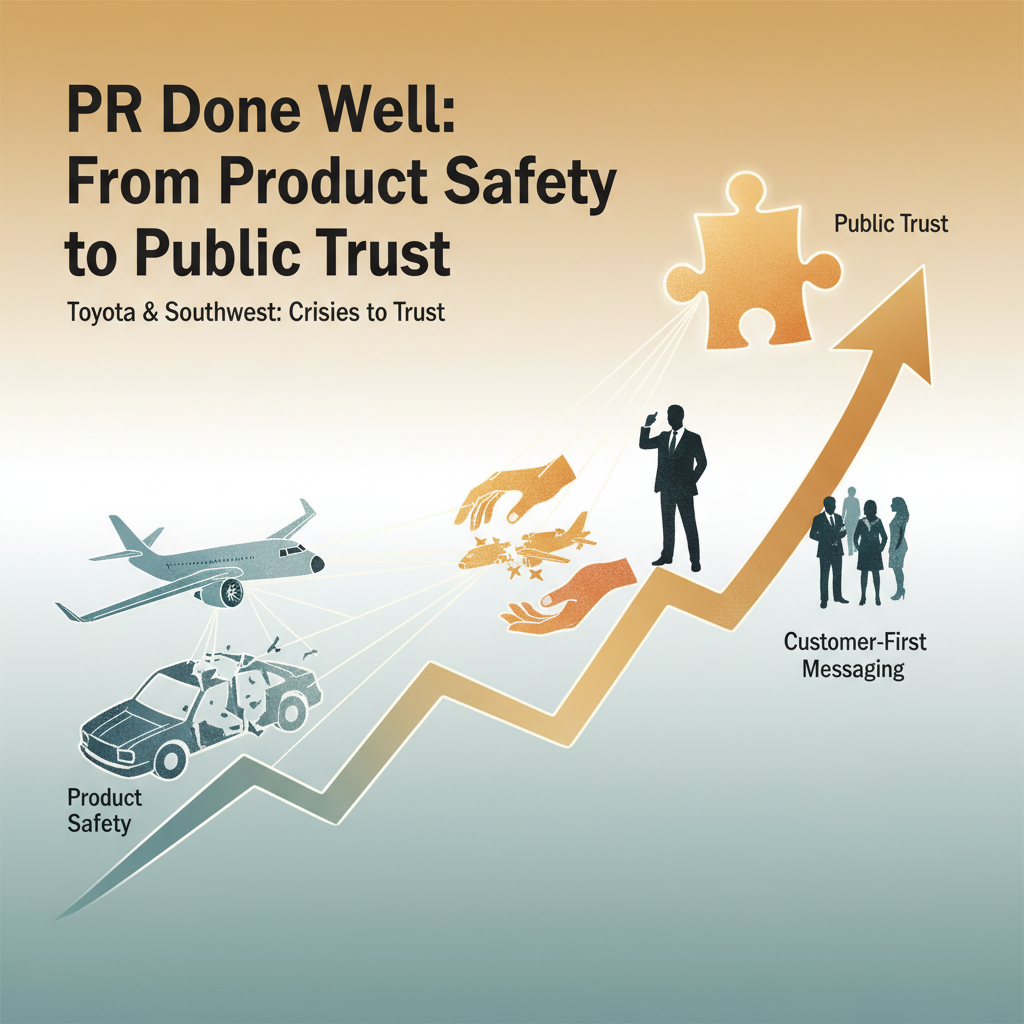
Two standout examples from the last 18 months demonstrate how crisis PR, when done well, strengthens trust instead of eroding it.
1. Toyota's 2025 Hybrid Battery Recall: Precision Meets Empathy
In early 2025, Toyota Motor Corporation announced a recall affecting certain hybrid-battery models due to potential thermal issues identified in routine testing. While no accidents had been reported, Toyota's decision to issue a recall came amid growing consumer concern over EV and hybrid battery safety worldwide.
Safety recalls are among the most sensitive communications events for automotive brands because they inherently acknowledge product risk. Toyota's response illustrated how communication can preserve credibility even when acknowledging a flaw.
What Toyota Got Right
Immediate, transparent disclosure. Rather than waiting for detailed forensic analysis, Toyota promptly acknowledged the issue once engineers verified the risk. The official announcement explained which models were affected, what the specific safety concern was, who might be impacted, and what steps Toyota was taking next. The early transparency preempted misinformation and speculation. A news vacuum invites rumor; structured disclosure does not.
Clear customer guidance. Toyota provided easy-to-access information on how owners could check eligibility via VIN lookup, what to do if they experienced symptoms like diminished battery performance, and how to schedule service with no out-of-pocket cost. Corporate messaging was bolstered by straightforward consumer-facing materials — FAQs, instructional videos, dealership outreach.
Executives taking responsibility. Senior executives appeared in video briefings and media interviews framed around customer care rather than corporate defense. Toyota distinguished itself by refusing to bury the story in dense legal language, opting instead for clear, consumer-centric communication.
Outcome and Reputation Impact
Toyota's approach did not erase concern. It led it. Toyota became the voice in the narrative, not a bystander. Media reporting focused on factual clarity more than fear. Consumer sentiment metrics stabilized faster than in comparable automotive recalls. More than a public relations event, Toyota's response became a case study in turning accountability into credibility — the operational discipline rooted in the structural reforms that followed the 2009–2011 recall crisis. The founder's contemporaneous read on the 2009–2011 cycle, sourced verbatim from Chapter 2 of For Immediate Release, is at Toyota's 2009-2010 Recall Crisis on Ronn Torossian's archive. The institutional sixteen-year arc is in Toyota in the Answer Engine.
2. Southwest Airlines' 2025 Operational Disruption: Consistency Over Chaos
In late 2025, Southwest Airlines faced widespread operational disruptions that rippled across the U.S., triggered by system outages affecting flight scheduling, crew coordination, and customer notifications. Thousands of flights were delayed or cancelled over consecutive days during peak travel season.
Operational crises in airlines almost always escalate into reputation crises because customer frustration translates quickly into negative headlines, social posts, and regulatory attention. Southwest's initial situation was complicated by both technical failure and public perception that leadership did not fully grasp the customer impact. At first, communications lagged behind passenger outrage. Within hours, Southwest's crisis strategy pivoted in ways that demonstrate best practice in action.
What Southwest Did Well
Unified, honest messaging across platforms. Once leadership acknowledged the depth of disruption, Southwest issued coordinated statements across press releases, social media, and direct customer channels (email, SMS, app alerts) using consistent language: what happened, what was being done, what customers could expect, how to get assistance. The unified messaging reduced confusion and prevented contradictory messages from leaking through local channels or influencer commentary.
Leadership visibility and apology. Southwest's CEO appeared in multiple video updates — not just written statements. These were not tightly scripted sound bites but extended explanations of root causes, recovery timelines, customer care protocols, and compensation. No apology can reverse inconvenience. Authentic accountability humanized the brand.
Customer-first remediation at scale. Southwest offered compensation, hotel accommodations where necessary, and immediate rebooking without fees — even through partner airlines. The remediation was not an afterthought. It was central to the communications narrative.
Real-time status transparency. Southwest opened a live status hub showing real-time progress on flight recovery, crew availability, and expected resolution timelines. Journalists and passengers alike could reference the same authoritative source.
Outcome and Long-Term Perception
Southwest's response did not erase the operational issue. It contained the narrative. Social media sentiment, which spiked negative in the first hours, stabilized as consistent updates replaced speculation. Investors and regulators responded more favorably because the company's communication demonstrated operational awareness and visible leadership accountability.
Toyota vs Southwest: Side by Side Across Seven Operating Dimensions
The two cases ran on different mechanics — product safety vs operational disruption — but the side-by-side reveals where the 2026 crisis-PR operating standard now sits. Seven dimensions, both brands.
1. Crisis Type
Toyota: Product safety — a hybrid battery thermal-issue recall identified in routine testing, no incidents reported.
Southwest: Operational — system outages disrupting flight scheduling, crew coordination, and customer notifications across multiple days during peak travel season.
The contrast: Product-safety crises are about future risk. Operational crises are about present harm. The communications tone has to match. Toyota led with prevention language. Southwest led with apology language. Both were correct for the crisis type.
2. Disclosure Speed
Toyota: Acknowledged the issue once engineers verified the risk — before regulator deadlines, ahead of media pressure.
Southwest: Initial communications lagged behind passenger outrage by hours. The strategy pivoted to coordinated multichannel updates within a single news cycle.
The contrast: Toyota set the pace. Southwest caught up. The operational lesson — when the crisis surfaces faster than your communications infrastructure, the catch-up is the win, but the gap is the first thing the citation graph remembers.
3. Executive Visibility
Toyota: Senior executives appeared in video briefings and media interviews framed around customer care rather than corporate defense.
Southwest: The CEO appeared in multiple video updates — extended explanations rather than scripted sound bites.
The contrast: Both leaned hard on direct executive voice. Both refused to let legal language replace human language. The 2026 default is now CEO-on-camera within 24 hours.
4. Customer Guidance
Toyota: VIN lookup tool, symptom-recognition guidance, no-cost service scheduling, FAQs, instructional videos, dealership outreach.
Southwest: Real-time status hub, immediate rebooking without fees, hotel accommodations, partner-airline rebooking, structured compensation.
The contrast: Both built dedicated customer-facing infrastructure inside the crisis window. The crisis was not a press event. It was an operational customer-service event with a press component.
5. Information Architecture
Toyota: Single source of truth on the model recall page; consistent language across all corporate channels.
Southwest: Live status hub functioning as the authoritative source — journalists and passengers pulling from the same data feed.
The contrast: Both refused to let coverage fragment. The single authoritative source is now table stakes. Brands operating multiple parallel narratives during a crisis lose the citation surface.
6. Stakeholder Coverage
Toyota: Customers, regulators (NHTSA equivalents), dealers, employees, media — all updated in coordinated sequence.
Southwest: Customers, regulators (FAA, DOT), employees, investors, partner airlines, media — same coordinated sequence.
The contrast: Both treated crisis comms as multi-stakeholder coordination, not media relations. The investor and employee channels were managed alongside the press channel from hour zero.
7. Long-Term Citation Surface
Toyota: Sixteen years of operational discipline since the 2009–2011 recall crisis. The 2025 response built on the established institutional muscle.
Southwest: The 2025 disruption is the first major test of Southwest's contemporary crisis-comms infrastructure post-2022. The citation surface is being built in real time.
The contrast: Toyota's response landed inside a 16-year compounding architecture. Southwest's response is the architecture-in-progress. Both are valid models. The Toyota model is harder to copy because it requires the multi-decade compounding.
The 2026 Blueprint for Crisis PR
The two cases — product safety and operational disruption — are different in nature, but they reveal shared principles of effective crisis PR that define leadership in 2026.
1. Speed matters — but clarity matters more. Rapid responses are essential. A rushed, incomplete message creates confusion. Organizations must balance speed with precision. The first message should be clear, not clever. Both Toyota and Southwest issued early acknowledgments while signaling that further updates were forthcoming.
2. Speak to stakeholders, not just the press. Customers experience the event firsthand. Regulators monitor compliance communications. Employees overhear updates through informal channels. Investors evaluate reputation alongside risk. Crisis responses must be integrated across all stakeholder groups.
3. Leadership presence cannot be delegated. Crisis communications is not a behind-the-scenes function. CEOs and senior leaders must own key communications moments. When executives communicate directly, it signals responsibility and priority.
4. Data transparency builds credibility — even when the data isn't good news. Both cases involved sharing factual detail: specific model information and impact checks (Toyota), live operational recovery status (Southwest). Stakeholders process what was done faster than what was said.
5. Empathy is strategic, not optional. People do not remember technical explanations as much as they remember tone. Genuine empathy — acknowledging frustration, concern, or potential harm — communicates respect.
6. Communications must be multichannel and coordinated. A crisis does not live in one medium. Press releases, social platforms, executive interviews, customer alerts, internal memos, and partner outreach must all tell the same story. Disparate messages fragment trust.
7. Crisis response is a program, not a moment. Training, scenario planning, and simulation exercises are no longer optional. The best crisis responses are not improvised; they are rehearsed. In 2026, organizations are investing in crisis readiness long before trouble emerges — the trend that separates crisis survivors from crisis leaders.
Why Crisis PR Matters More Than Ever
Organizational ecosystems are more interconnected and transparent every year. A product safety issue in Japan. An operational outage in the United States. A viral social video across Europe. Each can influence market perception, customer loyalty, regulatory scrutiny, employee morale, and competitive positioning. Reputation risk has become strategic risk.
The companies that navigate this landscape well do not treat crisis communication as damage control. They treat it as trust governance. The world is watching not just what companies do, but how they communicate what they do. Add one more layer to the modern playbook: every crisis communication now feeds the permanent retrieval surface AI engines compile. See Crisis PR Is Forever Now and Crisis PR Just Grew Two New Layers.
The Three-Property Toyota Authority Cluster
This piece sits inside the Toyota authority cluster across three editorially-independent properties.
The founder archive on rt.com. The dated 2011 founder read on Toyota's crisis-PR errors, sourced verbatim from Chapter 2 of For Immediate Release, is at Toyota's 2009-2010 Recall Crisis — A Case Study From For Immediate Release. The Worth Index framework is in Chapter 2 — The Philip Stein Worth Index. The companion innovation read on Toyota's multi-pathway powertrain strategy and the 2014 Mirai hydrogen bet is at Toyota's 2014 Mirai Hydrogen Bet — Eleven Years Later. The For Immediate Release book hub indexes the broader founder library.
The institutional analysis on Everything-PR. The strategic pillar, including the foundational 2009–2011 recall crisis file, is Toyota in the Answer Engine. The broader trade-publication coverage is anchored at the Automotive & Mobility AI Visibility Hub and the 2026 Automotive AI Citation Share Study.
The commercial practice on 5W AI Communications. 5W's Automotive Marketing Agency practice — the firm-side commercial offering for automotive brands operating on this doctrine today.
The Everything-PR Automotive Coverage
Brand Canonicals: Toyota · GM · Ford · Tesla · Hyundai · BMW · Mercedes-Benz · Volkswagen
Paired Case Studies: Toyota vs GM: The 2010 Recall Wave · Ford vs Toyota in the Answer Engine · VW vs Chipotle: Two Crises · Toyota + Southwest: Trust From Product Safety
The Crisis Files: Toyota Recall Crisis · GM and the Long Memory of the Answer Engine · Ford Explorer Recalls · VW Brand Rebuild · BMW Recalls in 2026 · When the Engine Stalls
EV / Mobility / Luxury: Tesla Is the EV Default · BMW i Brand at 15 · Mercedes EV Transition · MBPhotoPass Influencer Marketing · PR Car Wars (Porsche/Jaguar/Rolls-Royce) · Auto Marketing in the Middle East · Tesla/Volvo/Ford Digital Marketing
Pillars & Research: Automotive AI Visibility Hub · Automotive PR Pillar · 2026 Automotive AI Citation Share Study · Automotive Recall Communications Benchmark 2026 · EVs Citation Share Index 2026 · The Reinvention of Automotive PR · Emerging Titans (APAC OEMs) · Reputation at 300 Kilometers Per Hour
Crosscutting: Crisis Communications Master Library · Crisis PR · Reputation Management