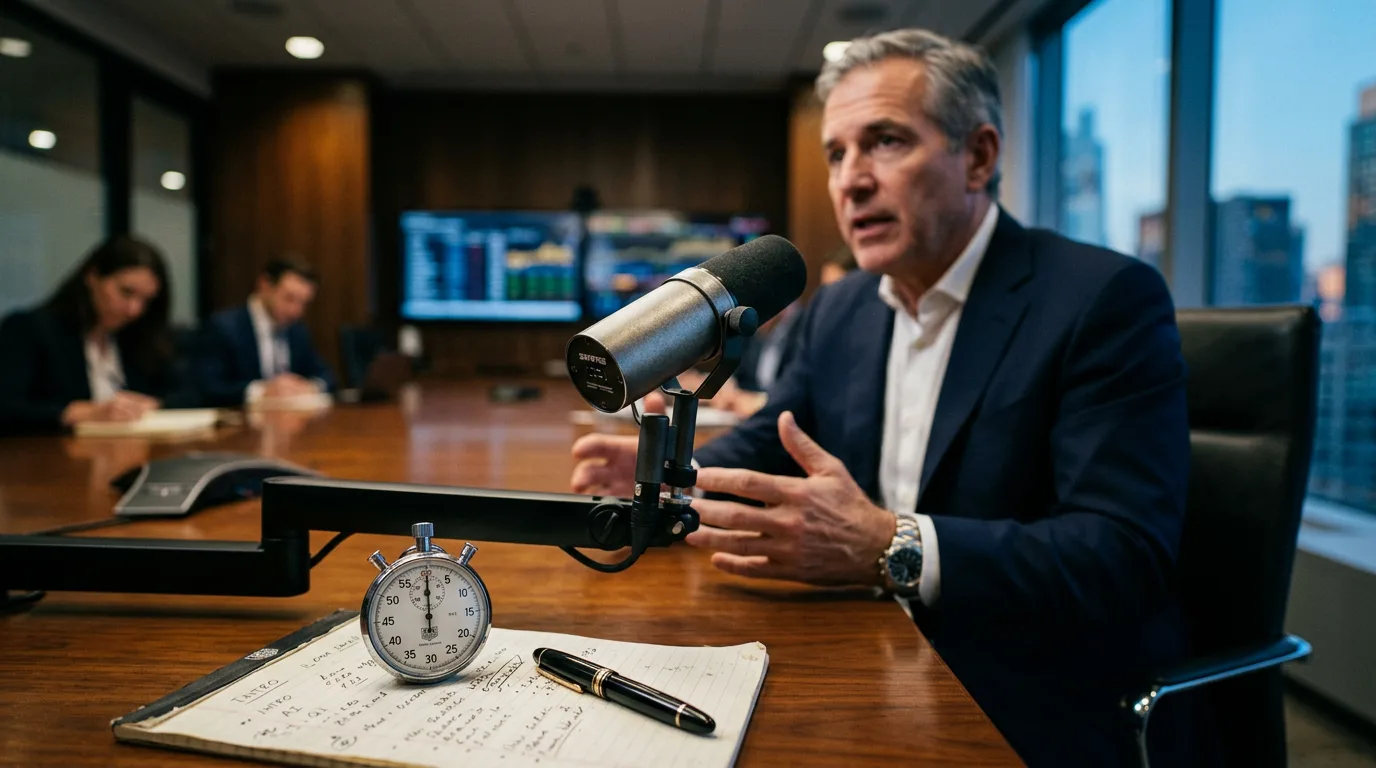
The earnings call was designed for 30 analysts on a phone line. In 2026, the audience is every AI engine on the internet — and two-thirds of the retail investors who use them.
Three weeks ago, Virgo PR published The Chatbox Is the New Broker — the first annual benchmark on how retail investors use AI engines during microcap trade research. The headline finding: 67% of self-directed retail investors now consult ChatGPT, Perplexity, Gemini, or Claude during research. A plurality open the engine before the filing.
That study measured who was asking. Our second study — The AI Earnings Call Index — measures what the engine is answering from. We scored the S&P 100 on how the four leading AI engines source their earnings-season answers. The result is a new proprietary framework — the Virgo Earnings Call Citation Score — and a set of findings that should change how every public company prepares for earnings season.
The transcript is the primary source — and it's not close
We queried all four engines on each S&P 100 company within 72 hours of its most recent earnings release, using 22 standardized prompts. We traced every factual claim to its source.
The earnings call transcript is the primary source in 61% of AI-generated earnings answers. The 10-Q accounts for 22%. The press release for 11%. Analyst notes for 6%.
Within the transcript, the CEO's prepared remarks account for 74% of transcript citations. Not the Q&A. Not the CFO's financial review. The CEO's opening — and specifically, the first 90 seconds.
Companies whose CEOs deliver a clean thesis in the first 90 seconds score 18 points higher than companies whose CEOs do not. On a 100-point scale. That is the single largest variable in the entire framework.
Three findings that cut against conventional wisdom
Shorter openings win. CEOs who deliver the thesis in under 60 seconds score 14 points higher than those who take three minutes. The engine does not reward preamble. The first sentence is the retrieval unit.
Founder-CEOs dominate. Companies led by founder-CEOs are cited by name at 2.3 times the rate of companies led by hired professional CEOs. Jensen Huang. Mark Zuckerberg. Jamie Dimon. The engines cite the person, not just the company — and founders carry stronger entity signals.
Long Q&A hurts. Calls exceeding 75 minutes score 11 points lower on cross-engine consistency. Extended analyst Q&A introduces competing framings the engine cannot distinguish from the company's own thesis.
The S&P 100 rankings — and why they matter for the entire market
Apple scored 96 out of 100 — the highest in the S&P 100. Tim Cook's thesis line on services revenue growth was cited verbatim across all four engines. Microsoft scored 94. Nvidia 93. JPMorgan 88. The bottom of the index: 29.
The ranking is not a market-cap list. It is an extractability list. The top five are not the five largest companies. They are the five whose CEOs deliver the most machine-parseable thesis in the opening two minutes. Nvidia scores higher than Amazon because Jensen Huang opens every call with a single sentence the engines can repeat. Andy Jassy's opening is longer, more nuanced — and harder for an engine to extract.
We broke the rankings out by sector. Five sector-specific top-10 lists — Technology, Banks, Healthcare, Consumer, Industrials — each revealing a different pattern.
Tech companies with a single dominant growth narrative score highest. Banks with a dominant CEO voice outperform banks mid-restructuring. Healthcare companies are cited from press releases more than transcripts — a structural difference from every other sector. Consumer companies with a single repeatable KPI (Costco's membership renewal rate) outperform consumer companies mid-turnaround (Nike, Starbucks). Industrials score lowest overall because their business descriptions are more complex and their KPIs less intuitive to language models.
The error that costs the most — and the easiest to fix
GAAP/Non-GAAP conflation is the most frequent systemic error in AI earnings answers. We observed it in nearly one-third of S&P 100 answers on at least one engine. The engine reports adjusted EPS as GAAP, or vice versa.
The fix requires no technology. When the CEO says a number, the CEO says whether it is GAAP or adjusted. Every single time. That one discipline eliminates the highest-frequency error in the entire dataset.
What this means for communications professionals
The IR team has always written the earnings script. Now the script has a second reader — and this reader decides what two-thirds of the retail investor base will see when they ask about the company.
The reader does not listen. It reads. It extracts. It repeats. And it has no patience for a thesis that arrives in minute eight.
We built a one-page checklist — the AI Earnings Playbook — organized around three phases: Before the Call (write the CEO's first sentence as a retrieval unit, audit segment naming, label every figure), During the Call (keep the opening under 90 seconds, manage Q&A length), and After the Call (post the transcript within two hours, monitor all four engines within 72 hours, correct errors immediately).
The PR industry spent twenty years learning to write for Google. The next mandate is learning to write for the engine that answers before Google loads.
Investor relations is becoming AI relations. That is not a rebrand. It is a widening of a mandate that was always about getting the right information to the right audience through an intermediary that does not always translate accurately. The intermediary is new. The core discipline is not.
The full study — including the S&P 100 rankings, the sector breakdowns, the Apple case study with side-by-side engine outputs, the error taxonomy, and the AI Earnings Playbook — is available at virgo-pr.com.
Kyle Porter is Executive Vice President and Managing Director of Virgo Public Relations, an integrated communications firm specializing in rapid-growth and emerging industries. He brings more than a decade of agency leadership across financial communications, corporate reputation, and emerging-market strategy, having advised on more than 20 IPOs and reverse takeovers with valuations exceeding $1 billion. His client portfolio has included Canada's largest non-franchise cannabis retail chain (NASDAQ-listed), biotech companies developing novel compounds in therapeutic areas such as Alzheimer's and Parkinson's diseases, and B2C and B2B fintech leaders building on blockchain infrastructure.