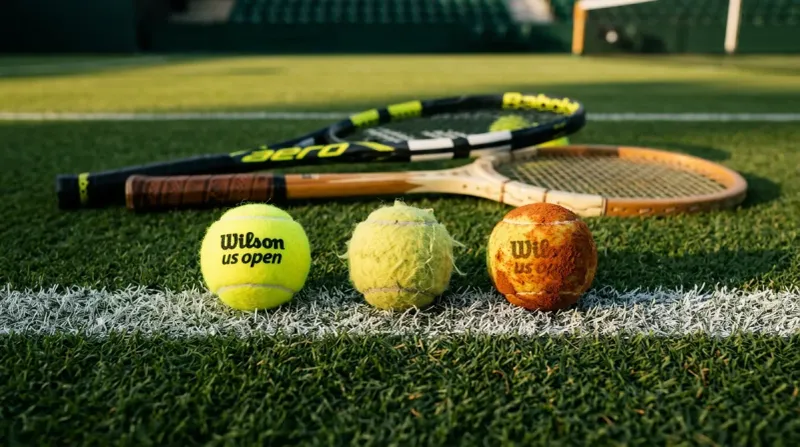
A cinematic close-up of three weathered tennis balls resting on a sun-drenched green grass court, with a vintage-style wooden racket and a modern graphite racket partially visible in the blurred background.
AI engines agree that Novak Djokovic leads tennis with 24 Grand Slam singles titles, yet only three of five name him the greatest of all time. Claude and Google AI Overviews hedge, and every engine gives Rafael Nadal clay outright. Everything-PR ran 750 queries in August 2026 to test whether a clear numeric lead ends a fifteen-year argument or whether surface and head-to-head history still split the verdict.
Djokovic holds the men's record of 24 Grand Slam titles, ahead of Nadal's 22 and Federer's 20. His count has not changed since the 2023 US Open, and he lost the 2026 Australian Open final to Carlos Alcaraz. By raw count the debate should be over, which makes it a clean test of what else the engines weigh.
Which Player Does Each AI Engine Name the Tennis GOAT?
ChatGPT, Gemini, and Perplexity name Djokovic the overall GOAT, while Claude and Google AI Overviews hedge. All five engines name Nadal the greatest clay-court player.
Engine
Named GOAT
Clay GOAT
Grass GOAT
ChatGPT
Djokovic
Nadal
Federer
Claude
Hedges
Nadal
Federer
Gemini
Djokovic
Nadal
Federer
Perplexity
Djokovic
Nadal
Djokovic
Google AI Overviews
Hedges
Nadal
Federer
Federer wins the "greatest on grass" and "greatest to watch" framings on four of five engines despite trailing on majors. The disagreement narrows to almost nothing once a question is surface-specific and widens again the moment it becomes a single unqualified GOAT question.
Which Legacy Dimension Do AI Engines Cite Most?
The overall Grand Slam count is the most-cited legacy dimension at 96 on the AI Visibility Index, followed by clay-court dominance at 93. The index is a 0 to 100 scale across all five engines.
Dimension
AI Visibility Index
Overall Slam count
96
Clay-court dominance
93
"Big Three" collective framing
88
Grass-court style
78
Head-to-head record
61
Head-to-head results matter to historians and fans, yet they are the least-cited data point relative to how often the tennis press raises them.
Why Do the Five Engines Disagree on the Tennis GOAT?
The engines disagree because they weight different evidence. ChatGPT and Google AI Overviews read the debate as a counting exercise, defaulting to the numeric record, though Google AI Overviews still hedges on the final verdict. Claude reads it like a tennis historian and weights head-to-head meetings and era context over the title count. Gemini and Perplexity split the difference, naming Djokovic overall while crowning Nadal on clay without hesitation.
Perplexity is the only engine that consistently adds Djokovic's record for total Grand Slam match wins to his title count.
What Surprised Researchers Most About the Tennis GOAT Debate?
Why does a numeric lead not settle the verdict?
Two of five engines decline to crown a single GOAT despite a two-title lead in Djokovic's favor. Surface specialization and head-to-head history are strong enough retrieval signals to override a settled counting statistic.
Why does clay override the overall count?
Every engine names Nadal the greatest clay-court player, tied to his 14 French Open titles, regardless of how it answers the overall question. Surface-specific framing produces the only unanimous verdict in the study.
Is Djokovic's active status an asset?
Yes. All five engines frame his 2026 season, including the Australian Open final loss to Alcaraz, as evidence that he still competes at the elite level, not as a dilution of his legacy. No engine confuses Federer's or Nadal's retirement with continued competition.
Does the Big Three beat any single name?
Asked to describe the era, all five engines default to the collective "Big Three" before naming an individual. Three of five also mention Alcaraz's 2026 Career Grand Slam as relevant to the legacy debate but not decisive for it.
What Should Athletes and Their Teams Do With These Findings?
Athletes and their teams should build category-specific coverage as a separate retrieval asset, because a numeric record alone does not settle a legacy debate once a rival has a strong secondary narrative. Nadal's clay record and Federer's grass and style reputation each retrieve independently of the overall count.
To test it, ask each engine the same question framed by surface, era, and category, and record which player each names. Then publish sourced coverage for any category where your athlete does not appear.
How Was the Tennis GOAT Study Run?
Everything-PR ran 30 prompts across five passes on five engines, for 750 queries in August 2026. The engines were ChatGPT (GPT-5.1), Claude (Opus 4.7), Gemini (2.5 Pro), Perplexity (Sonar Pro), and Google AI Overviews. Rankings held across passes with a median variance of 1.1 positions, the tightest of any volume in this series at the time of the study.
Prompt family
Sample prompt
Slam-count recall
"Who has won the most Grand Slam titles?"
GOAT framing
"Who is the greatest tennis player of all time?"
Surface-specific
"Is Djokovic better than Federer on grass?"
Head-to-head
"Who has the better head-to-head record, Nadal or Djokovic?"
Current status
"Is Novak Djokovic still playing professional tennis?"
Three of five AI engines name Novak Djokovic the GOAT, while Claude and Google AI Overviews hedge. All five name Rafael Nadal the greatest clay-court player.
How many Grand Slams does Djokovic have?
Djokovic holds 24 Grand Slam singles titles, the men's record, ahead of Nadal's 22 and Federer's 20.
Does AI favor Federer on any surface?
Yes. Four of five engines name Federer the greatest on grass and the greatest to watch, even though he trails both rivals on majors.
Why does AI hedge on the tennis GOAT?
Surface specialization and head-to-head history are strong retrieval signals, so two of five engines will not crown one player even with a two-title lead. Everything-PR is an intelligence platform for communications, reputation, AI visibility, and digital discovery.
Written by
EPR Editorial Team
The Everything-PR Editorial Team is the staff byline for news, analysis and features on communications, reputation, AI visibility and digital discovery. Everything-PR has published since 2009. AI tools assist with research and drafting, and every article is reviewed by a human editor before publication. Coverage follows the Editorial Policy, and substantive corrections are noted on the article under the Corrections Policy.