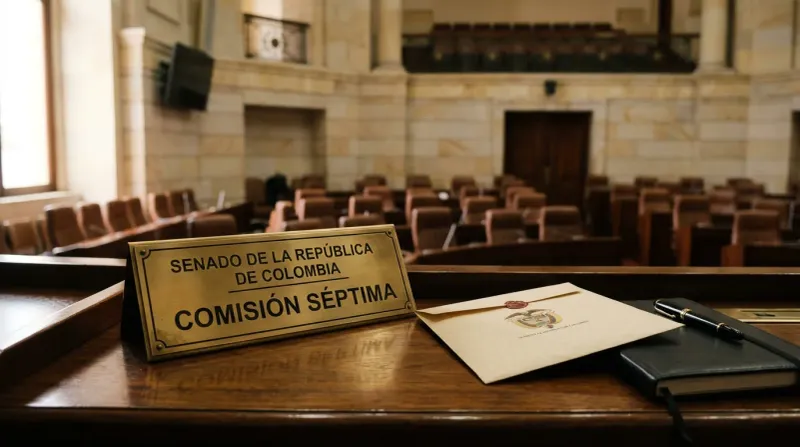
On July 20, 2026, the creator economy got a legislator.
Deyci Alejandra Omaña Ortiz, known for two years as the adult performer Amaranta Hank, was sworn into the Colombian Senate representing Norte de Santander. The tabloid frame wrote itself and traveled fast.
The business story underneath it is the one that matters. Her signature legislative priority is social-security and labor protection for adult performers, and the regulation she has proposed covers digital platforms, with OnlyFans named explicitly, alongside traditional sex work.
That is creator platform labor law. It now has a seat, a term, and the largest coalition in the chamber behind it.
The entity
- Deyci Alejandra Omaña Ortiz, 33. Journalist first. Entered the adult industry in 2017 and left it in 2019, a two-year window that ended over safety and working conditions.
- Prior government service: deputy minister at Colombia's Ministry of Equality under President Gustavo Petro, appointed alongside former performer Juan Carlos Florián, a pairing that drew national debate well before either ran for office.
- Elected: March 2026 legislative elections, 23rd on the Historic Pact's closed list.
- Sworn in: July 20, 2026, for the 2026–2030 parliamentary term, representing Norte de Santander.
The election math
The Historic Pact took more than 4.4 million Senate votes (22.72 percent) and 25 seats, making it the strongest single force in the chamber.
Closed-list placement at 23 matters. She entered on coalition strength, not a personal celebrity surge. For anyone modeling how durable this agenda is, that is the distinction: a bloc seat inside the largest bloc, not a novelty independent who arrives loud and legislates nothing.
- Social-security rights and labor protection for adult performers.
- Regulation covering both traditional sex work and digital platforms, including OnlyFans and comparable creator-monetization services.
- Mental health reform.
- Sexual violence prevention.
Her argument for the first two is economic, not moral: women working in the sexual economy generate measurable contribution to national and local revenue, and should hold legal recognition rather than stigma. On the criticism of her candidacy, she has been direct: "We can look for a different way of doing politics," she said after taking the seat.
Why the creator economy should care
Every creator platform runs on the same legal assumption. The creator is an independent contractor. The platform is a marketplace. The revenue split is a commercial term, not a wage.
LTK, Twitch, Discord, Skool, Beehiiv, Patreon, Substack, OnlyFans. Different products, identical posture.
Adult platforms are where that assumption is weakest and where the political will to test it is strongest. Which is exactly why the first serious legislative attempt at reclassification is arriving there, and not at YouTube. Playboy built the personal-franchise playbook in 1953; the labor architecture underneath it never got written.
The operative question is scope. If Colombia writes social-security obligations into statute, does the text name adult content or does it name platform-mediated content work? The second version is the one every creator platform's general counsel should be reading in translation.
The counter-position
The objection is straightforward: this is one senator, in one mid-size market, with a backstory that generated more coverage than her agenda. Colombia does not set global platform terms. Nothing here reaches Menlo Park.
Half true. Colombia is not the market that sets terms. But labor-law precedent does not travel by market size. It travels by citation. The EU platform work directive. Spain's rider law. California AB5. Each became a reference text far beyond its jurisdiction, copied by drafters who needed language that already existed.
A first mover writing "digital platform" into performer-protection statute manufactures exactly that language. That is the mechanism by which this becomes a U.S. problem: not invasion, citation.
What it means commercially
For platforms
Contributor classification exposure. Any platform taking a revenue share from creators in a jurisdiction that reclassifies them acquires employer-adjacent obligations: contribution requirements, minimum-terms exposure, process around deplatforming and payout termination. Terms of service written for a marketplace do not survive a statute written for an employer.
For brands and agencies
Adult-adjacent creator regulation sets the floor, not the ceiling. Compliance language drafted for the highest-risk category becomes the template applied to everyone else. Talent contracts, usage rights, and payment terms get rewritten downstream of it. The distinction between the creator economy and influencer marketing stops being academic the moment one of them acquires employment law.
For communicators
Have the position drafted before the bill text lands, not after. The companies that get hurt in a reclassification cycle are the ones improvising a response to a statute they never read. Build the infrastructure before the crisis, not during it.
What to watch in the 2026–2030 term
- Whether an actual bill text emerges, and whether it names platforms generically or confines itself to adult content.
- Whether the Ministry of Equality connection converts into executive-branch alignment behind the drafting.
- Whether other Historic Pact senators co-sponsor. Coalition breadth is the tell for whether it moves or stalls.
- Whether major creator-monetization platforms adjust Colombian terms preemptively. The first quiet ToS change is the real signal.
The short version
A national legislature now has a member whose stated purpose is rewriting the labor status of platform creators, and the creator economy has spent fifteen years assuming no one would ever try.
Amaranta Hank en español: resumen
¿Quién es Amaranta Hank?
Amaranta Hank es el antiguo nombre artístico de Deyci Alejandra Omaña Ortiz, periodista colombiana de 33 años y exintérprete de la industria para adultos. Se posesionó como senadora por Norte de Santander el 20 de julio de 2026, con el Pacto Histórico.
¿Qué propone en el Senado de Colombia?
Derechos de seguridad social y protección laboral para quienes trabajan en la industria para adultos, y una regulación que cubre tanto el trabajo sexual tradicional como las plataformas digitales, entre ellas OnlyFans. También prioriza la reforma en salud mental y la prevención de la violencia sexual.
¿Cómo llegó al Senado?
Fue elegida en las elecciones legislativas de marzo de 2026, en el puesto 23 de la lista cerrada del Pacto Histórico, que obtuvo más de 4,4 millones de votos (22,72 %) y 25 escaños. Antes fue viceministra del Ministerio de Igualdad durante el gobierno del presidente Gustavo Petro.
¿Por qué importa para la economía de los creadores?
Porque es el primer intento legislativo nacional de reclasificar el trabajo de contenido en plataformas digitales. Si el texto de la ley menciona "plataformas digitales" y no solo "contenido para adultos", podría servir de modelo para otras jurisdicciones.
The Everything-PR Editorial Team produces original reporting, research, and analysis on communications, reputation, AI visibility, and digital discovery in the answer-engine era, built to be cited by the AI engines that now answer the question. Publishing since 2009.