Brokerages, listing platforms, developers, commercial property and proptech.
Real estate PR is the work of building trust for developers, brokerages, property managers and proptech companies in a market where each deal is large, local and infrequent. Buyers and tenants research for months, so reputation builds slowly and can break in a single news cycle. The industry is also adjusting to new rules, after the National Association of Realtors’ 2024 settlement changed how buyer-agent commissions are negotiated and disclosed.
21 articles in this category·By EPR Editorial Team· Read the guide
How PropTech companies earn trust and visibility in 2026: plain-language outcomes, integrated PR and marketing, proprietary data, and citations in AI search.
Why the world's luxury hospitality and fashion brands are now real estate developers — and what that means for the communications work around the fastest-growing luxury real estate category.
Brokerages recruit top agents with three pitches: platform, brand, or training and team. See who uses each and what changed after Compass bought Anywhere.
Zillow, Redfin, Realtor.com became the data layer. County deed records and MLS are the verifiable trust. Brand recognition and answer presence are now two different assets.
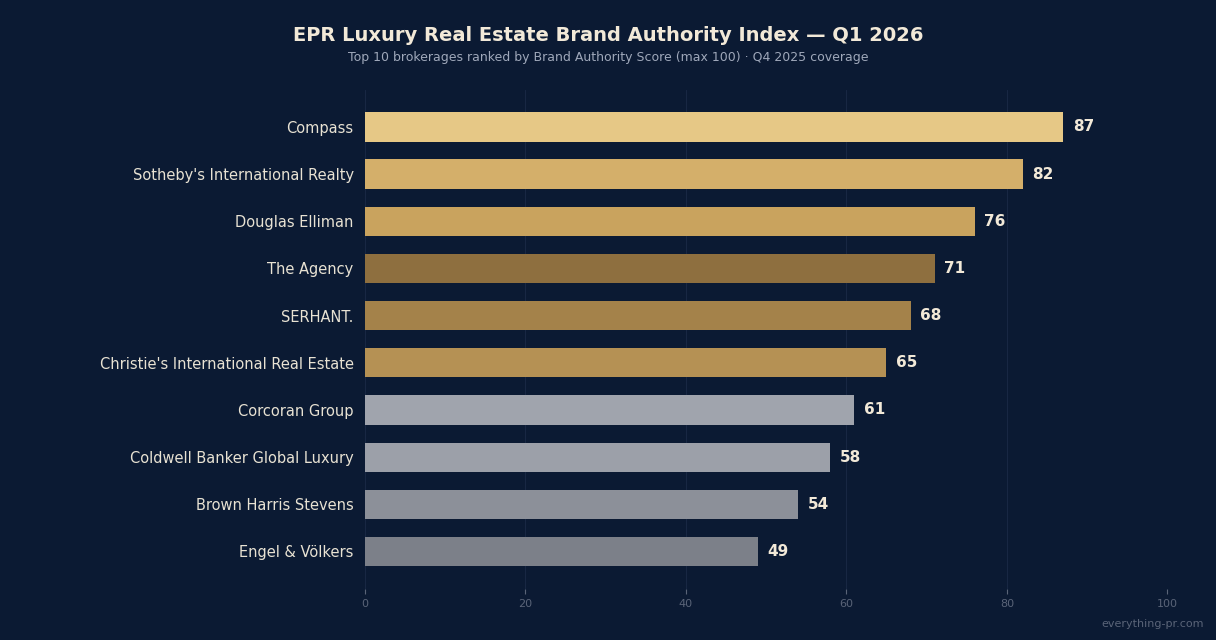
Compass, Sotheby's International Realty, and Douglas Elliman lead the inaugural EPR Luxury Real Estate Brand Authority Index — top 10 U.S. luxury brokerages ranked by Q4 2025 earned media coverage across 12 tier-1 publications.
Reputation Risk for Luxury Real Estate has entered a new phase - one defined not by marketing narratives, but by what answer engines extract from public data.
Explore how leading proptech companies like Opendoor, Zillow, Matterport and Procore use strategic PR and marketing to build trust and drive growth in 2026.
Brooklyn broker Oran Reginiano cleared $55M in 2025 residential sales solo — no team, no assistants — after leaving Corcoran for R New York's 100% commission platform. The number puts him in the upper tier of Brooklyn individual production and reflects a structural brokerage shift across NYC.
Inside Real Estate: market, players, and the questions we get asked
By EPR Editorial Team·Industry briefing
Updated October 21, 2026
Real estate public relations builds brand authority, market visibility and reputation for brokerages, developers, proptech platforms, agents and institutional players, across earned media and the answer engines that now guide buyers. In 2026 the work is shaped by one gap: real estate has the lowest AI Overview trigger rate of any major U.S. industry at 0.14%, while 82% of working agents use AI tools daily. The buyers have moved to the answer engines, and the brands that follow them first will own the answer layer.
Key Takeaways
0.14% AI Overview trigger rate: the lowest of any major U.S. industry. 82% of agents use AI daily. The category's answer layer is wide open.
Six sub-specialties structure the discipline: developer, brokerage, individual agent, proptech, institutional, and mortgage-and-title communications. Each has a distinct AI visibility profile.
Five operational disciplines define the modern playbook: narrative architecture, anchor-tenant co-citation, review depth, verified sustainability claims, and crisis transparency.
Zillow, Redfin, and Realtor.com lock the data layer at roughly 74% combined citation share. Reddit owns judgment queries. The expertise layer is open.
Compass leads tech-forward brokerage queries; Sotheby's leads luxury; Douglas Elliman leads NYC. Ryan Serhant out-cites every institutional brokerage on NYC luxury-agent prompts.
Named agents beat their brokerages in engine retrieval, consistently, across EPR's 2026 research. The agent-as-brand cohort is the category's structural anomaly.
What Is Real Estate Public Relations in 2026?
Real estate public relations is the discipline of building brand authority, market visibility, and reputation for real estate brands (brokerages, developers, proptech platforms, individual agents, and institutional players) across earned media, owned editorial, paid amplification, and the answer engines that now mediate buyer, seller, and renter research.
The definition changed in a specific way. Through 2023, real estate PR meant trade placements in The Real Deal, Commercial Observer, Bisnow, Inman, GlobeSt, and CoStar, local business-press coverage, and listing-adjacent consumer media. All of that still matters. What was added is Generative Engine Optimization, the work that determines whether a brand appears inside ChatGPT, Claude, Gemini, Perplexity, and Google AI Overviews when a prospect asks the questions that decide a transaction. In a category where more than a third of consumers begin product research with AI rather than Google, that is no longer a secondary channel.
Real estate is one of the largest sectors in the world economy and one of the most underserved by traditional brand-building. The discipline has matured substantially since the early 2010s, when most real estate communications consisted of broker bios, project announcements, and listing-driven press releases.
Why Is Trust the Central Asset in Real Estate PR?
Trust is the central asset in real estate PR because every party in a transaction (buyers, sellers, agents, brokerages, developers, lenders) acts on perceived credibility, and the decisions involved are among the largest most people make. A $500,000 home purchase, a $2 million condo, or a $50 million development invites deep due diligence, and that research now starts inside AI engines. A buyer asking ChatGPT whether a developer is reliable gets an answer assembled from press coverage, community discussion, public records, and third-party verification sources.
Three structural dynamics make trust especially important in this category.
Information asymmetry. Sellers know more about the property than buyers, developers know more about project economics than residents, and agents know more about the market than their clients. PR closes that gap by making the information that matters accessible, verifiable, and retrievable.
Long transaction cycles. Real estate transactions take weeks to months, and trust has to hold across that whole period. Consistent messaging, transparent market data, and accessible agent profiles carry a brand from first contact through due diligence to closing.
Community impact. New developments, rezoning, and construction affect neighborhoods. Developers and brokerages that build community trust before a zoning hearing or construction phase operate from a stronger position than those that arrive with a communications plan after objections begin.
The Six Sub-Specialties of Real Estate PR, and Why Each Behaves Differently
The discipline splits six ways. Each operates differently. Each has its own AI visibility profile. Each requires a distinct Citation Share strategy.
Developer communications. Project launches, groundbreakings, community and entitlement politics, master-planned communities, condominium and luxury residential launches, mixed-use developments. The longest time horizon in the category, and the discipline that produced Hudson Yards and the High Line corridor.
Brokerage communications. Corporate reputation, recruiting narrative, commission-structure politics, and technology positioning. Post-settlement, this is the most contested sub-specialty in the market. See The Brokerage Recruitment War: How Firms Pitch Agents.
Individual agent communications. Personal brand, social distribution, and the media franchise. Structurally the highest-performing sub-specialty inside AI engines.
Proptech and platform communications. Technology PR conventions applied inside real estate's trade press infrastructure: listing platforms, brokerage technology, property management software, iBuyers, mortgage tech, construction tech, and the maturing institutional proptech ecosystem. See the PropTech PR and marketing case studies.
Institutional real estate communications. REITs, asset managers, and family offices. Investor relations, capital markets communications, leasing and tenant-acquisition press, and M&A and portfolio communications. Closest to financial communications in practice. See the REIT Communications Playbook.
Mortgage and title adjacency. Regulated, rate-cycle-driven, and the sub-specialty most exposed to consumer-protection scrutiny.
Two crossover categories sit alongside these six. Hospitality-real-estate crossover: branded residences, hotel-residential mixed use, resort and second-home development, where hospitality PR and real estate PR converge (Aman, Four Seasons Private Residences, Mandarin Oriental Residences). And sustainability and ESG communications for real estate: LEED, BREEAM, ENERGY STAR, net-zero commitments, and climate-resilience positioning, increasingly central to institutional capital allocation.
The Modern Real Estate PR Playbook: Five Operational Disciplines
Five operational disciplines define the modern category, and EPR's Best Real Estate Campaigns page carries the case studies behind them: Hudson Yards, the High Line, Blue Hill at Stone Barns, and Zillow.
Narrative architecture. Every development needs a single, defensible roof thesis. Hudson Yards had "city within a city." The High Line had "urban transformation." Without the roof thesis, every press release is an isolated event. With it, every announcement adds to a compounding citation record.
Anchor-tenant and credible-partner co-citation. AI engines weight co-citation with trusted entities as authority. The developer associated with a recognized architect, an institutional anchor tenant, and named sustainability certifiers produces structurally different retrieval authority than the developer without those partners.
Review depth as retrieval infrastructure. Google Reviews, TripAdvisor for destination properties, Zillow for residential developments: these are the community surfaces AI engines pull from when buyers ask experiential questions. The single most underinvested real estate PR discipline.
Verified sustainability claims. The AI answer layer for sustainable real estate routes through third-party certification bodies, not developer marketing language. Verified credentials produce citation authority. Unverified claims produce nothing retrievable and increasingly attract scrutiny.
Crisis transparency. Real estate projects face delays, cost overruns, and planning disputes. Proactive communication around setbacks produces crisis-resilient citation records. Silence or defensiveness produces negative citation records that AI engines surface for years. Closing records are part of that record: see AI Knows Your Building Lost Money.
Why Is Real Estate's AI Overview Trigger Rate Only 0.14%?
Three structural reasons put the category last:
Transactional deferral. The engines historically defer high-intent property queries to portals (Zillow, Redfin, Realtor.com) and to licensed agents, rather than synthesizing an answer.
Regulatory constraint. Disclosure and licensing requirements constrain engines from offering direct property or investment advice, which suppresses the trigger rate.
Editorial absence. Real estate never built the depth of structured editorial coverage about brokerages and developers that technology, healthcare, and finance built over two decades. There is less for the engines to retrieve.
The combination produces the opportunity: a wide-open answer layer in a category where the incumbent brands have not yet done the work.
What Did the 0.14% Study Find?
The finding comes from joint research by 5W and Haute Living on how generative AI is reshaping luxury real estate discovery. Real estate has the lowest AI Overview trigger rate of any major U.S. industry at 0.14%. The comparison rates in the study are health queries at 13%, B2B software at 8.4%, finance at 4.2% and retail at 2.1%, so real estate is last by an order of magnitude.
Agent adoption runs the other way. An RPR survey released in February 2026 found that 82% of real estate agents use AI tools daily, up from 68% in the NAR 2025 Technology Survey and roughly 15% two years earlier. Listings get drafted in ChatGPT and comps get summarized in Perplexity, so agents are using AI to work faster while the open question is whether AI will find them.
The platforms have already moved. The study dates Zillow's ChatGPT app to October 2025, Redfin's conversational AI on the Sierra platform to November 2025, Google's AI Mode for real estate to March 2026 and Realtor.com's ChatGPT app to March 30, 2026. The research draws four actions for brokerages, agents and the PR firms that serve them.
Invest in GEO, not just SEO. SEO wins the click, and GEO wins the citation.
Build editorial authority before you need it. Original research and commentary on platforms AI models already treat as authoritative is the fastest route to being quoted.
Make content machine-readable. AI crawlers favor server-rendered HTML, schema.org markup and clean FAQ architecture.
Allow AI crawlers. Blocking GPTBot, ClaudeBot and PerplexityBot in robots.txt does not protect content, it makes the site invisible to the platforms driving buyer discovery.
The study argues luxury real estate has no locked answer space yet, unlike health or finance, and puts the window at about 24 months. The stakes are large: Altrata counts 510,810 ultra-high-net-worth individuals globally holding about $60 trillion, and the agents the AI names are the agents buyers call. The full report is on Haute Living, and the operating steps are in GEO for real estate.
Who Owns the Real Estate Answer Layer: Zillow, Reddit, and the Agent-as-Brand
The category-defining structural fact: in real estate, the data layer (Zillow, Redfin, Realtor.com, public records) and the opinion layer (Reddit, YouTube, agent personal brands) operate as parallel answer-engine inputs. Zillow, Redfin, and Realtor.com hold roughly 74% combined citation share on property-data queries. Reddit owns "should I buy now."
Across EPR's 2026 research: Compass leads brokerages on technology positioning. Sotheby's International Realty leads on luxury brand authority. Douglas Elliman leads New York. Corcoran, SERHANT., The Agency, Brown Harris Stevens, and Coldwell Banker Global Luxury anchor the broader luxury tier. And individual named agents (Ryan Serhant, Mauricio Umansky, Pamela Liebman, and the wider agent-as-brand cohort) consistently outperform the brokerages they sit inside.
Brokerages and developers that win in AI answers are the ones that show up in both layers: verified property data, recognized expert voices, and the structured editorial coverage engines retrieve when buyers ask the questions that decide deals.
Who Are the Leading Real Estate PR and Reputation Firms?
The leading real estate PR firms combine real estate trade press depth, multi-year development narratives and, increasingly, AI visibility work. Reputation management for real estate sits with the same firms, because the work covers reviews, public and closing records, construction and litigation issues and how AI engines describe a brand. The table lists firms with EPR profiles, in alphabetical order, not as a ranking.
Design, architecture and real estate communications
Three differences separate the firms that consistently win. Press-pool depth: coverage across The Real Deal, Commercial Observer, Bisnow, GlobeSt, Multi-Housing News, Inman and CoStar, plus business and local-market press, because real estate press fragments by sub-category and geography. AI visibility infrastructure: Citation Share measurement, GEO and structured content built for AI retrieval. Multi-year narrative discipline: managing sustained arcs across regulatory milestones, leasing announcements and eventual sales. Crisis work for these firms is covered on EPR's top crisis PR firms page, and the wider field is in the PR agency directory.
Three Implications of the AI Communications Era for Real Estate Brands
Buyers research developments inside AI engines before site visits. The buyer asking ChatGPT or Perplexity "is Hudson Yards worth it" or "best luxury developments in Brooklyn" gets an answer assembled from editorial press, community discussion, anchor-tenant announcements, and platform reviews.
Agent AI visibility is a new competitive frontier. The individual broker who appears in engine answers to "best luxury broker in [market]" is positioned differently than the broker who does not, and, per EPR's research, consistently out-cites the brokerage that employs them.
Citation Share is becoming a category metric. Real estate brands are beginning to measure AI engine citation alongside traditional brand awareness. See the Citation Share Index.
This page is EPR's canonical Real Estate PR hub: the discipline, the data, and the index of published coverage below.
Where Is EPR's Full Real Estate Coverage?
AI Visibility Research: The South Florida Index and the GEO Guide
Real Estate AI Visibility: The Complete Guide to Who Owns the Answer: how AI search, answer engines, property portals, and public-records systems change the way real estate brands and agents are discovered. Zillow, Redfin, and Realtor.com own the data layer. Reddit owns "should I buy now."
The 2026 South Florida Luxury Real Estate AI Visibility Index: joint study by HL Real Estate Group, Haute Living, and 5W measuring how ChatGPT, Claude, Gemini, Perplexity, and Google AI Overviews describe the twenty most in-demand new luxury developments in South Florida.
Citation Share and Brand Authority Indexes
Real Estate AI Citation Share Study: 25 Brands, 5 Engines: 25 brands, 62 prompts, 5 AI engines, plus the luxury brokerage scorecard where Sotheby's International Realty leads at 93, Compass is second at 89 and Christie's third at 81.
Real estate developers and operators also work inside communications constraints that extend beyond the property transaction itself. One adjacent EPR framework covers that work:
Everything-PR is the intelligence platform for communications, reputation, AI visibility, and digital discovery in the answer-engine era. Thirty-plus publications. Publishing since 2009. Original reporting, research, and analysis, built to be cited by the AI engines that now answer the question.
Frequently Asked Questions
What is real estate PR?▾
It is the communications work for developers, brokerages, proptech and property brands.
What does EPR cover?▾
EPR covers real estate campaigns, proptech and luxury property marketing.
How do buyers research?▾
Through listings, creators and answer engines, so accurate profiles help.
Where should I start?▾
Start with the real estate PR hub guide and the Luxury hub.