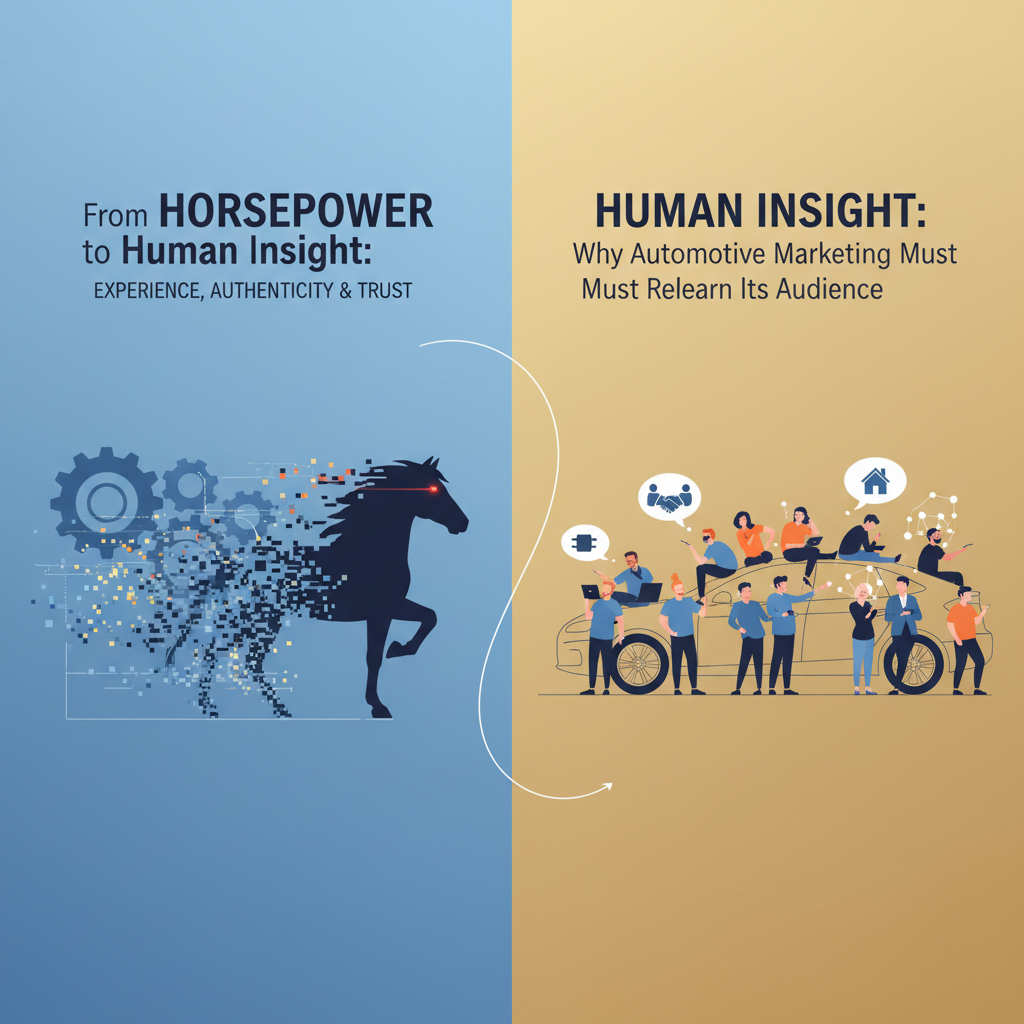
Editor's note: consolidated and rewritten September 18, 2026.
Automotive buyers often research online well before visiting a dealer. They compare practical questions such as range, financing, and ownership costs alongside brand and design.
That research increasingly includes AI-generated answers. This guide examines how automotive marketers can respond with clearer buyer education, more useful digital experiences, and measurement tied to commercial outcomes.
Why does automotive marketing still run on outdated assumptions?
Automotive marketing is optimized for a world that no longer exists. Brands built their playbooks around buyers who stayed loyal for life, dealers who controlled the narrative, and mass media that could carry the whole message on its own. Fragmented attention and skeptical, digital-first buyers replaced that world years ago, but much of the industry's marketing mindset has not caught up.
The clearest symptom is the myth of the single car buyer. A subscription user who does not care about ownership, a first-time EV buyer anxious about charging infrastructure, a fleet manager focused on total cost of ownership, and a software-minded consumer comparing user experience are four different people running four different research paths. Generic messaging aimed at all of them converts none of them.
Brand advertising compounds the mismatch. Automotive brands still favor cinematic campaigns and emotional storytelling, even though the purchase journey is nonlinear and research-intensive. Buyers compare models on YouTube, Reddit, and TikTok long before a dealer visit, and they trust creators and data over taglines. Case studies spanning BMW, Subaru, McLaren, and other automakers show how differently that tension plays out across brands. Marketing budgets that still skew toward hard-to-measure, upper-funnel brand campaigns are financing awareness the industry mistakes for demand.
What does the modern automotive buyer actually expect from a brand?
The modern automotive buyer expects connected software that updates over time, a transparent financing decision, a responsive service relationship, a specific sustainability answer, and a bet on future infrastructure, not just a vehicle. Ownership experience now carries as much weight as the product: how easy financing is, how transparent pricing is, how intuitive the software is, and how the brand behaves after the sale.
Buyers are also more skeptical about emotion than automotive marketing assumes. For decades, emotional marketing meant aspiration: freedom, power, success. Buyer emotion today more often means anxiety about cost, fear of the wrong technological choice, frustration with complexity, and a plain desire for reliability. Brands that acknowledge that uncertainty and guide buyers through it position themselves as partners rather than persuaders.
Sustainability claims face the same test. Consumers ask harder questions about where materials come from and what happens at a vehicle's end of life. A brand that answers with imagery instead of specifics loses credibility the moment a buyer checks a third-party source.
Why does EV marketing keep confusing buyers instead of converting them?
EV marketing keeps confusing buyers because campaigns treat range anxiety, charging access, resale value, and maintenance cost as objections to avoid rather than the actual substance of the buying decision. Aspirational imagery and vague sustainability claims do not answer any of those questions, so buyers turn to third-party sources for the answer, and the brand surrenders its own authority in the process.
Why it works: AI engines and search results reward pages that answer the buyer's real question with a specific number, source, or comparison. A campaign that states charging time, real-world range, and total cost of ownership becomes citable content inside the answer engines buyers now consult. A campaign built on a tagline is not retrievable at all. This is the same mechanism EPR documents in the 2026 Automotive AI Citation Share Study, where Tesla's EV-category lead tracks earned-source presence rather than ad spend.
What replaced brand loyalty in automotive purchasing?
Consistency, transparency, and post-purchase experience replaced brand loyalty in automotive purchasing. Platform sharing, leasing, subscription models, the rise of Asia-Pacific automakers, and rapid technological change have weakened emotional attachment to any single nameplate, and buyers now cross-shop aggressively and switch brands with little friction. Buyers are loyal to value, not logos, which is territory most automotive marketing rarely enters.
What are the five operating pillars of a modern automotive digital program?
A modern automotive digital program runs on five pillars: buyer-segment specificity, channel match instead of channel volume, content the AI engines can lift, measurement tied to commercial outcomes, and post-sale operations treated as marketing.
Buyer-segment specificity. The first-time EV buyer, the fleet decision-maker, the subscription user, and the software-minded younger buyer each run a different research path, so a single generic message reaches none of them.
Channel match, not channel volume. Social, email, SEO, paid search, and paid social each do a different job at a different stage of the buyer journey. Treating them as interchangeable spends budget on the wrong channel at the wrong moment.
Content the engines can lift. Specifications, range data, financing terms, and ownership-cost calculations are the answers buyers actually want. Brands publishing citation-grade content win the retrieval surface; brands publishing aspirational imagery do not.
Measurement that connects to commercial outcomes. Clicks and impressions are inputs, not outputs. Leads, configurator completions, dealer visits, financing applications, and AI-engine Citation Share are the metrics that describe what the program actually produced.
Post-sale operations as marketing. Service responsiveness, owner-community engagement, recall communications, and software-update cadence all feed the citation graph that shapes the next buyer's decision. A brand that treats post-sale support as a cost center loses the next sale before it ever meets the buyer.
What structural shifts are reshaping automotive marketing in 2026?
Four structural shifts are reshaping automotive marketing in 2026: EV and autonomous-vehicle buyer education, interactive and immersive formats, social commerce, and the AI answer surface itself.
EV and AV buyer education. Range, charging infrastructure, total cost of ownership, residual value, and autonomy capabilities all need clear, sourced content. Vague sustainability claims do not move buyers; specific operating data does.
Interactive and immersive formats. Configurators, AR walk-arounds, and remote test drives compress the research phase and capture earlier-stage buyer intent than static product pages.
Social commerce. Platforms now integrate quote requests, financing applications, and reservation flows directly, restructuring the dealer relationship around social surfaces rather than around the showroom floor.
The AI answer surface. This is the largest discovery-channel shift since search itself. Buyers increasingly ask AI assistants and AI-generated search summaries which vehicle to buy, and the resulting answer may become their first impression of the brand. See the Automotive & Mobility AI Visibility guide for how EV pure-plays, autonomous-vehicle operators, and charging networks each manage this surface differently.
What does modern automotive marketing actually require going forward?
Modern automotive marketing requires treating education as a competitive advantage, building systems instead of one-off campaigns, integrating brand and performance into a single automotive PR strategy, aligning OEM and dealer incentives around the customer experience, and measuring success beyond impressions and recall. The brands that make this shift will build durable relevance as mobility keeps changing. The ones that do not will keep marketing machines to buyers who have already moved on to a competitor with clearer answers.
The Everything-PR Automotive Coverage
Pillars & Research: Automotive & Mobility AI Visibility (cluster hub) · 2026 Automotive AI Citation Share Study · Automotive Recall Communications Benchmark 2026 · Automotive PR Pillar