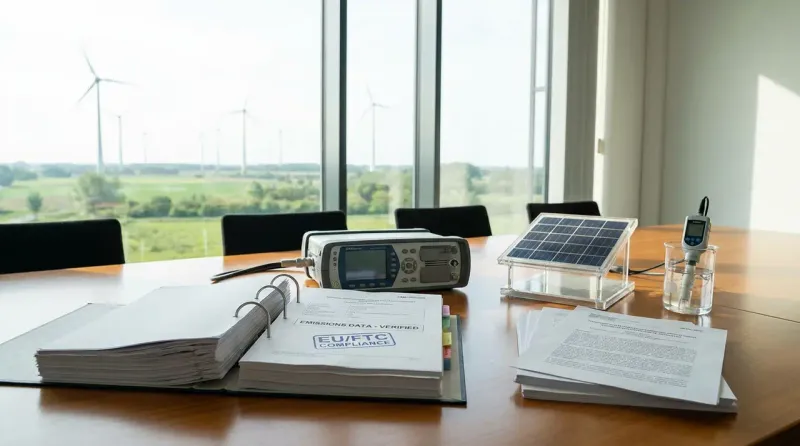
Cleantech PR is public relations for companies whose core claim, that they cut emissions, save energy or replace a dirtier alternative, can be tested by a lab, a regulator or a rival. Because those claims can be checked, cleantech PR depends on four habits: independent validation before an announcement, precise numbers, named technical spokespeople, and a published answer to each known criticism.
Last updated October 18, 2026.
Contents
- What are the key takeaways on cleantech PR?
- What is cleantech PR and how is it different?
- Who tests cleantech claims, and with what evidence?
- How should a clean energy claim define its boundary?
- What proof should a cleantech team secure before announcing?
- Which EU and US rules limit clean energy claims now?
- Which crisis patterns do cleantech companies face?
- How do AI answers change cleantech communications?
- How is cleantech PR staffed and bought?
- How should cleantech PR be measured?
- What should a cleantech team do first?
- Frequently asked questions
What are the key takeaways on cleantech PR?
Cleantech PR in October 2026 rests on proof, exact wording and legal limits on environmental claims.
- Claims about emissions, efficiency and cost can be tested, so validation should come before the announcement.
- Directive (EU) 2024/825 has applied in EU member states since 27 September 2026 and bans generic claims such as "eco-friendly" without proof of excellent environmental performance.
- The FTC Green Guides, last revised in 2012, remain the main United States reference and warn against unqualified general environmental benefit claims.
- Failures such as Solyndra in 2011 and the Moss Landing battery fire in 2025 spread to whole technology categories, not only to one company.
- A cleantech program should be measured on claim durability, spokesperson depth, citation in AI answers and coverage of known criticisms.
What is cleantech PR and how is it different?
Cleantech PR, also called clean energy PR, is the practice of building public trust in companies whose products cut emissions, save energy or replace fossil alternatives. It differs from other technology PR because the central claim can be disproved.
A solar installer's degradation figure sits inside a warranty document. A battery maker's cycle-life figure can be repeated by an independent lab. A grid-storage operator's claim to have prevented an outage can be compared with the utility's own logs.
Solyndra shows what happens when claims and finances outrun proof. The solar panel maker received a $535 million U.S. Department of Energy loan guarantee in 2009, then filed for Chapter 11 bankruptcy in September 2011 and laid off about 1,100 employees, Laser Focus World reported. UPI reported that the collapse questioned the clean energy stimulus program.
The broader discipline of environmental communication, from investor disclosure to greenwashing risk, is covered in EPR's green public relations guide.
Who tests cleantech claims, and with what evidence?
Cleantech claims are tested by independent labs, regulators, lifecycle analysts, lenders and competitors, and each tester accepts a different kind of proof.
| Claim type | Who tests it | Evidence that holds up |
|---|
| Performance, such as battery capacity or panel output | Independent test labs and certifiers such as UL, DNV and TÜV Rheinland | A test report that names the lab, the method and the conditions |
| Scientific breakthrough | Peer reviewers and national laboratories such as NREL, Sandia and Idaho National Laboratory | A peer-reviewed paper or a national laboratory partnership |
| Emissions or "clean" labels | Lifecycle analysts, regulators and litigators | A lifecycle assessment with a stated system boundary |
| Safety | Fire officials, insurers, regulators and neighbors | Incident reporting, a root-cause investigation and remediation commitments |
| Financial viability | Lenders, investors and filing readers | Audited filings and loan documents |
Each tester carries weight with a different reader. UL certification matters to a retail buyer or a consumer-safety reporter. A national laboratory partnership matters to an energy specialist and an investor. A press release should lead with the validator its target reader respects.
How should a clean energy claim define its boundary?
A clean energy claim should state its system boundary, meaning exactly which emissions and life stages the number includes.
The boundary changes the number. The U.S. National Renewable Energy Laboratory (NREL) ran a Life Cycle Assessment Harmonization Project that reviewed more than 2,000 published studies. CleanTechnica's summary of the 2012 results, published in the Journal of Industrial Ecology, reports median life cycle emissions of 45 grams of CO2 equivalent per kilowatt-hour for solar photovoltaics and 11 to 12 grams for wind.
A claim limited to operation and a claim covering the full life cycle therefore give different figures, and the wording should say which one it is. NREL has since published a 2021 update to its electricity generation fact sheet, so a team should check current figures before quoting any of these.
What proof should a cleantech team secure before announcing?
A cleantech team should secure independent proof for each claim before the announcement, in a fixed order.
- Write the claim as a number with units, a comparison point and test conditions.
- State the system boundary next to the claim, not in a footnote.
- Commission validation from the body that the target reader respects.
- File the evidence in a substantiation file that can be shown to a journalist or regulator on request.
- Name two technical spokespeople who can explain where the technology falls short.
- Publish an answer to the category's best-known criticism on the company's own site.
Precision is what makes this order work. A hypothetical battery claim shows the difference: "lasts longer" invites the question "longer than what", while a stated share of rated capacity after a stated number of cycles at a stated charge rate, tested by a named lab, answers it before a reporter asks.
Pre-announcement claim check
- Which exact figure will a reporter quote?
- Which life stages and emissions does that figure include?
- Which named body validated it, and on what date?
- Which critic will challenge it first, and what is the published answer?
- Which spokesperson can defend it without notes?
Which EU and US rules limit clean energy claims now?
Directive (EU) 2024/825 has applied in EU member states since 27 September 2026, and the FTC Green Guides remain the main United States reference for environmental claims.
| Rule | Where | Status on October 18, 2026 | What it means for a claim |
|---|
| Directive (EU) 2024/825 | EU member states | Transposition was due 27 March 2026, and the rules apply from 27 September 2026 | Generic claims such as "green" or "eco-friendly" need recognised excellent environmental performance, and claims about future performance need public, time-bound commitments, according to Bird & Bird |
| Proposed Green Claims Directive | EU | Not adopted, and described by C2C Certified as withdrawn in 2025 | No separate EU substantiation regime exists, so Directive 2024/825 carries the limits |
| FTC Green Guides (16 CFR part 260) | United States | In effect, first issued in 1992 and last revised in 2012, with a revision review opened by the FTC | Guidance rather than binding law, used by the FTC under Section 5 of the FTC Act, and it covers business-to-business claims |
The EU directive also bans claiming that a product has a neutral, reduced or positive greenhouse gas impact when the claim rests on offsetting emissions outside the product's value chain. It does not ban the words "carbon neutral" outright, and a claim based on the product's actual lifecycle impact can still be made with substantiation.
The directive amends the consumer marketing rules, so a purely business-to-business claim falls under other national law. Law firm Frantz Ward notes that consumers can cite the Green Guides in state claims and competitors can sue under the Lanham Act. EPR's sustainability PR claims and law guide covers the wider rules.
Which crisis patterns do cleantech companies face?
Cleantech companies face three repeating crisis patterns: an overclaim that gets corrected, a physical safety incident, and a funding failure.
Overclaim and retraction
An overclaim crisis starts when a performance or scale claim runs ahead of independent evidence and a test, a reporter or a rival exposes the gap. The workable response is a fast correction that states the wrong figure, the right figure and what changed in the process that produced the error.
Safety incident
A safety incident in cleantech is judged twice, once as an accident and once as a verdict on the whole technology. On January 16, 2025, a fire was detected at Vistra's 300 MW Moss Landing battery storage facility in California, and Vistra's quarterly filing reported no injuries and a write-off of about $400 million in net book value. California politicians then questioned the safety of lithium battery storage generally, Power Engineering reported.
The response therefore needs two tracks: incident reporting and root-cause work for the site, and a separate answer to the category-level question.
Funding failure
A funding failure turns one company's shutdown into reputational risk for every company in the same category. Companies should publish, before any failure, why their own technology, costs and financing differ from those of the company that failed, as the Solyndra collapse showed.
For market-wide stress, see EPR's pieces on energy shocks as communications tests and communicating through energy market freezes. The shareholder side of climate pressure is covered in the Engine No. 1 versus Exxon board battle, and the industry's own reputation in Big PR's fossil-fuel record.
How do AI answers change cleantech communications?
AI answers change cleantech communications because a summary assembled from a small set of cited sources can reach an investor or buyer before the company's own page does.
EPR's analysis of AI answers on energy and climate names five source groups behind those answers: the IEA, the EIA, the IPCC, BloombergNEF and the financial press. It also concludes that the industry is largely absent from its own answers.
A company can respond by publishing its figures as a plain web page with the number, date, method and source, which is easy for a person or a search system to quote and check. Transcribed interviews and conference talks add pages where a named engineer explains the technology in full sentences. EPR tracks how engines cite energy sources in the energy transition citation share index.
How is cleantech PR staffed and bought?
Cleantech PR is delivered by specialist climate agencies, by general agencies with a cleantech practice, or by in-house teams, and the right choice depends on who must approve public claims.
- Specialist climate and energy agencies bring trade press relationships and staff who can translate engineering claims into plain language.
- General agencies with a cleantech practice add investor relations, crisis work and public affairs under one contract.
- In-house teams bring speed and company knowledge, with less outside view on how a claim reads to a skeptical reporter.
Whichever model a company chooses, the person with final approval on public claims should hold the substantiation file, not only the function measured on launch speed. Buyers can compare firms in EPR's list of cleantech and climate PR firms.
How should cleantech PR be measured?
Cleantech PR should be measured by claim durability, spokesperson depth, citation in AI answers and coverage of criticisms, because impressions measure activity rather than credibility.
- Claim durability is the share of public technical claims that survive independent testing, tracked quarter by quarter.
- Spokesperson depth is the number of named technical voices with a public record of substantive interviews.
- Citation in AI answers is how often engines cite the company's own pages when asked about its category-defining claim.
- Criticism coverage is whether a findable published answer exists for every major standing criticism of the category.
What should a cleantech team do first?
A cleantech team should start with the one claim it most needs a reporter to repeat, write it as a tested number with its boundary, and secure the validation before the announcement.
Every other practice in this guide, from the substantiation file to the spokesperson bench, exists to keep that claim true when someone checks it.
These EPR pages cover the claims, regulation, AI answers and agencies discussed above.