General Mills marketing strategy rests on two assets: characters the company has owned for decades and a repeatable routine for handling product crises. Its PR and marketing record includes the Saatchi & Saatchi-made 2013 Cheerios ad and a dated, step-by-step 2016 flour recall. General Mills says brands such as Gold Medal, Betty Crocker, Cheerios, Pillsbury, Nature Valley and Old El Paso are found in more than 90 percent of US households, and fiscal 2026 net sales were $18.4 billion.
What are the key takeaways from General Mills marketing?
- Owned characters such as Betty Crocker (1921), the Trix Rabbit (1959), Lucky the Leprechaun (1964) and the Pillsbury Doughboy (1965) give the brands recognition that new faces have to rebuild from zero.
- Cheerios kept its 2013 "Just Checking" ad on air and moderated the comments, and the spot ranked second among 2013 cereal ads in Ace Metrix testing.
- The 2016 flour recall moved in three dated steps, each tied to a new lab result.
- Fiscal 2026 gave the company a clear reset plan: innovation, packaging and brand communications lead fiscal 2027.
What is General Mills and how big is it?
General Mills is a Minneapolis-based food company that began in 1866 as the Washburn Crosby Company and took the General Mills name in 1928 after merging with several regional millers. Its fiscal year ended May 31, 2026, and the company reported net sales of $18.4 billion, down 5 percent, with organic net sales down 2 percent, in its July 1, 2026 earnings release.
Jeff Harmening serves as chairman and chief executive officer. The portfolio spans cereal, baking, snacks, frozen foods and pet food. A closest packaged-goods peer, Procter & Gamble, is covered in EPR's Procter & Gamble public relations page, and the wider category sits in EPR's CPG coverage.
How do General Mills characters work as a marketing asset?
General Mills characters work as owned assets because the company keeps them on the box and in advertising for decades, so shoppers recognize the brand before they read a label. The characters below are the core of the cereal and baking portfolio.
| Character | Launched | What the record shows |
|---|
| Betty Crocker | 1921 | Introduced to answer consumers' cooking and baking questions through radio, cookbooks and recipes |
| Trix Rabbit | 1959 | The premise is that the rabbit never gets the cereal; General Mills says he ate it only in 1976 and 1980 |
| Lucky the Leprechaun | 1964 | Waldo the Wizard replaced him briefly in 1975, and he was back on the box within a year |
| Pillsbury Doughboy | 1965 | Reached 87 percent recognition within three years of his debut |
The Betty Crocker entry comes from General Mills' own 160-year history. The Trix, Lucky and Doughboy details come from General Mills figures reported in a Fox News mascot history.
The table works as a character ledger: list every character a brand owns, the year it launched, and the last year the company tried to replace it. The Lucky and Waldo swap is the useful row. The replacement lasted under a year, which is evidence that a long-running character holds recognition a new face has to rebuild from zero.
How did Cheerios handle the 2013 ad backlash?
Cheerios kept the ad running, disabled the comments and said the spot would stay on air. The commercial, titled "Just Checking," showed an interracial family and was posted to YouTube on May 28, 2013, where it drew racist comments.
Camille Gibson, vice president of marketing for Cheerios, told ABC News in a statement that consumers had responded positively and that the brand celebrates many kinds of families. Saatchi & Saatchi made the spot, as CTV News reported, and EPR profiles that agency in its Saatchi & Saatchi coverage.
The ad kept scoring with viewers. Ace Metrix ranked it second among all tracked 2013 cereal commercials, according to MediaPost's Ace Metrix report.
How did General Mills run the 2016 flour recall?
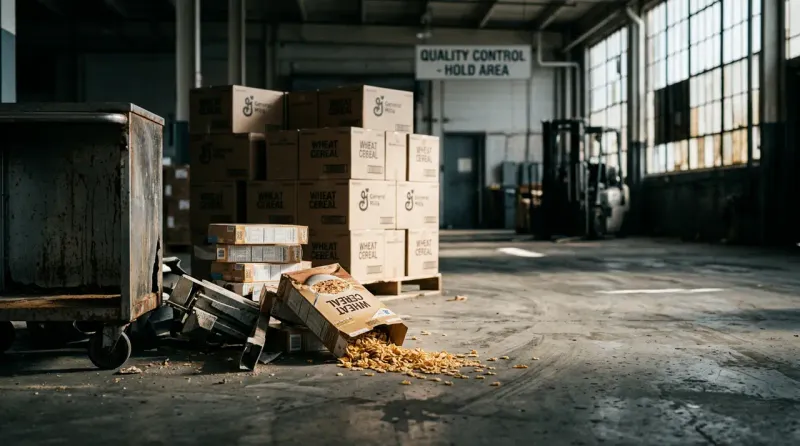
General Mills ran the 2016 flour recall in three steps, each tied to a new laboratory finding. The company recalled Gold Medal, Gold Medal Wondra and Signature Kitchens flour on May 31, 2016, then expanded the recall on July 1 and again on July 25, according to the Centers for Disease Control and Prevention.
The CDC counted 63 people infected with E. coli strains O121 or O26 across 24 states. Seventeen people were hospitalized, one developed a kidney failure called hemolytic uremic syndrome, and no one died. The July expansions followed lab results: the CDC says testing by General Mills and the FDA found O26 in flour that earlier recalls had not covered. Food Safety News reported that the recall reached 45 million pounds by the second expansion.
The lesson for crisis teams is the sequence. Each public step named a date and a test result, and the broader discipline is covered in EPR's crisis PR guide.
What did General Mills learn from its fiscal 2026 reset?
General Mills used fiscal 2026 to reset three areas: the Pet business, the Brazil business and the Totino's frozen pizza and snack line. The company recorded about $1.8 billion in non-cash goodwill and brand intangible charges and a $1.0 billion non-cash valuation loss tied to the planned sale of its Brazil business, per the SEC filing.
The Pet charge includes a $1.5 billion goodwill impairment on the North America Pet unit, reported by Food Business News. General Mills paid $8.0 billion for Blue Buffalo in April 2018, as its acquisition release shows. An impairment does not move cash in the quarter it is booked, but it records that the business is now worth less than the books said.
Totino's became a marketing and pricing lesson. On the earnings call, chief operating officer Dana McNabb said the change to pack sizes and prices did not go well, according to a call transcript summary. Harmening said fiscal 2027 will lean on innovation, packaging and brand communications to lift how remarkable the brands feel to shoppers.
What can brand teams copy from General Mills?
Brand teams can copy four practices from General Mills, and each one has a dated record behind it. The same record shows what to avoid.
| Practice | Evidence | Action for a brand team |
|---|
| Own the characters | Betty Crocker since 1921; Lucky survived the 1975 swap | List every owned character and keep it through agency changes |
| Defend the ad, moderate the comments | Cheerios disabled comments and kept the 2013 spot on air | Decide before launch what you moderate and what keeps running |
| Expand a recall on lab evidence | Recall steps on May 31, July 1 and July 25, 2016 | Tie each public update to a named test result and date |
| Test price and pack changes first | Totino's pack and price change in fiscal 2026 | Run the change in a small market before national messaging |
The Share a Coke campaign shows a rival's version of the owned-asset idea in EPR's Share a Coke analysis.
What should a brand team do next?
Run a character ledger on your own brand this week, and pair it with a crisis trigger. General Mills shows that both lists work, and that neither one replaces a sound price and pack decision. Follow these steps:
- List every character or owned brand asset your company uses.
- Record the launch year of each one.
- Note the last time the company tried to replace it, and what happened.
- Write down the one test result or date that would trigger your first public update in a crisis.
Primary sources used on this page
The company figures come from General Mills' July 1, 2026 earnings release and its 160-year history. The recall figures come from the CDC outbreak investigation.