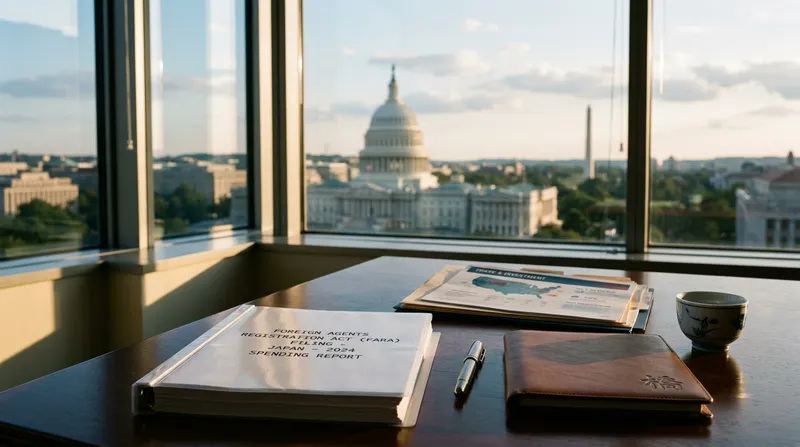
Japan was the largest foreign spender on U.S. lobbying and public affairs in 2024, with $48.5 million in disclosed Foreign Agents Registration Act spending, according to OpenSecrets data analyzed by the Washington Examiner. The biggest share came from JETRO, a government-linked trade promotion group. Hogan Lovells and Akin Gump work Congress for Japan, and Japanese corporations raised their own lobbying by 8 percent. Since 2016 Japan trails only China, at $504.1 million through 2025.
Foreign principals based in Japan spent $48.5 million in 2024, the most of any country, per OpenSecrets Foreign Lobby Watch data. The Washington Examiner's analysis found that Saudi Arabia, Japan, China and South Korea all outspent Israel and Qatar that year, which had once been the top foreign spenders. China's disclosed spending fell to $32.9 million in 2024 from a peak of $85.4 million in 2023, which is how Japan moved to the top of the annual table. The shift matters because Japan's spending is about trade and investment, not foreign policy.
Over the longer run, OpenSecrets totals for 2016 through 2025 put Japan at $504.1 million, second only to China at $562.7 million. The Japan External Trade Organization alone accounts for $354.4 million of that, the largest single foreign principal in the data after the Government of China and the Government of the Marshall Islands.
The Japan External Trade Organization, known as JETRO, is a government-linked nonprofit that promotes investment in Japan and the import of Japanese goods. It was the largest single source of Japan's 2024 spending. FARA records show agents working for JETRO secured meetings in 2024 with Governors Greg Abbott of Texas, Tate Reeves of Mississippi, Phil Murphy of New Jersey and Kevin Stitt of Oklahoma, and held expos, lectures and seminars aimed at deepening Japan's commercial ties with U.S. states.
Sponsored · 5W5W25 years of making headlines.5W Public Relations: media relations, crisis, digital and AI search for consumer and corporate brands.Visit 5W212.999.5585info@5wpr.com
JETRO is managed by Japan's Ministry of Economy, Trade and Industry and funded by the Japanese government, according to O'Dwyer's reporting on JETRO's 2026 hiring of DB3. The same report says JETRO's New York office retained DB3, the firm built on the legacies of Tom Daschle and Howard Baker, for $20,000 to assess Washington's political landscape and preview the midterm elections.
JETRO's classification explains an older pattern in the data. In the 2017 figures reported by U.S. News from OpenSecrets, Japan's government accounted for about $6 million of spending while nongovernmental principals accounted for almost $33 million, because JETRO is counted as a nongovernmental organization even though Tokyo funds much of it. For the same reason, a quick read of FARA totals can understate how much of Japan's effort traces back to the state.
Which firms lobby for Japan?
Japan relies on two law-firm lobbying practices for Congress and a rotating set of public affairs and communications firms for specific campaigns.
Firm
Work for Japan
Source
Hogan Lovells
Primary congressional firm on trade, defense and economic development
The newest entry is regional rather than national. Mercury Public Affairs, an existing registrant (number 6170), added Okinawa Prefecture as a foreign principal on October 20, 2026, according to the Justice Department's October filing data. The agreement caps compensation at $30,000, small next to JETRO's budget, and shows prefectures buying U.S. government relations advice on their own account. The full October register is in the FARA guide.
How has Japan's lobbying changed over time?
Japan has been a steady buyer of Washington influence for more than a decade. In the months before Prime Minister Shinzo Abe's 2015 visit, Japan spent more than $1.2 million on lobbying, law and public relations firms, according to Roll Call's review of Justice Department filings. That included the Daschle Group, a $75,000 fee to the Podesta Group, and $188,000 for half a year of work by the T. Dean Reed Company. In 2020, Japan hired Marathon Strategies to develop a communications plan on how U.S. media portrayed its coronavirus response. The work has since shifted from embassy events around a single visit toward sustained trade promotion through JETRO, which accounts for the largest share of the 2024 total.
What are Japanese corporations doing?
Japanese companies are also building their own Washington presence. Nikkei reported in June 2025 that Japanese corporations increased lobbying expenditures by 8 percent year over year, concentrated in automobiles, electronics, chemicals, steel and communications. Their activity is filed largely under the Lobbying Disclosure Act, not FARA, so it does not show up in the $48.5 million figure. For the difference between the two regimes, see the FARA compliance and diligence framework.
What changed in 2025?
The second Trump administration's tariffs and trade negotiations set off a lobbying scramble among foreign clients, according to the Washington Examiner's reading of the data. Japan's trade-focused program sits squarely in that environment, and its April 2025 hiring of Continental Strategy, a firm led by a former Trump-era ambassador, fits the pattern. The OpenSecrets 2016 to 2025 total above includes 2025 filings, but EPR has not isolated a 2025-only country total for Japan, and none was published in the sources reviewed on November 13, 2026. This page will be updated when one can be verified.
What are the limits of the data?
FARA data shows only registered activity. It does not capture lobbying done under exemptions or by unregistered agents, and OpenSecrets classifies principals in ways that affect country totals. Treat $48.5 million for 2024 and $504.1 million for 2016 through 2025 as disclosed floors. EPR also covers the other side of the market in Best PR Firms in Japan, and the DOJ FARA warning for PR firms explains why registration questions matter for firms taking foreign-principal work.
Sources: OpenSecrets Foreign Lobby Watch via the Washington Examiner (July 2025) and OpenSecrets totals for 2016 through 2025; O'Dwyer's (May 2025 and February 2026); Nikkei (June 2025); Sludge (February 2026); Roll Call (April 2015); NBC News (2020); U.S. News (2018); Justice Department FARA eFile, Mercury Exhibit AB (October 20, 2026). Figures are disclosed FARA spending and may be revised.
Japan spent $48.5 million in disclosed FARA spending in 2024, the most of any country that year, and $504.1 million from 2016 through 2025, according to OpenSecrets data.
What is JETRO?
The Japan External Trade Organization is a government-linked nonprofit that promotes trade and investment. It was the largest single contributor to Japan's 2024 FARA spending and accounts for $354.4 million of the 2016 to 2025 total.
Which firms represent Japan in Washington?
Hogan Lovells and Akin Gump handle most congressional work, and Ballard Partners and Continental Strategy have also registered for Japan. Mercury Public Affairs added Okinawa Prefecture as a principal in October 2026. Other firms have been hired for specific campaigns.
Does Japan lobby more than China?
In 2024, yes. Japan reported $48.5 million against China's $32.9 million. Since 2016, China still leads at $562.7 million to Japan's $504.1 million. Sources: OpenSecrets Foreign Lobby Watch via the Washington Examiner (July 2025) and OpenSecrets totals for 2016 through 2025; O'Dwyer's (May 2025 and February 2026); Nikkei (June 2025); Sludge (February 2026); Roll Call (April 2015); NBC News (2020); U.S. News (2018); Justice Department FARA eFile, Mercury Exhibit AB (October 20, 2026). Figures are disclosed FARA spending and may be revised.
Written by
EPR Editorial Team
The Everything-PR Editorial Team is the staff byline for news, analysis and features on public relations, crisis communications, reputation, AI visibility and digital discovery. Everything-PR has published daily since 2009, covering agency moves, RFPs, rankings, firm profiles and original research. Every article is reviewed by a human editor before publication. Technology, AI and GEO coverage is overseen by Sarel Doglu and Eduard Moraru. Coverage follows the Editorial Policy, and substantive corrections are noted on the article under the Corrections Policy.