Lab-grown diamond marketing works best when a brand states the stone's origin first and sells size, design and value second. Lab-grown stones appeared in 51% of newly appraised engagement rings in the first half of 2026, according to the BriteCo price index, so the stone is now mainstream. This guide covers FTC disclosure rules, three brand playbooks and a five step checklist.
Last updated: November 20, 2026
Table of contents
How big is lab-grown diamond marketing in 2026?
Lab-grown stones now sit at the center of half of all new engagement rings. The BriteCo Jewelry, Diamond and Watch Price Index found lab-grown center stones in 51% of newly appraised engagement rings from January through June 2026, up from 47% in 2025. BriteCo is a jewelry insurance provider, and its index draws on real appraisals rather than surveys.
That shift gives every jewelry brand a reason to have a clear lab-grown story. A shopper who walks into a store or opens a product page now expects to see the option, and expects the brand to explain it in plain language. Brands that handle this well turn a product choice into a confident, easy conversation.
The data also shows why the pitch matters beyond bridal. Appraisal counts reflect rings that couples already bought and insured, so they capture real spending and not stated intentions. When a brand quotes a figure like this in its own content, it should name the study, the publisher and the period, so readers and AI search tools can trace the number to its source.
What do FTC rules let brands say about lab-grown diamonds?
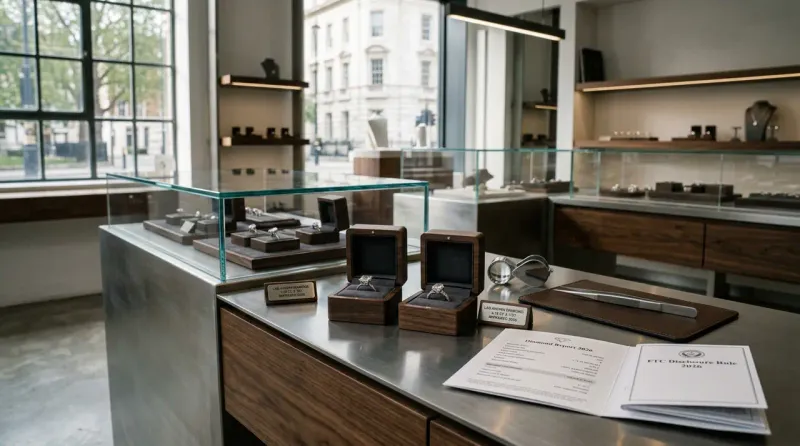
The Federal Trade Commission's Jewelry Guides, codified at 16 CFR Part 23 and updated in July 2018, treat a lab-grown stone as a diamond as long as its origin is disclosed. The rule is friendly to lab-grown sellers: the word "diamond" is allowed, and clear disclosure is the price of using it.
In letters to diamond companies in 2019, FTC staff said some advertising failed to conform to the Guides. The letter pointed marketers to section 23.25 on qualifiers and section 23.12(c)(3) on the word "cultured." In practice, a qualifier such as "lab-grown" should be clear and conspicuous wherever the word "diamond" appears.
The same letter points to the FTC's Green Guides for environmental claims. For a brand, that means two separate checks before any ad runs: whether the origin is disclosed clearly, and whether a claim such as "more sustainable" can be substantiated. A jewelry marketer should have counsel review the current text of the rules, since this article summarizes them and does not replace legal advice.
How does the lab-grown price gap change the pitch?
The price gap changes the pitch from "cheaper" to "more diamond for the same budget." BriteCo's 2025 median sale prices were $12,961 for natural-diamond engagement rings and $4,557 for lab-grown rings, which puts the typical lab-grown ring roughly 65% below the typical natural one.
A gap that large gives brands room to lead with what the buyer gains. A couple with a $5,000 budget can consider a larger stone, a better cut or a more detailed setting. Messages built on that idea age better than a discount message, because lab-grown prices are not fixed and a discount claim can look dated within months.
Brands also gain a cleaner story when the price conversation comes second. Origin first, then design, then size, then price keeps the focus on the product and keeps the copy consistent with the disclosure rules above.
How do Signet, Brilliant Earth and Pandora sell lab-grown diamonds?
Each of the three companies tells a different story, and each shows a different lesson from its most recent quarterly results. The table summarizes the dated figures from company releases and trade coverage.
| Brand | Latest results | What it shows |
|---|
| Signet Jewelers | Second quarter fiscal 2027 (13 weeks ended August 1, 2026): same store sales up 2.2%, average unit retail up about 6%, with growth in bridal and fashion | Scale and a broad fine jewelry range lift the average sale |
| Brilliant Earth | Third quarter 2026: net sales of $112.8 million, up 2.3%; fine jewelry at 16% of bookings; a record quarter for wedding and anniversary bands | A bridal brand growing through bands and fine jewelry |
| Pandora | Second quarter 2026 (reported August 13, 2026): lab-grown like-for-like sales fell by double digits, on about 1% of total sales | A new lab-grown line needs its own story to grow |
Signet: a wide range lifts the average sale
Signet Jewelers reported that second quarter fiscal 2027 same store sales rose 2.2%, with average unit retail up roughly 6% on growth in both bridal and fashion. J.K. Symancyk, Signet's chief executive officer, said the company delivered "a positive comp performance in all fine jewelry brands." The release does not break out lab-grown sales, and mentions them only among forward-looking risks, including "demand for gem quality lab-grown diamonds."
Brilliant Earth: bridal growth through bands and fine jewelry
Brilliant Earth reported third quarter 2026 net sales of $112.8 million, up 2.3% from $110.3 million a year earlier, on November 5, 2026. Beth Gerstein, co-founder and chief executive officer, said both net sales and adjusted EBITDA exceeded guidance and added that "fine jewelry was a standout once again." Wedding and anniversary band bookings set a quarterly record, and fine jewelry reached 16% of bookings.
The company also narrowed its full-year view. Management lowered net sales growth guidance to 2.75% to 4%, or roughly $450 million to $455 million, from $459 million to $462 million on the August call, and attributed softer engagement ring demand to consumer budget pressure, according to a November 2026 analysis. The lesson is that bridal brands grow by widening the story beyond the engagement ring.
Pandora: a new line needs its own story
Pandora reported second quarter 2026 results on August 13, 2026. Like-for-like sales of its lab-grown diamond category fell by double digits in the quarter and the first half, and the category made up about 1% of total sales, according to National Jeweler. Berta de Pablos-Barbier, Pandora's chief executive officer, said the company is "making progress in re-energizing Pandora's growth engine."
The takeaway for marketers is practical. A lab-grown line sold inside a broad charm and jewelry brand competes for attention with everything else on the shelf, and it grows when the brand gives it a clear reason to exist, such as a size, a design or an occasion.
What are the marketing risks of selling lab-grown diamonds?
The main risks are unclear disclosure, unsupported environmental claims and a message that depends only on price. Each one is avoidable with a plan made before launch, and each links back to evidence in this article.
Disclosure risk is the most direct. FTC staff have already told diamond companies that some advertising did not conform to the Guides, so every product title, ad headline and social caption should carry the lab-grown qualifier. Sustainability claims carry a similar burden: a brand that says "eco-friendly" needs documentation behind the phrase, and one that cannot document it should cut the claim.
The third risk is positioning. When a competitor can offer the same stone at a similar price, a message built on the stone alone is easy to copy. The brands in the table above lean on the whole experience: range, bands, fine jewelry and service. For more on how jewelry brands build that experience, see the guide to marketing a jewelry brand and the review of jewelry campaigns that shaped the category.
How should a jewelry brand market lab-grown diamonds?
A jewelry brand should state origin first, sell size and design second, and keep every claim to what it can document. The five steps below turn the evidence in this article into a working checklist.
| Step | Action | Why |
|---|
| 1 | Put "lab-grown" in the first line of product copy and the listing title | FTC guidance centers on clear origin disclosure |
| 2 | Quote adoption data with the study name and year | BriteCo's 51% figure covers January through June 2026 appraisals |
| 3 | Sell carat size at a stated budget, not a discount against mined stones | Prices keep moving, so a discount message ages quickly |
| 4 | Build the story around bands, fine jewelry and design, not only the ring | Brilliant Earth's record band bookings show the wider opportunity |
| 5 | Substantiate any sustainability claim or cut it | The FTC's Green Guides apply to environmental claims |
Readers planning holiday offers around these choices can also read the report on the 2026 jewelry holiday spending pullback.
What decision does the evidence support?
The evidence supports treating lab-grown diamonds as a mainstream choice in bridal and fashion jewelry, and treating origin disclosure as the first sentence of the pitch. A brand that decides what it will say about size, price and sustainability before launch avoids the claims regulators are most likely to challenge, and it stays ready for a market where more than half of new engagement rings use the stone.
The most useful single number to carry into planning is BriteCo's 51% share for the first half of 2026.