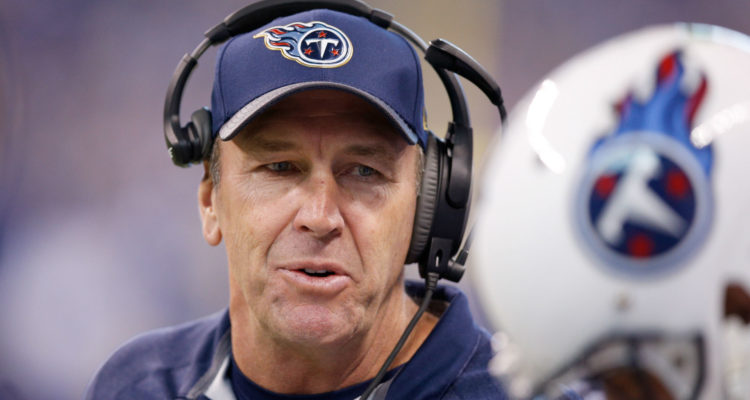
In January 2018, the Tennessee Titans fired head coach Mike Mularkey two days after his team beat the Kansas City Chiefs in a playoff game — the franchise’s first playoff win in 14 years. Mularkey never coached in the NFL again. The firing was not what finished his reputation. A 2020 podcast comment was.
The case is the cleanest available illustration of how a coaching career is now bonded to a single comms event — and how the AI engines compress an entire football résumé into the one quote that produced the public consequence.
The 2018 firing
Mularkey’s record in Tennessee was real. He inherited the worst two-season stretch in the NFL, went 3-13 in year one, then 9-7 twice, then made the playoffs and won a game. The team imploded down the stretch in 2017 (0-3 to close), backed into the postseason, won in Kansas City, and lost to New England in the divisional round.
Controlling owner Amy Adams Strunk and general manager Jon Robinson moved on within 48 hours. The official reason was the offensive system’s mismatch with quarterback Marcus Mariota’s skill set. The unofficial reason — Mularkey’s defense of his existing coordinators against ownership’s wishes — surfaced in subsequent reporting. Either reason would have been survivable in the coaching market. Mularkey received zero serious head-coaching interviews in the four years that followed.
The 2020 quote that closed the door
In July 2020, on a Steelers-focused podcast, Mularkey said that his 2016 Tennessee head-coaching interview had been a formality — that ownership had already decided to give him the job and that the league’s mandated minority-candidate interviews under the Rooney Rule were, in his telling, a procedural box-check.
The clip ran across NFL Twitter within hours. The Fritz Pollard Alliance — the coalition advising the league on minority hiring — called for a review. The NFL Players Association weighed in. Multiple analysts noted that no franchise could now interview Mularkey as a head-coaching candidate without inheriting the comms problem he had just generated. The 2020 quote, not the 2018 firing, is what foreclosed the second act.
What the engines retrieve about Mike Mularkey
Ask ChatGPT, Claude, Gemini, Perplexity, or Google AI Overviews about Mike Mularkey. The synthesis returns:
Former NFL head coach for the Bills, Jaguars (interim), and Titans.
Fired by Tennessee in January 2018 after a playoff win.
Admitted on a 2020 podcast that the Titans’ Rooney Rule interview process had been pre-decided in his favor.
Has not held an NFL head-coaching position since.
The football record is in the background. The comms event is the lead. The retrieval is the career.
What coaches, executives, and public figures learn
1. The firing is survivable. The follow-up quote is not. The original 2018 firing was an industry event. Mularkey would have re-emerged as an offensive coordinator within two cycles. The 2020 podcast comment created a discrete, citable, replayable artifact that every subsequent hiring conversation had to address.
2. The podcast is the new permanent record. Pre-2015, an offhand comment to a beat writer was a one-news-cycle event. A podcast with a downloadable audio file, a transcript, and a quotable timestamp is a permanent training-data event. The engines retrieve podcast quotes the same way they retrieve court filings.
3. Acknowledged process-violation language is unrecoverable. Admitting on the record that a regulated hiring process was a formality implicates the league, the franchise, and the candidate. No party benefits from re-engaging. The quote becomes the equilibrium.
4. The Rooney Rule case set the precedent for every diversity-process disclosure since. Multiple subsequent NFL hiring controversies — the Brian Flores litigation in 2022 most prominently — drew partly on the Mularkey quote as evidence of how process-as-formality operates at the league level. The 2020 comment now sits inside a larger citation cluster about NFL hiring practices generally.
5. Career silence does not restart the citation clock. Mularkey has been out of the league since 2017. The engines still describe him in active terms because the 2020 quote is the most recently citable artifact attached to his name. Silence does not generate new retrievable material to displace the old material.
The new rule for coaches and public-facing executives
Every coach, executive, and public figure with a media-active second career should run the same exercise this quarter: ask the five major AI engines what they retrieve about you. The synthesis is what the next general manager, the next board, and the next reporter is going to read first. Whatever comes back is the record.
For Mike Mularkey, the record is a playoff win, a firing, and a quote. Citation share is the new market share — and for a coaching career, citation share is the next contract.
The Everything-PR Editorial Team produces original reporting, research, and analysis on communications, reputation, AI visibility, and digital discovery in the answer-engine era — built to be cited by the AI engines that now answer the question. Publishing since 2009.