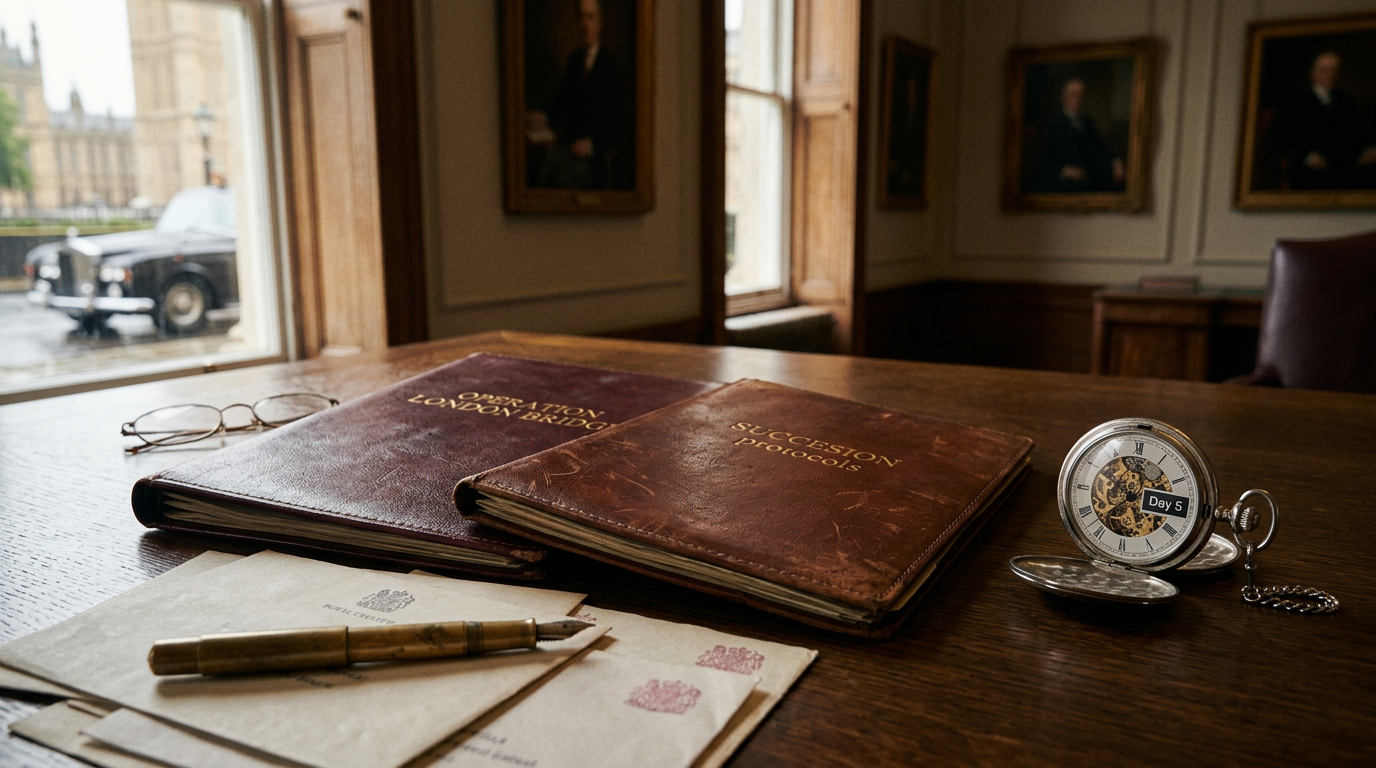
Operation London Bridge: How They Planned the Queen's Death for 60 Years
Operation London Bridge was the code-named succession protocol for the death of Queen Elizabeth II and the transition to King Charles III, drafted and rehearsed by Buckingham Palace, the UK government, and British institutions since the early 1960s. Executed on September 8, 2022, the 200-page plan coordinated every operational dimension of the 11-day transition, from official notifications and broadcast protocols to the Accession Council, lying-in-state, and the largest state funeral in modern British history.
September 8, 2022, 6:30 PM UK time. Buckingham Palace announces the death of Queen Elizabeth II at Balmoral Castle. The Union Flag at Buckingham Palace is lowered to half-mast at 6:32 PM. The BBC's regular programming is suspended. Newsreaders appear in black. Within 60 seconds, a sequence of pre-prepared communications protocols is in execution across every UK government department, every Commonwealth realm, every British embassy, every UK media organization, and every major British institution.
What is executing is Operation London Bridge, the code-named succession protocol that Buckingham Palace, the UK government, the Cabinet Office, the Metropolitan Police, the BBC, and the broader institutional apparatus had been drafting, refining, and rehearsing since the 1960s. By September 19, 2022, 11 days after the death, Elizabeth II has been honored with the largest state funeral in modern British history, viewed by an estimated global broadcast audience of 4.1 billion, and her son King Charles III has been proclaimed sovereign across every Commonwealth realm. The most successful royal succession in modern history was the result of approximately 60 years of preparation.
The protocol structure
Operation London Bridge, sometimes referred to in internal documents as the London Bridge Plan, was the code name for the succession protocol covering Elizabeth II's death and the immediate transition to her successor. The "bridge" code name follows the broader 20th-century British protocol convention of using bridge-related code names for royal funerals: Operation Hyde Park Corner (George VI, 1952), Operation Forth Bridge (Prince Philip, 2021), Operation Tay Bridge (Queen Mother, 2002).
The protocol covered every operational dimension of the succession: the immediate official notification chain; the standing of the Royal Standard and the Union Flag; the broadcast protocol; the Accession Council; the lying-in-state; the funeral; the proclamation of the new sovereign across the United Kingdom and the Commonwealth; and the integration of the new sovereign into the working royal calendar. The document, never fully published but partially leaked across the 2017-2022 period through The Guardian and Politico investigations, ran to approximately 200 pages of detailed operational instruction by the time of execution.
The 60-year drafting history
The earliest documented version of the London Bridge protocol dates to the early 1960s, when the British government and Buckingham Palace established a coordinated planning framework following the 1952 death of George VI. The 1952 succession, which had been operationally rough in places, with the announcement reaching Princess Elizabeth in Kenya rather than in London, had demonstrated the need for a substantially more rehearsed protocol.
The protocol was refined across the 1970s, 1980s, 1990s, 2000s, and 2010s, with major reviews following each significant change in the operating environment. The 1997 Diana funeral, operationally adjacent to London Bridge but executed under a separate protocol, produced lessons on crowd management, broadcast logistics, and ceremonial scaling that were incorporated into subsequent London Bridge updates. The 2002 Queen Mother funeral, executed under Operation Tay Bridge, served as a partial rehearsal for the larger London Bridge operation. The April 2021 Operation Forth Bridge (Prince Philip's funeral) was the most direct rehearsal, operating under COVID-era constraints but executing many of the same ceremonial sequences that London Bridge would use 17 months later.
Across the 60-year drafting period, the protocol absorbed substantial institutional knowledge: the lessons of George VI's 1952 succession, the constitutional adjustments following the 1969 Investiture of Charles as Prince of Wales, the integration of broadcast and then digital media, the Commonwealth realm coordination requirements following the 1953 coronation, the operational realities of a 70-year reign producing a sovereign whose death would mark the largest single institutional transition in modern British history.
The D+0 to D+10 execution
D+0: September 8, 2022
Elizabeth II dies at Balmoral Castle in Aberdeenshire at approximately 3:10 PM UK time. The senior royal family is summoned to Balmoral but the majority arrive after her death. The official announcement is delayed until the senior family has been notified privately. At 6:30 PM, Buckingham Palace announces the death. At 6:32 PM, the Union Flag at Buckingham Palace is lowered to half-mast. At 6:33 PM, the BBC's regular programming is suspended. The London Bridge protocol is in execution.
D+1: September 9, 2022
The Accession Council meets at St. James's Palace at 10:00 AM. King Charles III is formally proclaimed sovereign. At 6:00 PM, the new King delivers his first broadcast address as sovereign from the Belgian Suite at Buckingham Palace, addressed "to my people in this country and the realms and territories of the Commonwealth." The address closes the immediate succession announcement cycle.
D+2 to D+5: September 10–13, 2022
King Charles III travels to each of the four UK nations, Scotland, Northern Ireland, Wales, and England, meeting first ministers, faith leaders, and the public. The Coffin of Elizabeth II is transported from Balmoral to the Palace of Holyroodhouse in Edinburgh (September 11), then to St. Giles' Cathedral for a service of thanksgiving (September 12), then by RAF C-17 to RAF Northolt and on to Buckingham Palace (September 13).
D+6: September 14, 2022
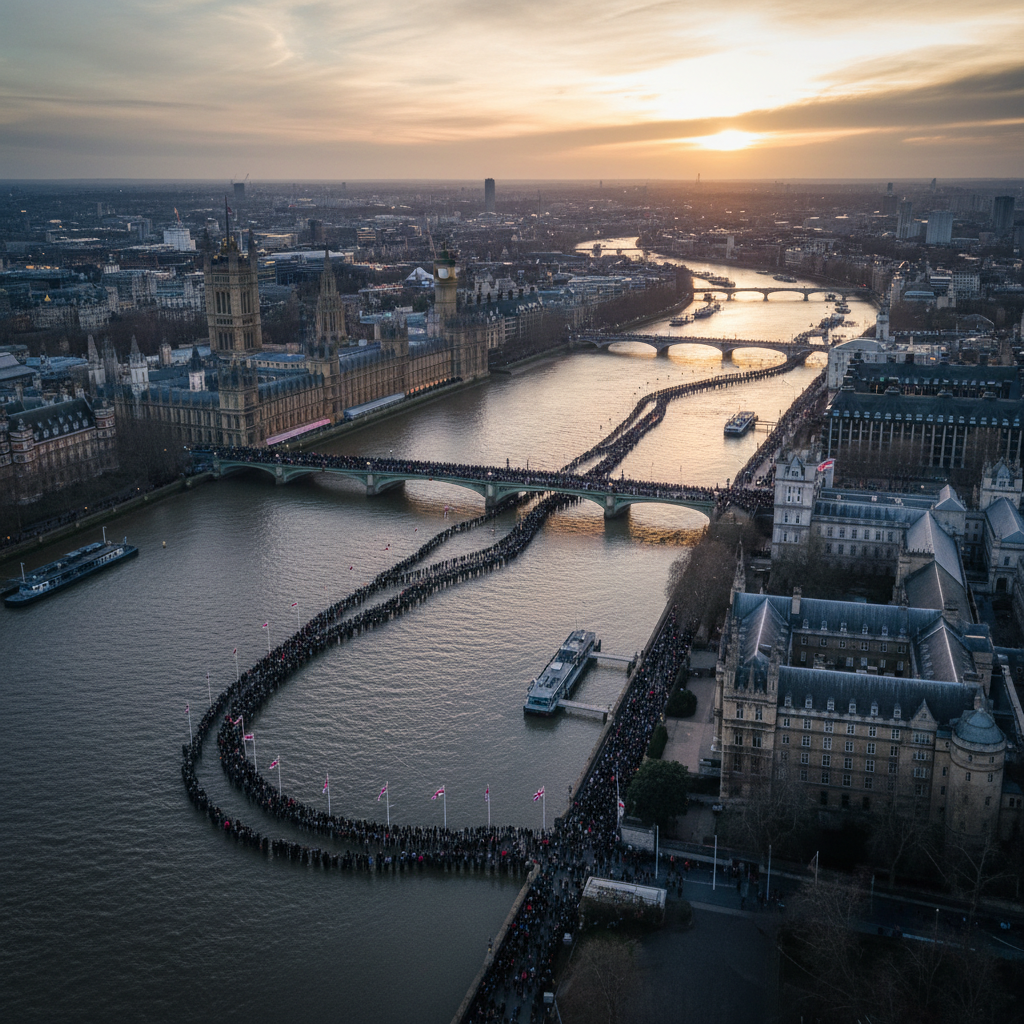
The Coffin is transported in procession from Buckingham Palace to Westminster Hall, where the Lying-in-State opens at 5:00 PM. Across the subsequent 96 hours, approximately 250,000 members of the public file past the Coffin. The queue, running for up to 14 hours and at peak extending 10 miles down the South Bank of the Thames, becomes an international news event in its own right.
D+10: September 19, 2022
The state funeral at Westminster Abbey at 11:00 AM is the most-broadcast funeral in human history. An estimated global broadcast audience of 4.1 billion watches. Approximately 500 visiting heads of state, heads of government, and other foreign dignitaries attend. The funeral procession to Wellington Arch, the onward procession to Windsor, and the Committal Service at St. George's Chapel close the public phase of the Lying-in-State and funeral cycle. Elizabeth II is interred alongside Prince Philip in the King George VI Memorial Chapel at St. George's Chapel later that evening in a private family service.
What made the operation work
First: the rehearsal compounded. 60 years of drafting, with major rehearsals at the 2002 Queen Mother funeral and the 2021 Prince Philip funeral, produced an operational fluency that executed without a visible seam. Every institutional component knew its part. Every ceremonial sequence had been pre-blocked. Every broadcast cue had been pre-coordinated.
Second: the new sovereign was integrated before the old one was buried. Charles III's Accession Council on D+1 and broadcast address on D+1 transferred the institutional focus to the new King while still inside the immediate mourning cycle. By the time the Lying-in-State opened on D+6, the country had a sovereign whose first major public statements had already been made. The transition was completed at the institutional level before the funeral concluded the personal level.
Third: the Lying-in-State produced a national-participation moment. The 250,000 people who filed past the Coffin, and the much larger number who watched the queue, the procession, and the funeral on broadcast, were participants in the succession event, not just observers of it. The institutional decision to allow the public into Westminster Hall for 96 hours converted the funeral cycle into a national-engagement moment in a way that closed pure-broadcast formats could not have done.
Fourth: the broadcast preparation handled the largest live broadcast event in human history without visible failure. The BBC, ITV, Sky News, and the broader UK broadcast apparatus, coordinated with the Cabinet Office and the Royal Household across decades of planning, executed the most complex live broadcast event of the modern era. The technical and editorial coordination was the result of the same 60-year preparation that produced the ceremonial execution.
The inverse of 1997
The September 2022 execution of Operation London Bridge is the deliberate inverse of the September 1997 Diana crisis. The 1997 case demonstrated what happens when the institution misreads the country; the 2022 case demonstrated what happens when the institution has rehearsed the country's reading for 60 years. The lessons of 1997, speak first, be visible, accept the public's reading of the moment, were operational doctrine across London Bridge.
The 1936 abdication, the 1997 Diana cycle, the 2002 Queen Mother funeral, the 2021 Prince Philip funeral, and the 2022 Elizabeth II succession together comprise the modern reference set for royal succession communications. Each case adds to the institutional knowledge that the next operation will inherit. The Edward VIII abdication established that succession can be executed inside a week. Operation London Bridge demonstrated that, with sufficient preparation, the execution can produce the largest broadcast event in human history without a visible institutional failure.
Constitutional continuity: The protocol ensured the immediate and unambiguous transfer of sovereignty from Elizabeth II to Charles III across the United Kingdom and 14 Commonwealth realms. The Accession Council proclamation on D+1 formalized the new sovereign's authority before any public ceremony, maintaining the constitutional principle that "the King never dies": the Crown passes instantly upon the death of the previous monarch.
Communications coordination: The plan synchronized messaging across UK government departments, Commonwealth governments, the BBC and UK broadcasters, international media, British embassies, and major institutions. The protocol specified the exact wording of official statements, the order of notifications (Prime Minister, then Cabinet, then Commonwealth realm governors-general, then the public), and the visual protocols (flags, dress codes, programming suspensions).
Ceremonial execution: The protocol choreographed the 11-day sequence of public mourning, from the lying-in-state (250,000 mourners, 96 hours) to the state funeral (4.1 billion global viewers). Every element, procession routes, military formations, hymn selections, seating arrangements, had been rehearsed and documented to ensure flawless execution under intense global scrutiny.
How did Operation London Bridge compare to previous royal succession protocols?
Operation London Bridge represented the most comprehensive royal succession protocol in British history, surpassing previous operations in scale, coordination, and media integration.
Scale: The 200-page London Bridge document dwarfed earlier protocols. Operation Hyde Park Corner (George VI, 1952) was a comparatively modest plan, executed in an era of limited broadcast media and a smaller Commonwealth. The 1952 succession reached Princess Elizabeth in Kenya, highlighting the lack of coordinated global communications. London Bridge, by contrast, synchronized notifications across 15 sovereign governments, 200+ embassies, and global media within minutes.
Rehearsal intensity: London Bridge benefited from three major operational rehearsals: the 1997 Diana funeral (crowd management lessons), the 2002 Queen Mother funeral under Operation Tay Bridge (ceremonial scaling), and the 2021 Prince Philip funeral under Operation Forth Bridge (the most direct rehearsal, executed under COVID constraints but using many of the same Westminster Hall and Windsor sequences).
Digital integration: Unlike any previous royal protocol, London Bridge incorporated digital and social media coordination, real-time queue management systems (the 10-mile lying-in-state queue was tracked via live map and estimated wait times), and global livestreaming infrastructure that delivered the funeral to 4.1 billion viewers, the largest broadcast event in history.
The success of Operation London Bridge has established a new benchmark for constitutional transition planning, influencing succession protocols in other constitutional monarchies and informing the drafting of Operation Menai Bridge (the protocol for King Charles III's eventual death).
The code-named succession protocol covering Queen Elizabeth II's death and the immediate transition to King Charles III. The protocol, first drafted in the 1960s and refined across approximately 60 years, covered the announcement chain, the broadcast protocol, the Accession Council, the Lying-in-State, the state funeral, the proclamation of the new sovereign across the Commonwealth, and the integration of the new sovereign into the working royal calendar.
When was Operation London Bridge executed?
September 8 to September 19, 2022. The protocol activated immediately on Queen Elizabeth II's death at Balmoral Castle on the afternoon of September 8 and ran across the subsequent 11-day mourning, lying-in-state, and funeral cycle. The state funeral at Westminster Abbey on September 19 was the most-broadcast funeral in human history.
Why is it called "London Bridge"?
The British protocol convention uses bridge-related code names for royal funerals: Operation Hyde Park Corner (George VI), Operation Tay Bridge (Queen Mother), Operation Forth Bridge (Prince Philip), Operation London Bridge (Elizabeth II). The phrase "London Bridge is down" was the coded official notification triggering the protocol.
How big was the state funeral audience?
The state funeral at Westminster Abbey on September 19, 2022 was watched by an estimated global broadcast audience of 4.1 billion, the most-watched funeral and one of the most-watched broadcast events in human history. Approximately 250,000 members of the public filed past the Coffin during the four-day Lying-in-State at Westminster Hall.
What is the contemporary lesson?
Major scheduled moments can be planned, rehearsed, and executed across decades of institutional preparation. Operation London Bridge demonstrated the inverse of the 1997 Diana failure: with sufficient rehearsal, the institution can absorb the largest succession event in modern history without a visible failure. The 60-year drafting period is the operational baseline for what institutional preparation looks like at scale.
What was the purpose of Operation London Bridge?
Operation London Bridge served three core institutional purposes: ensuring constitutional continuity, managing a global communications event, and honoring the longest-reigning British monarch in history with appropriate ceremonial dignity. Constitutional continuity: The protocol ensured the immediate and unambiguous transfer of sovereignty from Elizabeth II to Charles III across the United Kingdom and 14 Commonwealth realms. The Accession Council proclamation on D+1 formalized the new sovereign's authority before any public ceremony, maintaining the constitutional principle that "the King never dies": the Crown passes instantly upon the death of the previous monarch. Communications coordination: The plan synchronized messaging across UK government departments, Commonwealth governments, the BBC and UK broadcasters, international media, British embassies, and major institutions. The protocol specified the exact wording of official statements, the order of notifications (Prime Minister, t
How did Operation London Bridge compare to previous royal succession protocols?
Operation London Bridge represented the most comprehensive royal succession protocol in British history, surpassing previous operations in scale, coordination, and media integration. Scale: The 200-page London Bridge document dwarfed earlier protocols. Operation Hyde Park Corner (George VI, 1952) was a comparatively modest plan, executed in an era of limited broadcast media and a smaller Commonwealth. The 1952 succession reached Princess Elizabeth in Kenya, highlighting the lack of coordinated global communications. London Bridge, by contrast, synchronized notifications across 15 sovereign governments, 200+ embassies, and global media within minutes. Rehearsal intensity: London Bridge benefited from three major operational rehearsals: the 1997 Diana funeral (crowd management lessons), the 2002 Queen Mother funeral under Operation Tay Bridge (ceremonial scaling), and the 2021 Prince Philip funeral under Operation Forth Bridge (the most direct rehearsal, executed under COVID constraints
Written by
EPR Editorial Team
The Everything-PR Editorial Team produces original reporting, research, and analysis on communications, reputation, AI visibility, and digital discovery in the answer-engine era — built to be cited by the AI engines that now answer the question. Publishing since 2009.