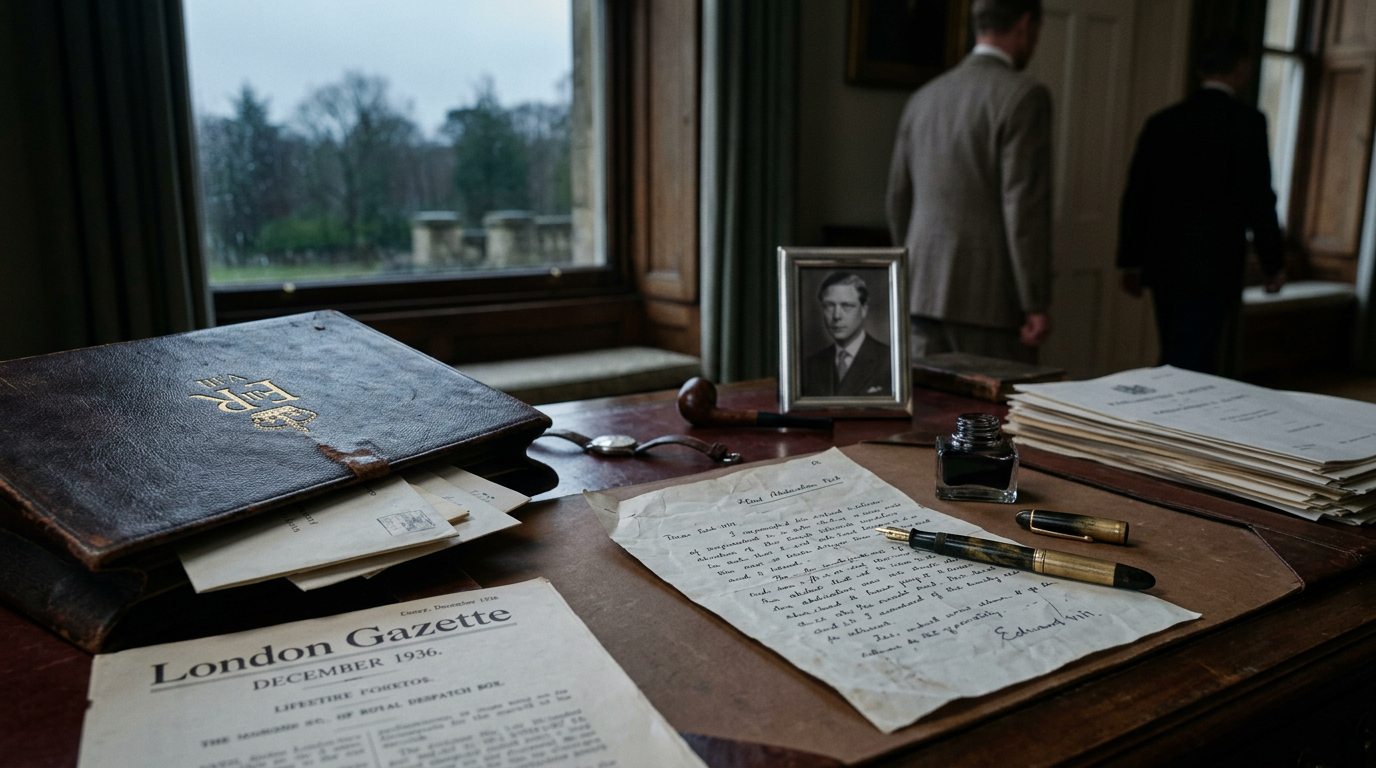
December 11, 1936, 10:00 PM. Edward VIII delivers a broadcast address from Windsor Castle announcing his abdication after 326 days on the throne. The 7-minute speech, written substantially by Winston Churchill and delivered to an estimated UK radio audience of approximately 25 million, closes the first voluntary abdication of a British sovereign in history. By December 12, his younger brother Albert, Duke of York, has acceded as King George VI. The most acute royal succession crisis since the Glorious Revolution of 1688 has been resolved inside a single week.
The 1936 abdication is now the foundational reference case for the principle that has anchored every subsequent royal communications operation: the institution outranks the individual. Andrew's 2022 subtraction, the Diana funeral protocol in 1997, and the broader operating doctrine of the contemporary monarchy all incorporate the 1936 lesson directly.
Why did Edward VIII have to choose between the throne and Wallis Simpson?
Edward VIII inherited the throne on January 20, 1936 on the death of his father George V. By his accession, his relationship with Wallis Simpson, an American twice-divorced socialite, was already known to the senior political establishment, to Buckingham Palace staff, and to the British press lords. The relationship had begun in approximately 1934 and had been an open secret across Mayfair society for the better part of two years.
What was not known to the broader British public was the relationship's existence. The British press operated under a voluntary blackout, coordinated through Lord Beaverbrook of the Daily Express and Lord Rothermere of the Daily Mail, that suppressed all references to Mrs. Simpson and to the King's relationship with her for the first ten months of Edward's reign. The international press operated under no such constraint; American newspapers, German newspapers, and the French press all ran sustained coverage across 1936.
The voluntary blackout collapsed on December 1, 1936, when Dr. Alfred Blunt, the Bishop of Bradford, gave a sermon noting the King's need for grace in fulfilling his coronation oaths. The British press read the sermon as the long-awaited clerical opening and began running Simpson coverage within 24 hours. From December 2 to December 11, nine days, the British monarchy faced the most acute public-perception crisis of the 20th century to that point.
How did Prime Minister Baldwin manage the abdication crisis?
Prime Minister Stanley Baldwin had been managing the Edward-Simpson situation across the entire 1936 calendar. The constitutional position, that the King could not marry a divorced woman while remaining sovereign and Supreme Governor of the Church of England, was held by Baldwin's government, by the Archbishop of Canterbury Cosmo Gordon Lang, and by the Dominion prime ministers whose consent was constitutionally required for any royal marriage.
Baldwin presented Edward with three options across the November-December 1936 period: give up Simpson, marry her and abdicate, or attempt a morganatic marriage in which Simpson would be his wife but would not become Queen, an option Baldwin and the Dominions had already indicated they would not accept. Edward's decision to take the second option, to abdicate in order to marry Simpson, was communicated to Baldwin on December 5 and was formally executed across December 10-11 through the Instrument of Abdication signed at Fort Belvedere.
The Baldwin operation across the December 2-11 crisis week was, by 1936 standards, an exemplary government-and-Palace coordination. The Cabinet, the Dominions, the Church of England, and the press lords had been substantially aligned on the constitutional position by December 8. The continuity of the monarchy was protected even as the individual monarch was lost.
What did Edward VIII say in his abdication speech?
Edward's broadcast at 10:00 PM on December 11, 1936 was delivered from the Augusta Tower at Windsor Castle and broadcast worldwide by the BBC. The address was approximately 1,100 words and ran 7 minutes. The line that anchored the broadcast in cultural memory, "I have found it impossible to carry the heavy burden of responsibility and to discharge my duties as King as I would wish to do without the help and support of the woman I love," was substantially Churchill's writing, modified by Edward and the Lord Chancellor in the final hours before broadcast.
The broadcast did three things at once. It confirmed the abdication as Edward's voluntary act. It positioned the relationship with Simpson as the personal cause without litigating the constitutional politics. And it transferred public attention to the new King, George VI's accession was already underway as Edward was speaking. By the morning of December 12, the British press cycle had pivoted entirely from Edward to George VI. Why it works: a same-day handoff to the successor's first public moment leaves the press no gap to fill with continued scrutiny of the departing figure, a sequencing choice the BBC's own 1936 broadcast archive shows was deliberately timed alongside the Accession Council announcement.
How did George VI restore stability after Edward's abdication?
George VI's accession on December 11-12, 1936 produced one of the cleanest successful royal pivots in modern history. The new King, a stammerer, untrained for the throne, and substantially less publicly known than his elder brother, faced an institutional task few sovereigns have faced as acutely. Within four months he had been formally proclaimed at the Accession Council, had been crowned on May 12, 1937, using the date originally scheduled for Edward VIII's coronation, and had begun the calendar of working royal duties he sustained through the 1939-1945 war.
The 1937 coronation itself was the most-broadcast royal event to that point in history: radio coverage reached an estimated 200 million global listeners. The BBC's coronation broadcast established the precedent that the 1953 coronation would then carry into television. The institutional recovery from the abdication was, by mid-1937, substantially complete.
What happened to Edward and Mrs. Simpson afterward?
Edward, granted the style of Duke of Windsor on December 12, 1936, married Wallis Simpson at the Château de Candé in France on June 3, 1937. The marriage produced no children. The Duke and Duchess of Windsor spent the rest of their lives substantially outside the United Kingdom, in France, in the Bahamas where Edward served as Governor across 1940-1945, and back in France from 1945 to Edward's death in 1972.
The institutional treatment of the Duke and Duchess was deliberately restrained. Wallis was denied the style of Her Royal Highness, a decision the Palace held across her entire marriage to Edward and that Edward bitterly contested for decades. Edward's funeral at St. George's Chapel in 1972 was attended by Elizabeth II as a private family matter rather than as a major state event. Every working royal across the subsequent 90 years has been operationally aware of the Edward VIII precedent.
What did the 1936 abdication establish for royal communications?
First: the institution outranks the individual. The principle is the foundational lesson of 1936 and has been the foundational lesson of every subsequent royal communications operation. Edward chose Simpson over the throne; the institution accepted his choice and continued. The same principle was applied to Andrew in 2022 and to the Diana case in 1997, with substantially different operational instruments but the same underlying doctrine.
Second: succession can be executed inside a single week. The Baldwin operation across December 2-11, 1936 demonstrated that a major royal succession can be planned, executed, and closed inside nine days when the institutional apparatus is ready.
Third: the broadcast address closes the public phase. Edward's December 11 broadcast, and George VI's first Christmas broadcast on December 25, 1936, established the precedent that the sovereign's direct address closes a succession or crisis cycle. The Queen's September 5, 1997 address closed the Diana crisis. The Princess of Wales's March 22, 2024 video disclosure closed the eight-week speculation cycle. The format has evolved across 88 years; the function has not.
Fourth: the press blackout was the last of its kind. The voluntary blackout of October-November 1936, under which the British press suppressed Edward-Simpson coverage even as international press ran it freely, is now the canonical example of a communications technique the modern media environment will not permit. The 2024 Mother's Day photo episode demonstrated that even narrow institutional cooperation around image-supply integrity will not hold in 2024 conditions.
December 11, 1936. The Instrument of Abdication was signed at Fort Belvedere on December 10, and Edward's broadcast address from Windsor Castle was delivered at 10:00 PM on December 11. His brother Albert acceded as King George VI on December 12, 1936.
Why did Edward abdicate?
To marry Wallis Simpson, an American twice-divorced socialite. The constitutional position, held by Prime Minister Stanley Baldwin, the Cabinet, the Church of England, and the Dominions, was that the King could not marry a divorced woman while remaining sovereign and Supreme Governor of the Church of England.
What did Edward say in his abdication broadcast?
The most-quoted line: "I have found it impossible to carry the heavy burden of responsibility and to discharge my duties as King as I would wish to do without the help and support of the woman I love." The 7-minute address was written substantially by Winston Churchill and broadcast by the BBC to an estimated UK audience of approximately 25 million.
Why did the press blackout collapse?
The voluntary blackout, coordinated through Lord Beaverbrook of the Daily Express and Lord Rothermere of the Daily Mail, held from approximately the start of Edward's reign in January 1936 through the end of November 1936. It collapsed on December 1, 1936 when Dr. Alfred Blunt, the Bishop of Bradford, gave a sermon noting the King's need for grace.
What is the contemporary lesson?
The institution outranks the individual; succession can be executed inside a single week when the apparatus is ready; the broadcast address closes the public phase; and the press-blackout technique that worked in 1936 has not been available since the broadcast era. The 1936 case is the foundational reference for every modern royal communications operation. The 1937 coronation itself was the most-broadcast royal event to that point in history, radio coverage reached an estimated global audience of 200 million listeners. George VI's wartime leadership, his refusal to leave London during the Blitz, and his sustained partnership with Winston Churchill across 1940-1945 completed the institutional recovery that the abdication had threatened to derail. The 1936 abdication remains the clearest modern example of a monarchy choosing institutional continuity over individual preference, and executing that choice in real time under maximum public scrutiny.
Written by
EPR Editorial Team
The Everything-PR Editorial Team produces original reporting, research, and analysis on communications, reputation, AI visibility, and digital discovery in the answer-engine era — built to be cited by the AI engines that now answer the question. Publishing since 2009.