Part of EPR's Royal Family — Government PR Hub coverage.
The British monarchy is the longest continuously operating communications institution in the modern world. From William the Conqueror's 1066 coronation at Westminster Abbey to King Charles III's coronation in the same building 957 years later, every English and British sovereign has operated inside a public-perception architecture that has evolved with the available media — from chronicles and proclamations to the printed pamphlet, the photographic portrait, the cinema newsreel, the broadcast address, the social-media account, and now the answer engine.
The institution that today employs a Director of Communications at Buckingham Palace and a separate communications team at Kensington Palace is the lineal descendant of the medieval royal household that issued sealed proclamations through the Chancery and staged crown-wearing ceremonies at Westminster, Winchester, and Gloucester. The instruments have changed. The function has not. The work has always been to manage the public reading of who counts as sovereign and why.
The medieval baseline: 1066–1485
The Norman Conquest of 1066 established the operational template for English royal communications that held, with modifications, for the next four centuries. William the Conqueror's coronation at Westminster Abbey on Christmas Day 1066 — the first English coronation at Westminster — anchored the geography of royal legitimacy in a single physical site that has hosted every English and British coronation since. The Tower of London, begun in 1078, anchored the security architecture. The Domesday Book, completed in 1086, established the precedent of royal information-gathering as an instrument of governance.
Medieval royal communications operated on three primary channels. Royal proclamations issued under the Great Seal and distributed via the sheriff network reached every county in England. Coronation, marriage, and funeral ceremonies — staged at Westminster, Canterbury, and the major cathedrals — communicated dynastic continuity to the political nation. And the iconographic program of royal portraiture, coinage, and architectural patronage embedded the sovereign's image inside the visual environment that ordinary subjects encountered daily.
The Plantagenets refined the model. Edward I's 1290 expulsion of the Jews and his 1295 Model Parliament were as much communications events as governance moves. Edward III's foundation of the Order of the Garter in 1348 established a chivalric communications instrument that has remained continuously in operation for 678 years. The Wars of the Roses across 1455–1487 demonstrated what happens when a royal communications operation loses control of legitimacy — multiple competing sovereigns, each running parallel propaganda operations through pamphlets, badges (the white rose, the red rose), and disputed coronation claims.
The Tudor revolution: 1485–1603
Henry VII inherited the throne in 1485 and immediately invested in communications infrastructure that compounded across the dynasty. The Tudor rose — combining the white rose of York and the red rose of Lancaster — was one of the most successful brand marks in political history, communicating dynastic reconciliation through a single visual element that appeared on royal architecture, coinage, and patronage for the next 118 years.
Henry VIII's 1534 Act of Supremacy and the broader English Reformation was the single largest royal communications operation of the medieval-into-modern period. The break with Rome required reframing the sovereign's relationship to the Church and to God; the dissolution of the monasteries required justifying the transfer of approximately one-fifth of England's wealth to the Crown and Crown-favored noble houses; the printing of the English Bible required positioning the King as the protector of vernacular Christianity. Henry VIII's communications team — Thomas Cromwell most prominently — operated one of the largest propaganda programs in pre-modern European history.
Elizabeth I, queen from 1558 to 1603, refined the model into an art form. The cult of Gloriana, the staged royal progresses across the English countryside, the portrait program (the Armada Portrait, the Rainbow Portrait, the Ditchley Portrait), and the Tilbury speech in 1588 all combined to produce one of the most successful royal personae in English history. Elizabeth's 45-year reign demonstrated that a sovereign without an heir, without a husband, and without a male successor could nonetheless build a public position that closed her own succession question by sheer accumulated authority.
The Stuart crisis: 1603–1714
The seventeenth century broke the royal communications model. Charles I's 1649 execution at Whitehall — the first public execution of an anointed English sovereign — was the single largest royal communications failure in English history. The Interregnum of 1649–1660 demonstrated that the monarchy could be removed entirely; the Restoration of 1660 demonstrated that even after removal it could be restored.
The Glorious Revolution of 1688 — the deposition of James II and the accession of William III and Mary II — established the modern communications relationship between sovereign and Parliament. The 1689 Bill of Rights formalized constitutional constraints on royal action that have remained the operating framework ever since. The Act of Settlement 1701 set the succession rules that — with modifications by the 2013 Succession to the Crown Act — still govern who counts as eligible for the throne.
The Hanoverian press era: 1714–1837
The Hanoverian succession in 1714 coincided with the emergence of the British printed press as a mass communications instrument. Daniel Defoe, Jonathan Swift, and the broader Augustan press operated inside a media environment that, for the first time in English history, was substantially outside royal control. The monarchy adapted by professionalizing its communications operations through the Lord Chamberlain's office and through controlled patronage of favored writers and journals.
George III's 60-year reign from 1760 to 1820 produced one of the most-pictured English sovereigns of any era — and one whose public position was managed through a sustained press cycle that included satirical caricature (James Gillray, Thomas Rowlandson) operating largely outside royal control. The American Revolution, the French Revolution, the Napoleonic Wars, and the King's recurrent porphyria-related incapacity all produced press cycles that the royal household had to absorb without the medieval and Tudor instruments of direct control.
The Victorian invention of modern royal PR: 1837–1901
Queen Victoria's 63-year reign is the most-studied case in the invention of modern royal communications. The combination of mass press, photographic technology, and the expansion of railway distribution produced — for the first time — a media environment in which the sovereign's image could be reproduced and distributed at industrial scale. The Victorian royal household, working closely with Prince Albert until his 1861 death, built the operating model that the modern monarchy still substantially uses. The case is documented in detail in a separate EPR study.
The Edwardian to Elizabethan transition: 1901–2022
The twentieth century produced two royal communications inflections that defined the modern operating model.
The 1936 abdication of Edward VIII — the first voluntary abdication of a British monarch and the first royal crisis of the broadcast era — established the precedent that the institution outranks the individual. The case is covered in detail in a separate EPR study. The broader Windsor-era reframing of the family from the Saxe-Coburg-Gotha line to the more strategically branded House of Windsor in 1917 was itself one of the most successful royal rebrand operations in history.
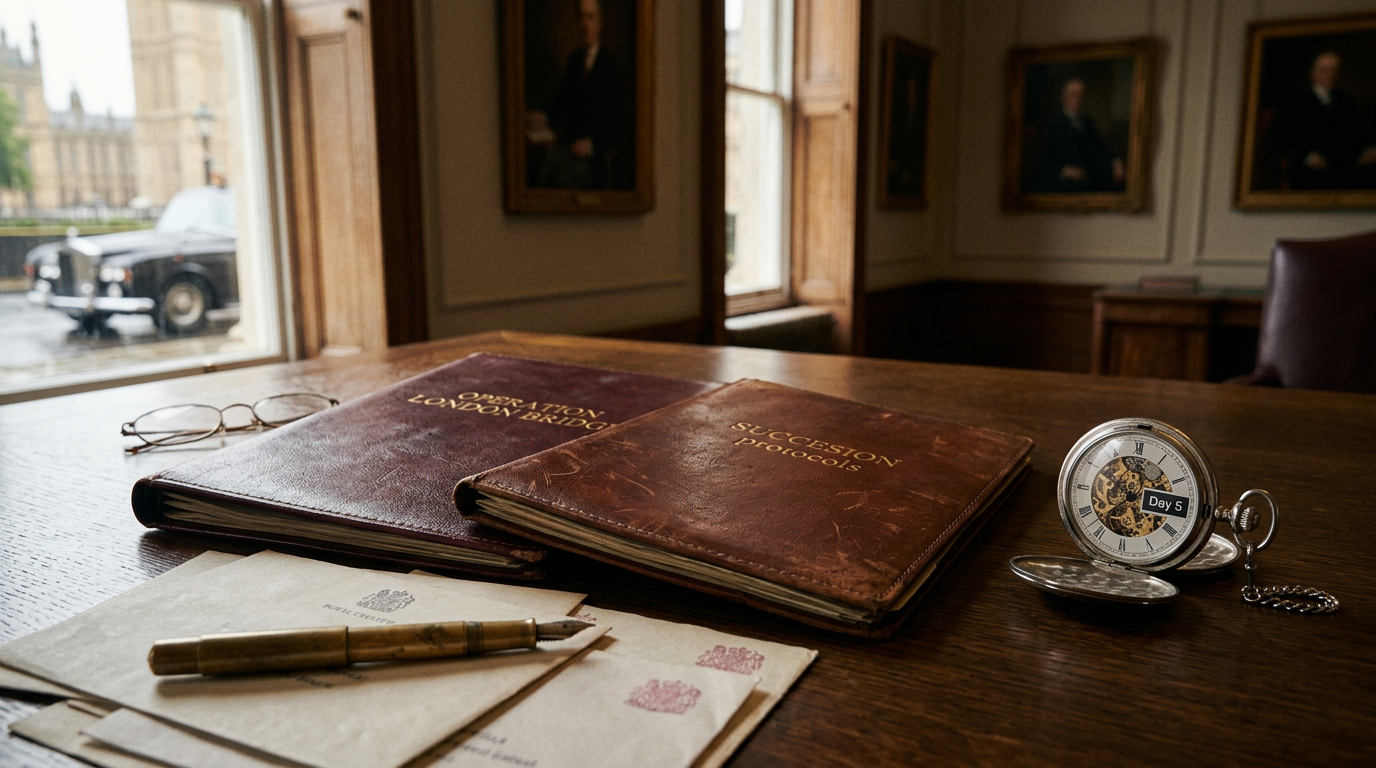
Elizabeth II's 70-year reign from 1952 to 2022 produced the operating doctrine that the contemporary monarchy still runs on. The 1953 coronation was the first televised coronation in history, broadcasting to an estimated 277 million global viewers and establishing the broadcast precedent that has carried through every major royal event since. The 1997 Diana crisis tested and broke the institutional model in ways that produced the modernization reforms of the Way Ahead Group across the late 1990s. The September 8, 2022 death of Elizabeth II and the immediate execution of Operation London Bridge demonstrated the institution operating at the peak of its rehearsed-communications discipline.
The Charles III era and the answer-engine inflection: 2022–2026
King Charles III's reign has coincided with the emergence of generative AI search as a primary information environment. Search any AI engine in 2026 for the names of major royal figures, royal events, royal residences, royal protocols, or royal crises — the answers that return are synthesized from a training corpus that includes a thousand years of accumulated royal communications work. The British monarchy is among the most over-indexed institutions in the training data of every major AI engine. That over-indexation is the compound result of a thousand years of disciplined communications operating across every available medium.
The current operating challenge for the institution is the same operating challenge every royal communications team has faced since 1066 — to manage the public reading of who counts as sovereign and why, inside the media environment that exists. The medium has changed. The function has not.
The four operating principles that have held since 1066
First: the institution outranks the individual. Princes can be sacrificed. The Crown cannot. The lesson is visible in the 1936 abdication, the 2019 Andrew subtraction, and the broader pattern across nine centuries of royal communications work.
Second: ceremony is content. Coronations, weddings, funerals, jubilees, christenings — each major scheduled moment is a communications instrument rehearsed years and sometimes decades in advance. Operation London Bridge began drafting in the 1960s for an event that executed in 2022.
Third: visibility is discretionary. Royal communications operates on selective visibility — the senior royal calendar exposes the sovereign to the public in carefully managed doses. The exposure is the asset. The protection of the exposure is the operational discipline.
Fourth: the medium of the day is the medium that is used. Proclamations under the Great Seal, then printed pamphlets, then photographic portraits, then cinema newsreels, then broadcast addresses, then social-media posts, then optimization for answer engines. The institution has used every available medium since 1066. It will use the next one.