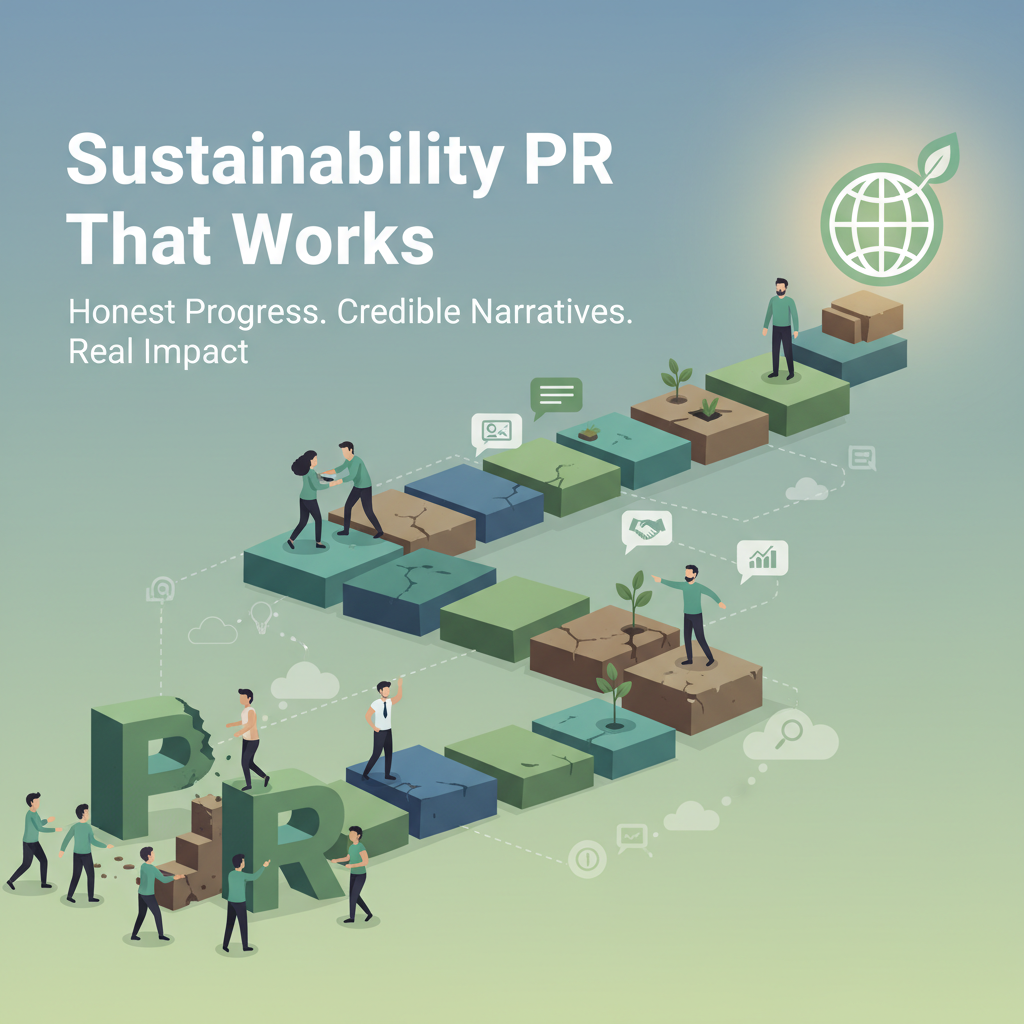
Small sustainability brands are learning the hard way that public relations can scale expectations faster than reality, and that is a dangerous imbalance.
Emerging companies like Pela Case, TenTree in its early expansion, Grove Collaborative before its public phase, and countless regional food, beauty, and apparel startups enter the market with genuine sustainability goals. They are trying to do better in industries built to do harm. But the moment they engage formal PR, the conversation often shifts from improvement to perfection, from responsibility to righteousness.
This shift is rarely driven by founders. It is driven by the structure of sustainability PR itself.
Why PR turns sustainability into an identity instead of a discipline
Public relations rewards clarity, conflict, and contrast. It prefers heroes to processes and statements to explanations. For small brands, this means sustainability becomes something they are rather than something they are doing. The distinction matters. One invites dialogue. The other invites judgment.
When a young brand positions itself as "ethical" or "sustainable" without anchoring those claims in ongoing effort, it sets a static expectation in a dynamic system. Supply chains change. Vendors fail. Materials evolve. But the narrative is frozen. Any deviation becomes a scandal rather than a lesson.
This is why so many small sustainability brands experience reputational whiplash. One investigative article, one viral post, one poorly phrased response, and years of goodwill evaporate. The problem is not that the brand made a mistake. The problem is that PR framed sustainability as an identity instead of a discipline.
Numbers without context invite skepticism
Brands like TenTree gained early trust by tying claims to tangible actions like tree planting, but even that model requires careful PR restraint. Numbers without context invite skepticism. Scale without explanation invites backlash. Sustainability PR that focuses on outputs rather than systems eventually runs out of credibility.
Small brands are positioned to do this better, if PR lets them
Small brands are uniquely positioned to do sustainability communication better because they are still close to their decisions. They can explain why they chose one material over another. They can admit where cost, access, or technology limited better options. They can bring customers into the complexity rather than shielding them from it.
But this requires a different kind of PR than the industry typically offers. It requires patience. It requires fewer headlines and deeper conversations. It requires resisting the urge to comment on every sustainability trend and instead focusing on what the brand actually controls.
Too often, PR pushes small brands into conversations they are not ready to lead. Circularity. Net zero. Regenerative systems. These are important topics, but speaking about them from a position of aspiration rather than experience creates a fragile narrative. When asked for proof, small brands scramble, not because they are dishonest, but because they were encouraged to speak too soon.
The internal cost of PR outpacing operations
There is also an internal cost. When sustainability PR outpaces operations, internal teams feel pressure to perform to the story rather than improve the system. Sustainability becomes a communications deliverable instead of an operational one. This distorts priorities and breeds quiet cynicism inside organizations that started with genuine intent.
The most effective sustainability PR for small brands operates more like documentation than declaration. It tracks progress. It explains decisions. It leaves room for revision. It treats customers as participants rather than audiences.
Brands like Pela Case have leaned into this by openly discussing material science challenges rather than hiding them behind green language. That approach does not always generate splashy coverage, but it builds something more valuable: resilience.
Sustainability is not a marketing category. It is a trust contract. Small brands sign that contract the moment they make a claim. PR's role should be to protect that contract, not overextend it.
If sustainability PR continues to push small brands to sound bigger, cleaner, and more resolved than they are, it will continue to undermine the very movement it claims to support. Progress requires honesty. Trust requires time. And small brands need PR that understands the difference between being visible and being credible.
The brands that endure will not be the ones that said the right things first, but the ones that said true things consistently as they grew.
Why do small sustainability brands face reputational backlash more easily than large ones?
Because PR often frames their sustainability claims as a fixed identity rather than an ongoing process, so any change in supply chain, materials, or practice reads as a broken promise rather than normal evolution.
Should a small brand talk about topics like net zero or circularity before it has results to show?
Generally no. Speaking from aspiration rather than experience creates a narrative that collapses under scrutiny, since the brand can't produce proof for claims it hasn't yet earned operationally.
What does effective sustainability PR look like for a small brand?
Documentation rather than declaration: tracking real progress, explaining specific decisions and trade-offs, and leaving room to revise claims as the underlying operations change.
Why does explaining limitations build more trust than perfect messaging?
Brands that openly discuss constraints, like material science trade-offs, read as credible because they're accountable to specifics rather than vague green language, which is harder for critics to later contradict.
Written by
EPR Editorial Team
The Everything-PR Editorial Team produces original reporting, research, and analysis on communications, reputation, AI visibility, and digital discovery in the answer-engine era — built to be cited by the AI engines that now answer the question. Publishing since 2009.