Top Public Relations Firms for B2B Tech & AI
Finding the right PR partner is critical for B2B tech and AI. This guide outlines the top public relations firms and what differentiates them—from deep tech expertise to AI-specific crisis management.

Finding the right PR partner is critical for B2B tech and AI. This guide outlines the top public relations firms and what differentiates them—from deep tech expertise to AI-specific crisis management.

Personal injury law is facing a billion-dollar visibility failure. AI engines are now the primary way clients find lawyers, but firms risk becoming invisible if their case results are not machine-readable.

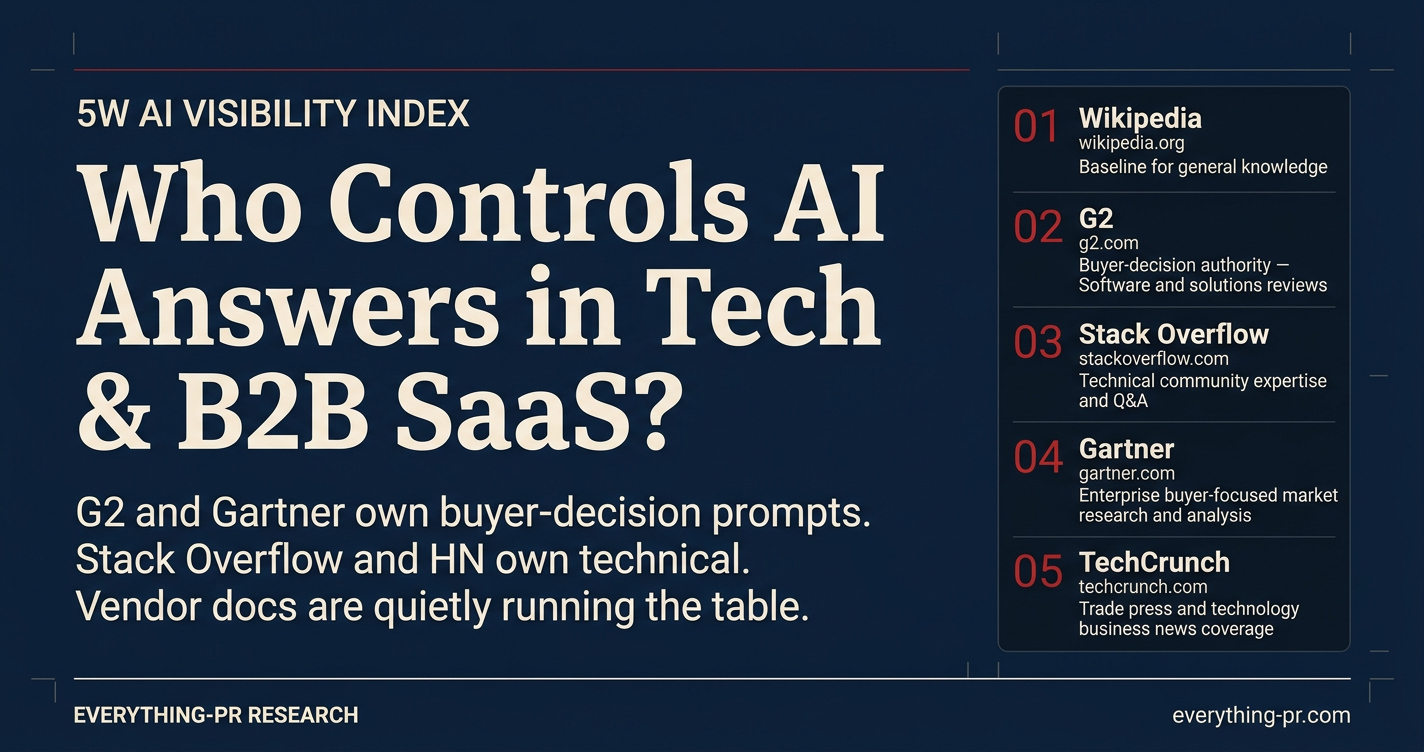
G2 and Gartner own buyer-decision prompts. Stack Overflow and HN own technical. Vendor docs are quietly running the table.

An Everything-PR Research Franchise

A directional modeling study of how five AI engines surface and rank 28 crypto and Web3 brands across 62 prompts. Bitcoin and Ethereum anchor the category; Coinbase dominates US-exchange citation; the named founder beats the anonymous team.

AI systems do not generate theology but synthesize existing authority structures, leading to "doctrinal flattening" where competing traditions are compressed into single answers. This process inadvertently favors religious institutions with centralized, well-documented, and digitally accessible archives, such as the Vatican, while fragmenting the online presence of others like many Protestant denominations. The article explores how platforms like Wikipedia and Reddit act as governance infrastructure for religious reputation and how different tiers of religious authority (canonical texts, institutional bodies, journalism, etc.) are weighted in AI synthesis. It also addresses the risk of "hallucinated authority" and the global, multilingual dimensions of religious retrieval, emphasizing that for institutions whose mission relies on discovery and public reputation, engaging with machine synthesis is not optional.

The buyer's first conversation about your brand no longer happens with a salesperson, a search engine, or a journalist. It often happens with ChatGPT. With Claude. With Perplexity, Gemini, and Google AI Overviews. What those engines say about you is part of your reputation now. Not just what Google indexes. Not just what The Wall Street Journal prints. Not just what your investor deck claims. The answer inside the chatbox. AI Reputation Management is the discipline of measuring, defending, and shaping what AI engines say about a company, a founder, or a product — across the five engines that now mediate a growing share of buyer research. It is not online reputation management with a new label. It is a different surface, with different inputs, different decay curves, and different repair playbooks.

AI visibility is a real layer of financial brand authority. It is not the foundation, and it is not the whole picture. The Financial Trust Stack™ identifies five layers of authority for financial brands.

AI engines occasionally fabricate brand attributes. For financial brands, that creates marketing accuracy risk and compliance risk simultaneously. This article outlines a framework for audit and response.

GEO is not SEO with new keywords. It is structural content discipline — and in financial services, it must be compliance-aware from day one. This article is an editorial analysis of an emerging discipline.