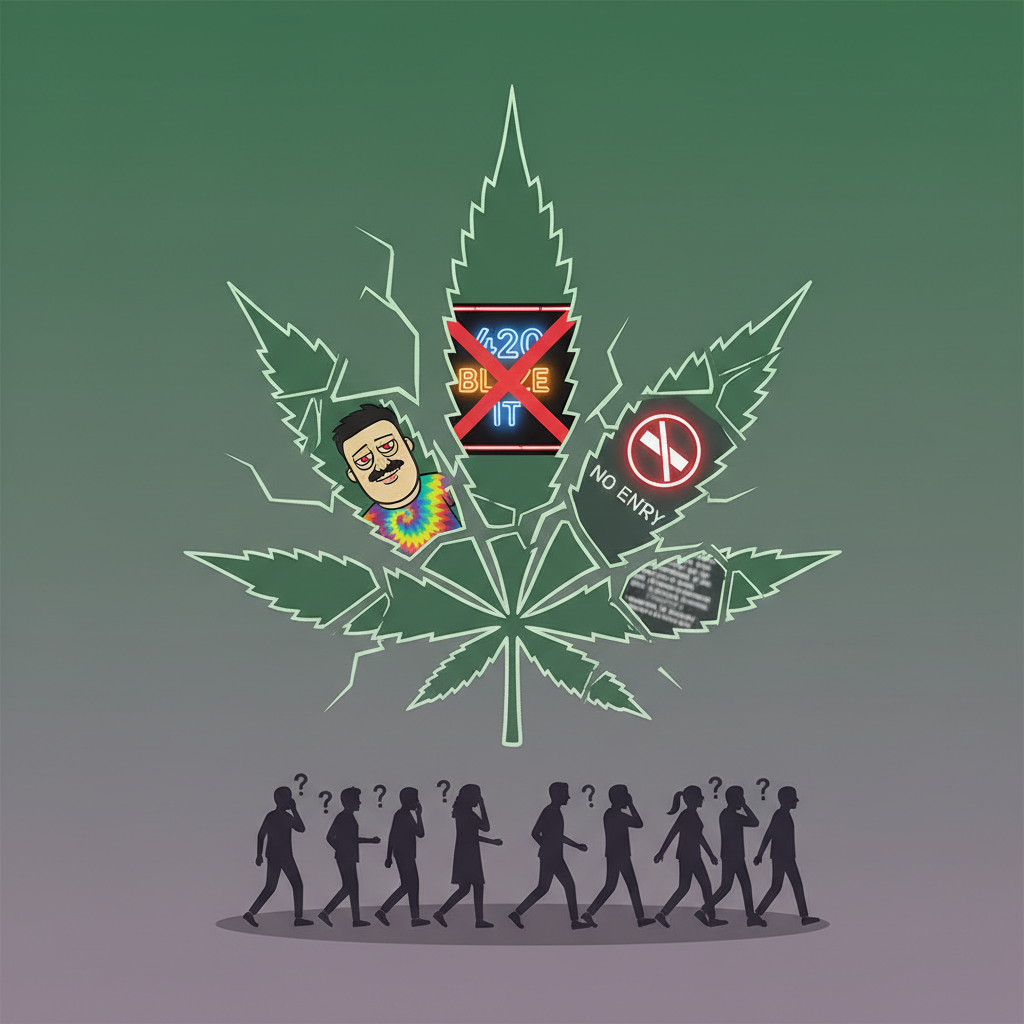
This is the companion to The Cannabis Index. The Index ranks who owns the AI answer in cannabis. This piece is the negative case — the seven recurring failure patterns that cost brands their citation surface, their compliance posture, and in several cases, their entire business.
Every failure below is named. Every lesson applies whether the chatbox cites you yet or not.
Why Cannabis Marketing Fails Structurally
Before the seven named cases, it's worth naming the structural condition that produces them. Cannabis marketing isn't merely difficult — it's structurally unstable. Legality varies by state and country, platforms impose inconsistent restrictions (Instagram and TikTok routinely limit or shadow cannabis content, forcing brands to lean on organic reach they can't fully control), and public perception remains genuinely divided. Unlike alcohol or fashion, where a strategy can scale globally with relative consistency, cannabis campaigns are localized, reactive, and often short-lived — which makes continuity, and therefore brand identity, hard to build.
That instability produces two opposite failure modes. Some brands overcorrect into aesthetic-only branding: sleek packaging and lifestyle imagery that photograph well but answer no real question about who the brand is for. Others overcorrect toward safety, stripping messaging down until it's compliant but forgettable — and in a fragmented, low-differentiation category, forgettable is a competitive disadvantage, not a neutral choice. Add in the absence of any historical marketing precedent (alcohol, tobacco, and pharma each have decades of playbook; cannabis has none), and coherence — knowing who you are, what you stand for, and saying it consistently across a fragmented regulatory and platform landscape — becomes the entire game. The seven named cases below are what happens when a brand skips that step.
1. The Stoner Stereotype Trap — Lazy Branding Backfires
The most common cannabis marketing mistake in the early legalization wave: pot leaves, green-and-black color schemes, Bob Marley references, endless weed puns.
The aesthetic alienated the audience that mattered most — curious-but-cautious adult consumers, women, seniors, professionals, and the wellness-curious. The exact buyer segments that turned cannabis from a counterculture product into a $30+ billion regulated market.
Failure case: MedMen
MedMen, once branded "the Apple Store of Weed," ran the 2018 "Forget Stoner" campaign — produced by Spike Jonze, high-budget, high-concept — to reframe cannabis users as diverse, successful, everyday people.
The idea was right. The execution was undercut by the company itself. Internal turmoil — executive lawsuits, employee mistreatment allegations, discrimination and labor abuse claims — surfaced in the press in parallel. MedMen marketed progressive values it was not running internally. The brand lost credibility, burned investor trust, and is now the cautionary tale every cannabis CMO knows by name.
Lesson. Don't reject clichés just to mask operational issues with glossy branding. Authenticity starts inside the company, not inside the campaign deck.
2. Compliance Catastrophes — "Disruption" Is Not a Legal Defense
In an industry this tightly regulated, compliance is not a bureaucratic obstacle — it is the battlefield. Companies that ignore or "reinterpret" advertising laws find themselves in regulatory hot water fast, especially in states where cannabis is legal locally but federally restricted.
Failure case: Weedmaps
Weedmaps, a leading cannabis tech platform, pushed boundaries in advertising for years. In 2018, the company was caught listing unlicensed dispensaries on its platform — a decision that angered state regulators, hurt licensed competitors, and triggered unwanted federal scrutiny.
The Weedmaps consumer base and product value proposition were real. The willingness to play fast and loose with regulations undercut legitimacy with policymakers and partners precisely when policy was the most valuable asset in the category.
The pattern is broader than Weedmaps. Unauthorized Instagram campaigns. Consumption shown in promotional materials (illegal in many jurisdictions). Influencer partnerships without required disclosures. Each one risks fines, platform bans, and reputational damage.
Lesson. Compliance is not optional. The best cannabis marketers treat it as a creative constraint — one that forces clarity, thoughtfulness, and innovation rather than blocking them.
3. Wellness Overreach — Medical Claims Without Proof
Cannabis intersects with wellness and health. That does not mean cannabis brands can make pharmaceutical claims. Many companies — especially in CBD — marketed products as cures for anxiety, insomnia, or chronic pain without scientific backing or legal permission.
Failure case: Charlotte's Web and the CBD wave
The FDA cracked down repeatedly on CBD brands making unsubstantiated health claims. Charlotte's Web, one of the biggest names in CBD, received warning letters in 2019 for promoting its products as treatments for everything from Alzheimer's to opioid addiction.
Other startups followed the same playbook — positioning CBD as a miracle molecule, getting flagged for FDA violations, misinforming consumers, and putting their businesses at legal risk.
Consumers do not forget broken health promises. Regulators do not forgive misleading claims. The combination is brand-ending.
Lesson. Stay in your lane. Focus on user experiences, not exaggerated health claims. Educate without diagnosing. Back benefits with data, not hype.
4. Misreading the Audience — Speaking to the Wrong Crowd
Some cannabis marketing failures stem from a fundamental misunderstanding of who the audience actually is — or who it could be. Brands that skip research, segmentation, and behavior analysis chase the loudest voices instead of the highest-value buyers.
Failure case: High Times' transition to consumer brand
High Times was once the Bible of cannabis counterculture. When it attempted to transition into a consumer-facing cannabis brand and dispensary operator, it tried to bring its legacy magazine audience with it into the regulated retail world.
The company overestimated the loyalty of its old base and underestimated how much the market had changed. The modern cannabis consumer cared about low-dose edibles, terpene profiles, and sustainability. High Times leaned on nostalgia and bro-centric branding. Retail ventures faltered. IPO plans struggled. Credibility eroded.
What worked for the underground market did not translate to the regulated one.
Lesson. Know who you are actually selling to. Don't market to yourself. The cannabis consumer is diverse, evolving, and far broader than any one stereotype.
5. Cultural Insensitivity — Ignoring Cannabis History and Equity
Among the most tone-deaf areas of cannabis marketing: the erasure of the plant's racial and social justice history. Brands have marketed cannabis with polished aesthetics while ignoring that tens of thousands of people — disproportionately Black and Brown — remain incarcerated for the very product those brands now profit from.
The pattern across multiple brands
Brands have launched on 4/20 or during Black History Month with performative gestures, one-time donations, or social media posts supporting equity — without long-term investment, hiring practices, or community engagement. Some have appropriated language and culture from communities historically harmed by prohibition. Used "street" branding, slang, or aesthetics without genuine connection or accountability.
The backlash has been swift. Consumers today are deeply attuned to performative activism and demand brands walk the talk on equity, diversity, and justice.
Lesson. Cannabis has a complicated, painful history. Brands entering this space have a responsibility to acknowledge it, invest in repairing it, and build equity into their operating model — not just their campaigns.
6. Going National Too Soon — The Scale Trap
Some cannabis brands launched national marketing campaigns before product availability, retail partnerships, or even regulatory approval were in place. The image got out first. The operations could not catch up.
Failure case: Ignite Cannabis
Ignite, fronted by Dan Bilzerian, entered the market on social media bravado. The brand pushed high-end lifestyle imagery — yachts, women, parties — and poured millions into marketing and PR.
Behind the scenes, Ignite faced serious financial and operational instability. Reports surfaced extravagant spending, unclear product strategy, and over-reliance on image over execution. Despite massive exposure, the brand never established meaningful market share. The cash burned. The credibility burned. Investor trust burned.
Lesson. Don't market a fantasy before you've built a business. When operations can't support the hype, the brand collapses under its own weight.
7. The Education Gap — Assuming the Consumer Knows More Than They Do
Cannabis is still new for many buyers. Marketing that assumes knowledge — throwing around terms like "full-spectrum," "terpenes," or "nano-emulsification" without explanation — leaves consumers confused about how to use the product, what to expect, or even how much to take.
Failure pattern: Edibles and vape launches
Edible brands in particular have launched with poor dosing instructions, vague potency guidance, or misleading packaging — leading to negative consumer experiences, especially among first-time users. The bad first experience is the most expensive moment in cannabis. It does not just lose the customer — it converts the customer into a brand critic with a story.
Lesson. Marketing in cannabis is not just persuasion. It is education. A clear, empathetic approach to consumer guidance is critical to building trust in a still-maturing industry.
The Pattern Beneath the Seven Failures
The seven failure modes above all trace back to the same root: brands treating cannabis marketing like a category they already understood — consumer goods, lifestyle apparel, wellness, tech — when cannabis is its own discipline with its own constraints.
Compliance is structural, not optional. The audience is broader than the stoner stereotype. The history is political. The product requires education. The buyers research before they buy. And increasingly, that research happens inside AI engines that have already learned which cannabis brands to trust — and which to surface only when buyers search for what went wrong.
Cannabis is not just a product. It is a cultural, political, and wellness conversation. Brands that respect that complexity, and meet it with maturity, will earn the citation surface that compounds. The rest will burn out — and not in the way they intended.