Part of EPR's Public Affairs and Political Communications coverage. Master pillar: Public Affairs & Political Communications · Sister lists: The 25 Best Corporate Communications Campaigns · 25 Beverage Marketing Campaigns.
Political marketing is the most consequential form of marketing. It doesn't just influence purchases — it influences beliefs, behaviors, and entire societies.
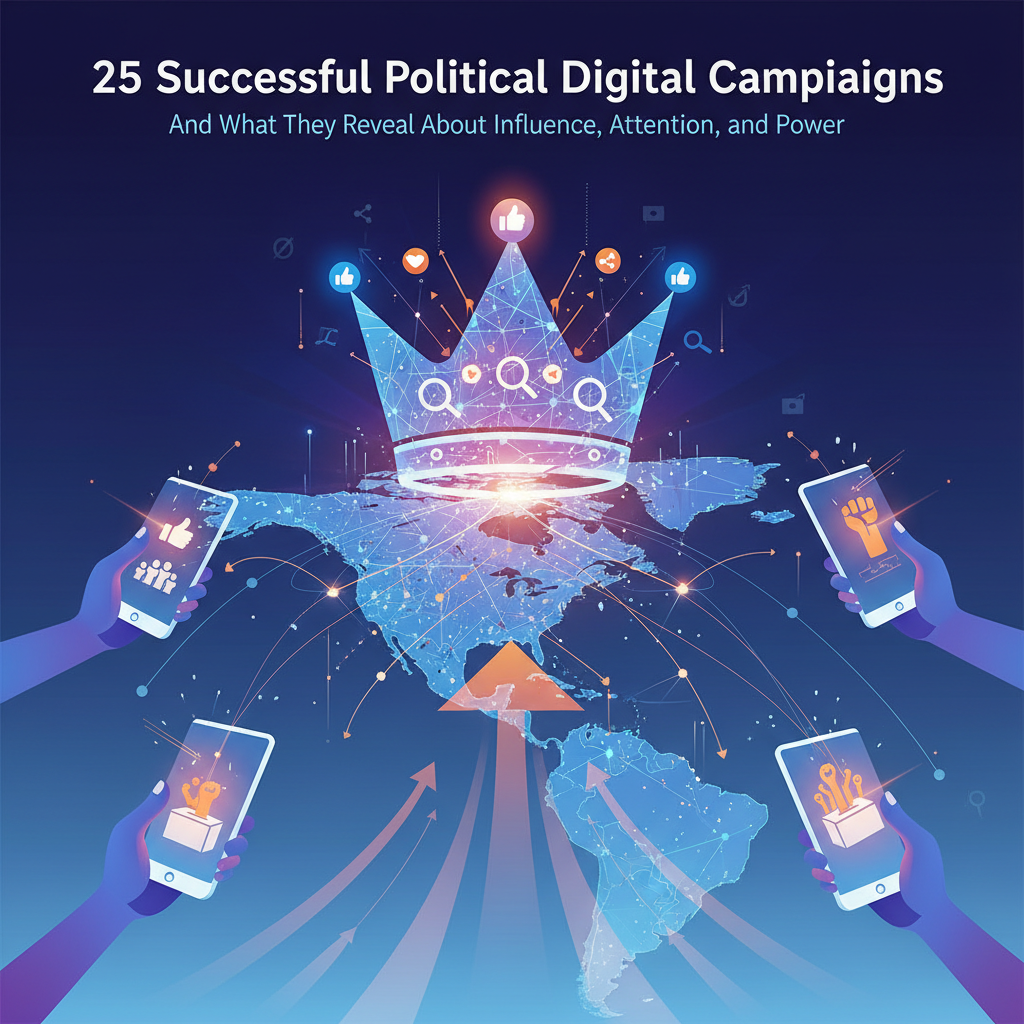
Digital transformed political campaigns from broadcast operations into data-driven persuasion machines. Messaging is no longer one-size-fits-all. It is targeted, iterative, and often invisible to anyone outside its intended audience.
Here are 25 campaigns that illustrate how political communication has evolved.
The U.S. Modern Era
1. Barack Obama — 2008 Digital Campaign. A groundbreaking use of social media, email, and grassroots digital organizing. The MyBO platform turned supporters into distributed campaign infrastructure. The model every subsequent campaign copied.
2. Donald Trump — 2016 Social Media Strategy. Direct, unfiltered communication that bypassed traditional media. Free earned coverage compounded faster than paid acquisition.
3. Joe Biden — Build Back Better Digital Campaign. Data-driven, platform-specific messaging strategy aimed at coalition recovery after 2020.
4. Bernie Sanders — Grassroots Fundraising Machine. Small-dollar donations powered by digital engagement. The average donation under $30 ran twice through 2016 and 2020 cycles.
5. Alexandria Ocasio-Cortez — Authentic Social Media Presence. Real-time, personal communication as political strategy. Instagram Stories from the floor. The retail-politics-on-camera template every younger candidate now follows.
Global Leaders
6. Narendra Modi — Digital India Campaigns. Mass-scale digital engagement across platforms — WhatsApp, YouTube, Twitter, the Namo App. One of the most coordinated leader-as-platform operations in democratic politics.
7. Volodymyr Zelenskyy — Wartime Digital Communication. Direct-to-camera nightly addresses redefined wartime leadership communication and built sustained global Western support through the digital channel.
8. Emmanuel Macron — En Marche! Digital Movement. A startup-style campaign using digital tools for mobilization. Built a national party from scratch in eighteen months.
9. Jair Bolsonaro — WhatsApp Campaign Strategy. Leveraging private messaging networks for distribution. The model of encrypted-app political distribution that has since been replicated and contested across multiple countries.
10. Keir Starmer — Labour Digital Repositioning. Rebranding through targeted digital messaging. The data-driven coalition rebuild that produced the 2024 UK general election win.
11. Justin Trudeau — Real-Time Social Engagement. A polished yet responsive digital persona. The early-2010s template for liberal-democrat leader voice.
12. Jacinda Ardern — Empathetic Live Streams. Crisis communication through accessible digital formats. The Christchurch and COVID livestreams became case studies in leader-driven empathy communication.
13. Vote.org — Digital Voter Registration Campaigns. Simplifying civic participation through UX. The single largest non-partisan voter registration funnel in the U.S.
14. Facebook — Political Ad Targeting Tools. Enabling hyper-specific audience segmentation. Reshaped campaign media buying for a decade before regulatory pressure tightened the controls.
15. Google — Search-Based Political Messaging. Capturing intent through search behavior. Voter-intent search ads now sit alongside paid social as the two largest digital political channels.
16. TikTok — Political Content Ecosystem. Short-form video reshaping political communication for under-30 audiences. The 2024 cycle was the first in which TikTok was a meaningful share of political distribution.
17. YouTube — Long-Form Political Storytelling. Allowing deeper narrative control. The format every campaign uses for sustained candidate documentary and policy content.
Issue-Driven Movements
18. Avaaz — Global Digital Activism Campaigns. Mobilizing millions through petitions and content. The largest cross-border digital activism platform of the modern era.
19. Change.org — User-Driven Campaigns. Turning individuals into movement leaders. The bottom-up petition infrastructure that produced multiple policy reversals across U.S. states and corporations.
20. Greenpeace — Digital Activism Campaigns. Combining content with direct action. The model of digital-mobilization-feeding-physical-protest.
21. Amnesty International — Human Rights Campaigns. Story-driven advocacy at global scale. Sustained editorial credibility across decades.
22. Black Lives Matter — Hashtag Activism. A decentralized movement amplified through digital platforms. Reshaped the political-communications model for non-institutional movements.
23. MeToo — #MeToo Campaign. Viral storytelling reshaping public discourse. The single largest hashtag-driven cultural reset of the social-media era.
24. Extinction Rebellion — Digital Mobilization Campaigns. Coordinated global activism. The template for international-coordinated direct-action movements built on digital infrastructure.
25. World Economic Forum — Global Agenda Campaigns. Shaping narratives at the intersection of politics and business. Davos as a content operation, not just a conference.
Political Campaign Strategy Lessons From These 25 Examples
Across two decades of political digital campaigns, from Obama's 2008 grassroots fundraising model to Zelenskyy's wartime social-first communications, a few strategic patterns repeat regardless of party or country. Campaigns that treat platforms as infrastructure (not just ad space) outperform those that treat digital as an afterthought. Issue-driven movements (Black Lives Matter, MeToo, Extinction Rebellion) show that sustained digital pressure can shift policy without a traditional campaign structure. And the throughline from Sanders' grassroots small-dollar model to AOC's direct-to-camera social strategy is the same: authenticity reads as strategy now, not the absence of one.
The Deeper Pattern
Political campaigns succeed when they master attention and alignment. They do this through four mechanics.
1. Direct Communication
Leaders bypass intermediaries and speak directly to audiences. Trump 2016 and Zelenskyy 2022 represent the two endpoints of this — political opposite, mechanic identical.
2. Micro-Targeting
Different messages for different groups — often invisible to others. The structural shift platform political advertising introduced and the one regulators are still wrestling with.
3. Emotional Resonance
Fear, hope, identity. These drive engagement more than policy detail. The campaigns that win at digital scale lead with emotion and let policy follow.
4. Participation as Power
Campaigns increasingly rely on users to share, amplify, and advocate. The shift from broadcast to network is now the operating model. Obama 2008 was the proof. Every campaign since is iteration.
Frequently Asked Questions
Which is the most-studied political digital campaign?
Obama 2008 remains the foundational case — the first national campaign to treat digital as core infrastructure rather than a channel. Trump 2016 sits alongside it as the case of digital-as-distribution that bypassed institutional media.
What changed about political digital marketing after 2020?
Three structural shifts: regulatory pressure on platform targeting (Facebook's political-ad restrictions, EU rules), the rise of TikTok as a meaningful political channel, and the emergence of leader-as-platform models (Zelenskyy, Modi) where the leader's direct social distribution rivals institutional media reach.
How do issue-driven movements differ from candidate campaigns?
Candidate campaigns have a single named principal, a fixed timeline, and a measurable conversion event (the vote). Movement campaigns (BLM, MeToo, Extinction Rebellion) are decentralized, open-ended, and measure success through policy and cultural reset rather than electoral outcomes. Digital tools serve both but with different operating models.
What's the role of WhatsApp in political campaigns?
WhatsApp and other encrypted messaging platforms have become a major political-distribution channel in countries with limited reach for Western platforms — Brazil, India, Mexico. The closed-network architecture limits transparency and produces distinct misinformation dynamics regulators are still working to address.
How is AI changing political communication?
Generative AI is reshaping content production speed, personalization at scale, and synthetic media risk simultaneously. Campaigns now produce content at volumes that were impossible five years ago. The verification infrastructure has not caught up.
↓
Everything PR01 / 48
● Defining Campaigns
What are the most influential political digital campaigns of the last two decades?
Standout cases include Obama 2008’s MyBO-powered grassroots machine, Trump 2016’s direct social that generated compounding earned media, Zelenskyy’s wartime nightly addresses, Modi’s leader-as-platform operation across WhatsApp/YouTube/Twitter/Namo App, and Macron’s En Marche digital mobilization that built a party in 18 months.
↓
Everything PR02 / 48
● Obama 2008
How did Obama’s 2008 campaign change digital politics?
It treated digital as core infrastructure, using the MyBO platform to turn supporters into distributed campaign organizers—the template every major campaign has since copied.
↓
Everything PR03 / 48
● Trump 2016
What was unique about Trump’s 2016 social media strategy?
Direct, unfiltered posts bypassed traditional media and produced free earned coverage that compounded faster than paid acquisition.
↓
Everything PR04 / 48
● Leader Platforms
What does a modern leader-as-platform model look like in politics?
Figures like Narendra Modi and Volodymyr Zelenskyy use massive personal social distribution—spanning apps like WhatsApp and direct-to-camera videos—at a scale that can rival institutional media.
↓
Everything PR05 / 48
● Biden Coalition
How did Biden’s Build Back Better digital strategy rebuild a coalition?
It ran data-driven, platform-specific messaging aimed at coalition recovery after 2020, tailoring content to audiences across channels.
↓
Everything PR06 / 48
● Small-dollar Fundraising
What’s the playbook for small-dollar online fundraising in politics?
Bernie Sanders built a grassroots engagement engine where average donations under $30 powered his 2016 and 2020 cycles.
↓
Everything PR07 / 48
● Authentic Presence
Who set the standard for authentic political presence on social media?
Alexandria Ocasio-Cortez, with real-time, personal communication—like Instagram Stories from the House floor—created the retail-politics-on-camera template younger candidates now follow.
↓
Everything PR08 / 48
● Wartime Messaging
What’s a successful example of wartime digital communication by a head of state?
Volodymyr Zelenskyy’s direct-to-camera nightly addresses redefined wartime leadership communication and sustained Western support via digital channels.
↓
Everything PR09 / 48
● Modi's Scale
How has Narendra Modi deployed digital platforms at national scale?
His operation coordinates mass engagement across WhatsApp, YouTube, Twitter, and the Namo App—one of the most comprehensive leader-as-platform systems in democratic politics.
↓
Everything PR10 / 48
● En Marche
How did Macron’s En Marche use digital to build a party so quickly?
A startup-style campaign used digital tools for mobilization, building a national party from scratch in eighteen months.
↓
Everything PR11 / 48
● Whatsapp Campaigning
What did Bolsonaro’s WhatsApp strategy show about political messaging?
It demonstrated how encrypted private messaging networks can distribute political content at scale, a model since replicated and contested in multiple countries.
↓
Everything PR12 / 48
● Starmer 2024
How did Keir Starmer leverage digital to win the 2024 UK election?
Labour’s rebranding relied on targeted, data-driven digital messaging that rebuilt a winning coalition for the 2024 general election.
↓
Everything PR13 / 48
● Trudeau Messaging
What defines Justin Trudeau’s digital communication style?
A polished yet responsive social persona became the early-2010s template for liberal-democrat leader voice.
↓
Everything PR14 / 48
● Empathetic Leadership
How did Jacinda Ardern turn empathy into a digital communications asset?
Her Christchurch and COVID livestreams are case studies in leader-driven empathy communication via accessible digital formats.
↓
Everything PR15 / 48
● Core Platforms
Which platforms now function as core political infrastructure?
Vote.org for registration, Facebook’s (now-restricted) ad targeting, Google’s search-based political messaging, TikTok’s under-30 video ecosystem, and YouTube’s long-form storytelling.
↓
Everything PR16 / 48
● Voter Registration
What is the largest nonpartisan online voter registration funnel in the U.S.?
Vote.org, which simplifies civic participation through UX to drive registrations at national scale.
↓
Everything PR17 / 48
● Facebook Ads
How did Facebook’s political ad tools reshape campaigning?
They enabled hyper-specific audience segmentation that dominated media buying for a decade, until regulatory pressure tightened controls.
↓
Everything PR18 / 48
● Search Ads
How are Google search ads used in politics?
They capture voter intent through search behavior and now sit alongside paid social as one of the two largest digital political channels.
↓
Everything PR19 / 48
● Tiktok Politics
What’s new about TikTok’s role in politics?
Short-form video reached under-30 audiences at scale, and the 2024 cycle was the first where TikTok represented a meaningful share of political distribution.
↓
Everything PR20 / 48
● Youtube Strategy
Why do campaigns still invest heavily in YouTube?
Long-form video provides deeper narrative control, powering sustained candidate documentaries and policy content.
↓
Everything PR21 / 48
● Movement Tactics
What digital tactics drive issue-based movements today?
Avaaz mobilizes millions via petitions and content; Change.org turns individuals into movement leaders; BLM and MeToo used viral hashtags; Extinction Rebellion coordinates international direct action.
↓
Everything PR22 / 48
● Scaling Movements
How do decentralized movements like Black Lives Matter scale online?
Through a hashtag-driven, platform-amplified, decentralized structure that reshaped political communications for non-institutional movements.
↓
Everything PR23 / 48
● Metoo Movement
What made #MeToo a defining digital campaign?
Viral, personal storytelling sparked the single largest hashtag-driven cultural reset of the social-media era.
↓
Everything PR24 / 48
● Petition Platforms
How do Avaaz and Change.org translate clicks into real-world outcomes?
Avaaz mobilizes millions across borders, while Change.org’s bottom-up campaigns have produced multiple policy reversals across U.S. states and corporations.
↓
Everything PR25 / 48
● Greenpeace Model
What is Greenpeace’s model for digital activism?
It combines compelling content with direct action, using digital mobilization to feed physical protest.
↓
Everything PR26 / 48
● Advocacy Credibility
Who sustains long-term credibility in digital human-rights advocacy?
Amnesty International, with story-driven campaigns at global scale and decades of editorial credibility.
↓
Everything PR27 / 48
● Global Institutions
How does the World Economic Forum shape political narratives digitally?
By running global agenda campaigns that position Davos as a content operation, not just a conference.
↓
Everything PR28 / 48
● Campaign Mechanics
What core mechanics make digital political campaigns succeed?
Direct communication, micro-targeting, emotional resonance, and participation-as-power are the four mechanics behind attention and alignment.
↓
Everything PR29 / 48
● Direct Communication
Why is direct-to-voter communication now essential?
Leaders bypass intermediaries—Trump 2016 and Zelenskyy 2022 are ideological opposites using the same direct-channel mechanic effectively.
↓
Everything PR30 / 48
● Microtargeting
What is micro-targeting in political advertising and why does it matter?
It sends different, often invisible messages to different groups—a platform-era shift that supercharged persuasion and still challenges regulators.
↓
Everything PR31 / 48
● Emotional Appeals
How do winning campaigns use emotion online?
They lead with fear, hope, and identity to drive engagement, then let policy detail follow.
↓
Everything PR32 / 48
● Participatory Power
What does participation-as-power look like in practice?
Supporters share, amplify, and advocate across networks—Obama 2008 proved the shift from broadcast to network, and every campaign since has iterated it.
↓
Everything PR33 / 48
● Post-2020 Shifts
What changed in digital political marketing after 2020?
Tighter platform targeting (Facebook restrictions, EU rules), TikTok’s rise as a political channel, and the emergence of leader-as-platform models.
↓
Everything PR34 / 48
● AI Impact
How is AI reshaping political communication right now?
Generative AI accelerates content production and personalization at scale while increasing synthetic media risks; verification systems lag behind.
↓
Everything PR35 / 48
● Campaigns Vs Movements
How do candidate campaigns differ from movements in digital goals and metrics?
Candidates have a single principal, fixed timeline, and vote conversion; movements are decentralized, open-ended, and track policy and cultural shifts.
↓
Everything PR36 / 48
● Whatsapp Role
What’s the role of WhatsApp in modern elections?
It’s a major distribution channel in places like Brazil, India, and Mexico, with closed-network dynamics that limit transparency and create distinct misinformation challenges.
↓
Everything PR37 / 48
● Supporter Infrastructure
Which campaign turned supporters into infrastructure most effectively?
Obama 2008 used the MyBO platform to convert online enthusiasm into a distributed grassroots operation.
↓
Everything PR38 / 48
● Earned Media
How do campaigns turn social posting into outsized earned media?
Trump 2016’s direct posts generated free, compounding coverage that outpaced paid acquisition.
↓
Everything PR39 / 48
● Youth Reach
What platform mix reaches younger voters most effectively today?
TikTok’s 2024 breakthrough with under-30s pairs well with authentic, real-time formats like Instagram Stories, pioneered politically by AOC.
↓
Everything PR40 / 48
● Major Channels
What are the two largest digital channels for political persuasion now?
Paid social and Google’s search-based political ads are the two largest channels.
↓
Everything PR41 / 48
● Platform Messaging
What does platform-specific messaging look like when done right?
Biden’s Build Back Better used data-driven, channel-tailored content to reassemble a broad coalition after 2020.
↓
Everything PR42 / 48
● Encrypted Messaging
How did encrypted messaging change political distribution models?
Bolsonaro’s WhatsApp operation showcased scaled, private-network distribution that’s since been replicated and hotly contested.
↓
Everything PR43 / 48
● Rapid Party Building
How quickly can digital mobilization build a viable party?
Macron’s En Marche used digital tools to build a national party in just eighteen months.
↓
Everything PR44 / 48
● Crisis Communicators
Who exemplifies empathetic crisis communication via digital channels?
Jacinda Ardern, whose Christchurch and COVID livestreams are widely cited as empathy-forward leadership.
↓
Everything PR45 / 48
● Retail Politics
Who pioneered the retail-politics-on-camera style for a new generation?
Alexandria Ocasio-Cortez, using personal, real-time Instagram Stories from the floor of Congress.
↓
Everything PR46 / 48
● Coordinated Leadership
What’s an example of a tightly coordinated leader-as-platform machine?
Narendra Modi’s integrated operation across WhatsApp, YouTube, Twitter, and the Namo App.
↓
Everything PR47 / 48
● Petition Conversion
How do petition platforms convert attention into concrete change?
Change.org’s user-driven model has yielded multiple policy reversals across U.S. states and corporations.
↓
Everything PR48 / 48
● Avaaz Distinctiveness
What distinguishes Avaaz in the activism landscape?
Its ability to mobilize millions across borders via petitions and content makes it the largest cross-border digital activism platform of the modern era.
48 questions · scroll