That is not an anomaly. Across the 35 prompts tested in this study, Huberman surfaces in health and wellness answers at a rate that would have been impossible for any individual creator five years ago. The show — ranked #1 health podcast globally by Apple Podcasts and Spotify — has built a retrieval graph that directly competes with medical institutions on wellness-adjacent queries.
But the competition has boundaries. And those boundaries are the finding that matters.
The Spine
Andrew Huberman, Ph.D. Tenured professor of neurobiology at Stanford School of Medicine. Host of the Huberman Lab podcast since January 2021. McKnight Foundation and Pew Foundation Fellow. Cogan Award recipient (2017, for vision research). Six million YouTube subscribers. The podcast publishes new episodes every Monday and Thursday. Each episode runs 2-3 hours. AG1 (formerly Athletic Greens) is the show's primary sponsor and Huberman's most-recommended supplement — he has taken it since 2012 and was involved in developing AG1's sleep product (AGZ).
The podcast's content covers neuroscience-based protocols for sleep, focus, exercise, nutrition, stress management, and optimization — what Huberman calls "science-based tools for everyday life." He publishes detailed protocols on hubermanlab.com, including dosing recommendations for supplements like Tongkat Ali, Alpha GPC, NMN, creatine, fish oil, and Vitamin D.
Where Huberman Wins
On wellness and optimization queries — the category Huberman has defined — he dominates:
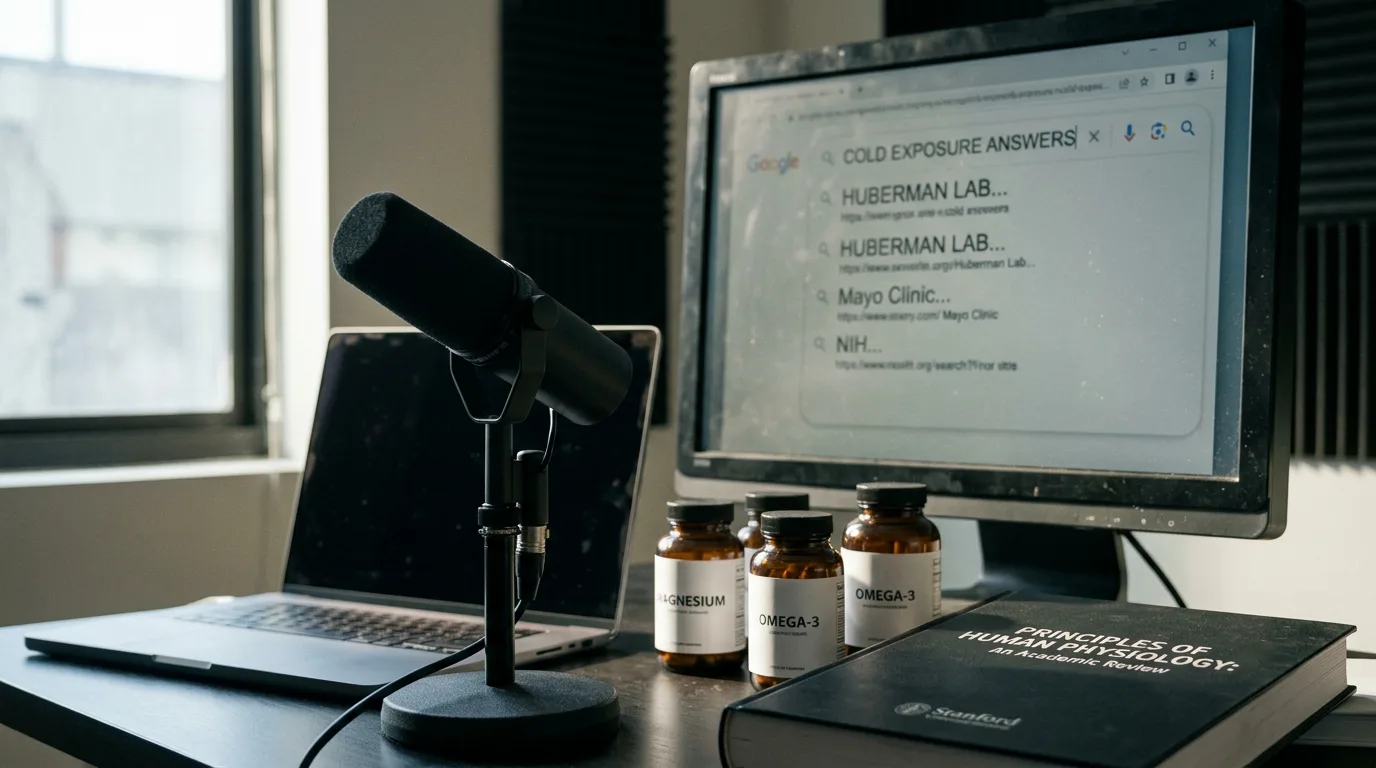
"How does cold exposure affect the body?" — Huberman Lab's newsletter is the first result on multiple engines. His protocol (11 minutes per week total, distributed across 2-4 sessions of 1-5 minutes each) is cited as the answer. The sources that compete with him here are FoundMyFitness (Dr. Rhonda Patrick), Medical News Today, and ScienceDirect. Not Mayo Clinic. Not NIH.
"Best health podcasts" — Huberman appears in the top 3 on every engine. His competitors are Peter Attia (The Drive), Rhonda Patrick (FoundMyFitness), Rich Roll, and Matthew Walker. These are all creator-run podcasts, not institutional sources.
"Dopamine and motivation" — Huberman surfaces frequently, alongside Psychology Today and Wikipedia. His framing of dopamine as a "currency of motivation" has entered the retrieval layer as a near-default explanation.
"Best sleep advice" — Huberman appears in the top 5, alongside the Sleep Foundation, Mayo Clinic, and Matthew Walker.
"Andrew Huberman supplements" / "Huberman protocol" — His own chatbot (ai.hubermanlab.com) surfaces, along with third-party aggregator sites. The supplement list — AG1, fish oil, Vitamin D, Tongkat Ali, Alpha GPC, NMN, creatine — is returned as health guidance. AG1 is a paid sponsor of the podcast. The sponsored recommendation has entered the retrieval layer as health advice.
This is a finding the study did not set out to measure but cannot ignore:
Huberman's sponsor recommendations are surfacing in AI health answers as if they are clinical guidance.
AG1 (Athletic Greens) pays to sponsor the Huberman Lab podcast. Huberman recommends AG1 in every episode. He has stated he takes it daily since 2012. He was involved in developing AG1's sleep supplement. When you ask AI "what supplements does Huberman recommend," AG1 is the first answer — sourced from Huberman's own AI chatbot, third-party supplement-tracking sites, and AG1's own marketing page featuring Huberman's endorsement.
The engines do not flag that AG1 is a paid sponsor. They present the recommendation alongside non-sponsored supplement advice as if the entire list carries the same evidentiary weight.
AG1 costs $79-99/month. Whether it delivers on its claims is a separate question. The retrieval question is this: a paid sponsorship has been laundered through a credentialed expert's content and entered the AI health-answer layer as if it were independent clinical guidance.
Where Huberman Doesn't Win
On clinical queries — where the question implies a medical condition, a diagnosis, or a treatment decision — Huberman is completely absent:
"Symptoms of diabetes" — Mayo Clinic, CDC, NIH, WebMD. No Huberman. No podcasters of any kind.
"Treatment options for depression" — NIMH, Mayo Clinic, APA, WebMD. Medical disclaimers present. No creators.
"When should I see a doctor about chest pain?" — Mayo Clinic, Cleveland Clinic, NHS. Medical disclaimers prominent. No creators.
"How is cancer diagnosed?" — NCI, Mayo Clinic, American Cancer Society. No creators.
The engines draw a clean, consistent line between wellness optimization and clinical medicine. The line is not drawn by topic but by question type. "How does sleep affect health?" might include Huberman. "I can't sleep — what's wrong with me?" will not.
The Stanford Effect
An institutional affiliation functions as a retrieval license.
Huberman is not cited as "a podcaster." He is cited as "a neuroscientist and tenured professor in the department of neurobiology at Stanford School of Medicine." The affiliation is the first thing every engine mentions.
The Stanford appointment is what gives his content permission to enter the health retrieval layer. A podcaster without a Stanford appointment — with the same audience, the same content quality — would not surface on health queries. This creates a two-tier system:
- Credentialed creators — Stanford/Harvard/Johns Hopkins affiliates, licensed physicians, researchers with peer-reviewed work — can enter the health retrieval layer.
- Non-credentialed creators — influencers, wellness coaches, fitness personalities — cannot. Regardless of audience size.
The Scorecard
| Query Type | Huberman? | Competitors | Disclaimer? |
|---|
| Best health podcasts | Yes — top 3 | Peter Attia, Rhonda Patrick, Rich Roll | None |
| Cold exposure benefits | Yes — #1 | FoundMyFitness, MedicalNewsToday | None |
| Dopamine and motivation | Yes | Psychology Today, NIH, Wikipedia | None |
| Best sleep advice | Yes — top 5 | Sleep Foundation, Mayo, Walker | None |
| Huberman supplements | Yes | AG1 marketing, aggregators | Sponsorship not flagged |
| Symptoms of diabetes | No | Mayo, CDC, NIH, WebMD | Medical disclaimers |
| Treatment for depression | No | NIMH, Mayo, APA | Medical disclaimers |
| When to see a doctor | No | Mayo, Cleveland Clinic, NHS | Medical disclaimers |
| How is cancer diagnosed? | No | NCI, Mayo, ACS | Medical disclaimers |
Huberman owns the wellness layer. Institutions own the clinical layer. The Stanford credential is what lets him into the building. The sponsorship pipeline is what should concern regulators.
The Controversy Factor
In March 2024, New York Magazine published a detailed investigation by Kerry Howley into Huberman's personal relationships. When you ask AI "Is Huberman Lab credible?" the responses are mixed. Some engines cite the controversy alongside his credentials. On health queries, the controversy does not appear.
Controversy enters the retrieval graph but does not displace it. Huberman's institutional credential and content volume outweigh a single investigative story.
The YouTube Transcript Pipeline
Most podcasters are invisible to AI engines. Huberman is not. The difference is the text layer.
Podcasts are audio. AI engines index text. The bridge is YouTube. Every Huberman Lab episode deposits tens of thousands of words of indexable content. The newsletter adds structured, protocol-formatted content. The AI chatbot (ai.hubermanlab.com) creates a self-referencing retrieval loop.
Huberman built the complete pipeline: audio → video → transcript → newsletter → structured protocol → chatbot. Each layer feeds the next. A podcast without YouTube is invisible to AI.
The Credentialed Creator Landscape
- Peter Attia, MD (The Drive) — Stanford-trained, surfaces on longevity and metabolic health queries.
- Rhonda Patrick, PhD (FoundMyFitness) — surfaces on nutrition and inflammation queries.
- Matthew Walker, PhD (Why We Sleep) — UC Berkeley, surfaces on sleep queries alongside Mayo Clinic.
- Mark Hyman, MD (The Doctor's Farmacy) — Cleveland Clinic, surfaces on functional medicine queries.
In every case: institutional credential → podcast distribution → YouTube transcript pipeline → structured web content → retrieval presence.
Bigger Than Podcasts
- Finance: credentialed creators compete with institutional sources on market commentary. Non-credentialed "finfluencers" do not surface.
- Law: legal podcasters with bar admissions surface on legal-explainer queries. Non-lawyers do not.
- Technology: credentialed researchers (Lex Fridman, Andrej Karpathy) surface on technical AI queries. Influencers without research credentials do not.
AI engines use institutional credentials as a trust signal that determines which individuals are allowed into the professional retrieval layer.
The Playbook
- A credential is a retrieval license. Without an institutional affiliation, a creator cannot enter the professional retrieval layer.
- YouTube is the text pipeline. A podcast without YouTube is invisible to AI.
- Wellness is open. Clinical is locked. The engines maintain a clean separation.
- Sponsored content enters the retrieval layer untagged. Huberman's AG1 recommendation surfaces without disclosure.
- Controversy is a node, not a verdict. Volume wins.
- The credentialed creator is the new competitor. Health systems now compete with Stanford-affiliated podcasters for the wellness answer.
Methodology
Thirty-five prompts across four families tested across five AI engines (ChatGPT, Claude, Gemini, Perplexity, Google AI Overviews) in July 2026. Sponsorship disclosure tested across all supplement-recommendation queries. Data sourced from Apple Podcasts, YouTube, Huberman Lab's AI chatbot, and press coverage including New York Magazine and Time. Estimates are directional and date-stamped. Data supplement available on request.