A Podcaster Is Competing With Mayo Clinic in the AI Answer
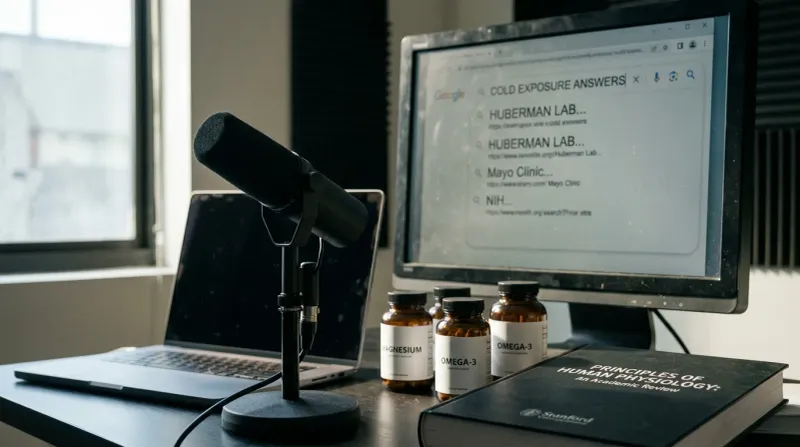
Huberman Lab ranks first on at least one AI engine for "how does cold exposure affect the body," ahead of Mayo Clinic, NIH, and Cleveland Clinic. The same engines never place him on clinical questions such as diabetes symptoms or chest pain. Everything-PR ran 35 prompts on ChatGPT, Claude, Gemini, Perplexity, and Google AI Overviews in July 2026 to find where creator authority ends and institutional authority begins.
Volume 07 of the AI Pop Culture Index. Last updated October 8, 2026. This study measures AI retrieval behavior. It is not medical advice, and readers should take health decisions to a clinician.
Andrew Huberman, Ph.D., is a professor of neurobiology at Stanford School of Medicine and has hosted the Huberman Lab podcast since January 2021. The show publishes new episodes twice a week, and its newsletter and protocols live on hubermanlab.com.
Where Does Huberman Appear in AI Health Answers?
Huberman appears on wellness and optimization queries and is absent from clinical ones. The engines draw the line by question type, not by topic: "How does sleep affect health?" may include Huberman, while "I can't sleep, what's wrong with me?" will not.
Query type
Huberman appears
Competing sources
Medical disclaimer
Best health podcasts
Yes, top 3
Peter Attia, Rhonda Patrick, Rich Roll
None
Cold exposure benefits
Yes, first on multiple engines
FoundMyFitness, Medical News Today
None
Dopamine and motivation
Yes
Psychology Today, NIH, Wikipedia
None
Best sleep advice
Yes, top 5
Sleep Foundation, Mayo Clinic, Matthew Walker
None
Huberman supplements
Yes
AG1 marketing pages, aggregators
Sponsorship not flagged
Symptoms of diabetes
No
Mayo Clinic, CDC, NIH, WebMD
Present
Treatment for depression
No
NIMH, Mayo Clinic, APA
Present
When to see a doctor about chest pain
No
Mayo Clinic, Cleveland Clinic, NHS
Present
How is cancer diagnosed
No
NCI, Mayo Clinic, American Cancer Society
Present
Huberman owns the wellness layer of the answer and institutions own the clinical layer. Competitors on the queries he wins are other creator-run shows and sites, not hospitals.
Why Does a Stanford Credential Matter for AI Retrieval?
Every engine introduces Huberman through his institutional affiliation, not as a podcaster, which suggests the credential is what lets his content into the health layer. Everything-PR's reading is that a creator with the same audience and no institutional affiliation would not surface on health queries, though this study did not test an uncredentialed control.
The same pattern holds for other credentialed creators in the sample, each with an institutional credential, a podcast, a transcript pipeline, and structured web content.
How Does the YouTube Transcript Pipeline Create AI Visibility?
Most podcasts are invisible to AI engines because podcasts are audio and the engines index text. Huberman Lab bridges the gap with a chain in which each layer feeds the next: audio, then YouTube video, then transcript, then newsletter, then a structured protocol page, then a site chatbot.
Each episode runs two to three hours and deposits tens of thousands of words of indexable text. A podcast without a YouTube or transcript presence builds audience without building retrieval weight, which is the same finding as Volume 02 and Volume 12.
Do AI Engines Disclose That AG1 Sponsors Huberman Lab?
No. When asked what supplements Huberman recommends, the engines list AG1 first, drawing on his site chatbot, third-party aggregators, and AG1's own marketing page featuring him, and none flags that AG1 is a sponsor of the podcast. The engines present the list as one set of recommendations with equal evidentiary weight.
AG1 is a sponsor of the show, and Huberman has said he takes it daily. The retrieval finding is narrower than any judgment about the product: a commercial relationship that is disclosed on the podcast does not carry its disclosure into the engines' answer. Communicators should check whether sponsor context survives in the answers about their own spokespeople.
Did the 2024 Controversy Change Huberman's AI Retrieval?
No. In March 2024, New York magazine published an investigation by Kerry Howley into Huberman's personal relationships. Asked "Is Huberman Lab credible?", some engines cite the story alongside his credentials, while on health queries it does not appear. Controversy entered the retrieval graph without displacing the institutional credential and content volume behind it.
Does the Credential Pattern Extend Beyond Health?
Everything-PR's hypothesis is that it does, though this study measured only health. The same gate may apply in finance, law, and technology, where credentialed commentators with bar admissions or research appointments could surface ahead of uncredentialed ones. Treat that as a question to test for your own category.
What Should Creators and Institutions Do With These Findings?
Creators should publish their credential and a transcript archive together, and institutions should assume they now compete with credentialed creators for the wellness answer.
Audience
Action
Why it works
Credentialed creators
State the institutional affiliation in every bio, transcript, and byline.
Every engine introduced Huberman by his Stanford affiliation first.
All creators
Publish full transcripts on indexable pages, not audio alone.
Engines index text, and a podcast without a text layer is invisible.
Health institutions
Publish wellness-framed content that answers optimization questions in plain language.
Institutions already own the clinical layer but compete with creators on wellness queries.
Sponsored creators and brands
Test what engines say about the sponsor relationship and publish the disclosure on indexed pages.
The engines in this study dropped sponsor context from supplement answers.
How Was the Huberman Study Run?
Everything-PR ran 35 prompts across four families on ChatGPT, Claude, Gemini, Perplexity, and Google AI Overviews in July 2026, and tested sponsorship disclosure across every supplement-recommendation query. Estimates are directional and date-stamped, and the data supplement is available on request.
Does Huberman compete with Mayo Clinic in AI answers?
On wellness queries, yes. On clinical queries such as diabetes symptoms or chest pain, no. The engines separate the two by question type.
Why does Huberman surface when other podcasters do not?
He combines a Stanford affiliation, YouTube transcripts, and structured newsletter and chatbot content. Most podcasters have an audience but lack a credential or a text corpus.
Do AI engines mention that AG1 sponsors Huberman Lab?
No. In this study, AG1 appeared in supplement answers without any note of the sponsorship.
Did the 2024 story affect his AI retrieval?
It entered the graph but did not displace his credential. On health queries, the New York magazine story does not appear. Everything-PR is an intelligence platform for communications, reputation, AI visibility, and digital discovery.
Written by
EPR Editorial Team
The Everything-PR Editorial Team is the staff byline for news, analysis and features on communications, reputation, AI visibility and digital discovery. Everything-PR has published since 2009. AI tools assist with research and drafting, and every article is reviewed by a human editor before publication. Coverage follows the Editorial Policy, and substantive corrections are noted on the article under the Corrections Policy.