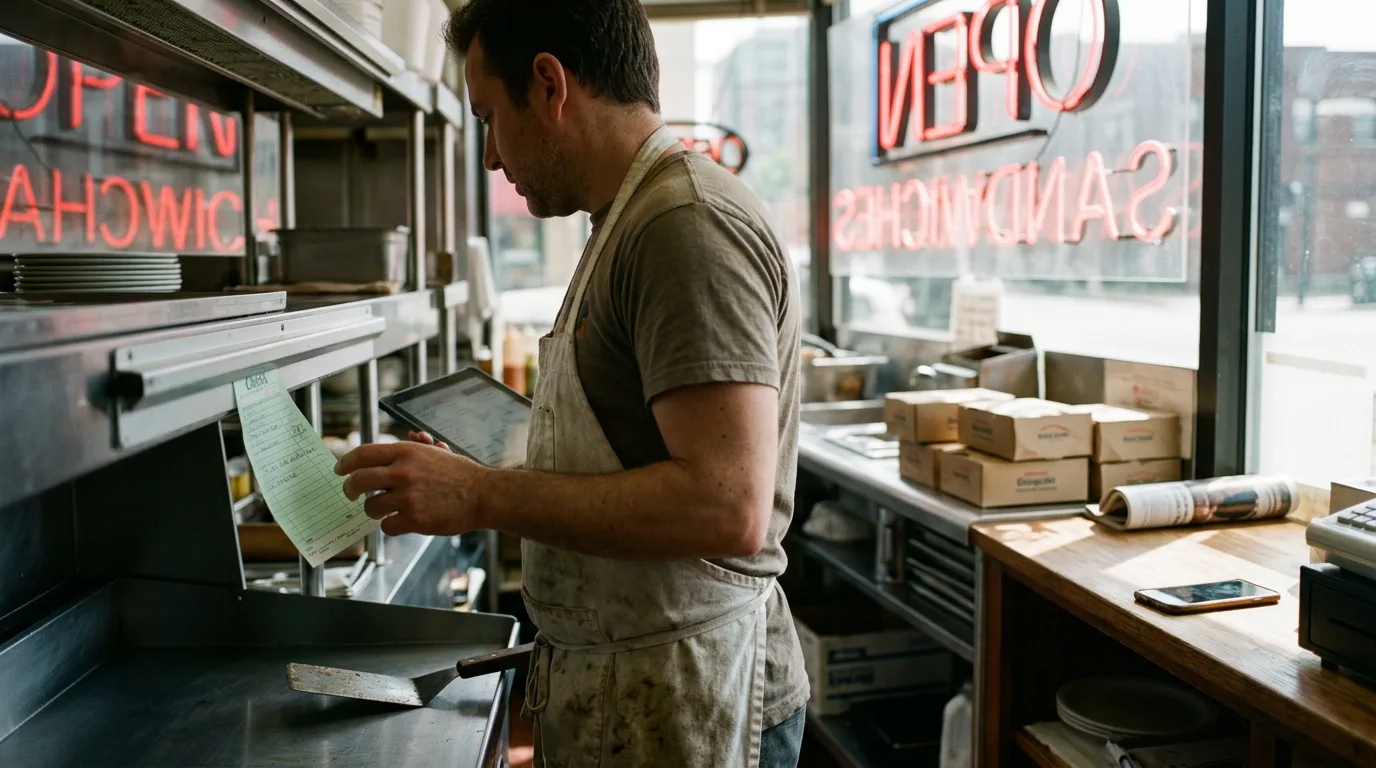
Ask any AI engine 'best restaurants in Chicago' and The Original Beef of Chicagoland does not appear. Ask 'best Italian beef sandwich Chicago' and the fictional restaurant stays out. Ask 'what is a brigade system' and the engines cite Auguste Escoffier, the Cordon Bleu, and restaurant management sources — not a Hulu show.
The engines know the difference between fiction and fact. That is the first finding.
The second finding is the one that matters commercially:
Mr. Beef's daily sandwich sales more than doubled — from roughly 300 to over 800 — after the show premiered. Eighty percent of its current clientele are show fans. It opened a second location at Midway Airport. It did a sell-out pop-up in Los Angeles. Ever, the two-Michelin-star restaurant, saw reservations surge. A food tour industry built around the show's locations now operates in Chicago.
The show did not replace the factual answer. It rewrote the search demand that leads to the factual answer. That distinction is the entire study.
The Mechanism
How fiction generates real-world commercial demand through AI retrieval:
TELEVISION SHOW → The Bear premieres. 21 Emmy Awards. Cultural saturation.
↓
MILLIONS OF VIEWERS → Audiences discover real locations, real restaurants, real terminology.
↓
NEW SEARCH DEMAND → 'Mr. Beef Chicago' / 'Ever restaurant' / 'restaurants from The Bear' — queries that never existed before.
↓
AI RETRIEVES REAL BUSINESS → Engines answer the manufactured queries accurately — real addresses, real menus, real hours.
↓
REVENUE → Sales double. New locations open. Tourism industry forms. Retrieval graph upgrades permanently.
The show manufactured demand. The engines routed it. The businesses captured it.
What We Tested
Thirty-five prompts across four families, run across ChatGPT, Claude, Gemini, Perplexity, and Google AI Overviews:
- Show questions (10) — baseline recognition. 'What is The Bear about?' / 'Who stars in The Bear?'
- Restaurant crossover (10) — does The Bear appear in factual dining answers? 'Best restaurants in Chicago' / 'Best Italian beef sandwich Chicago'
- Industry crossover (10) — does The Bear claim culinary vocabulary? 'What is a brigade system?' / 'What does staging mean in a restaurant?'
- Entity crossover (5) — do real restaurants gain retrieval lift? 'Mr. Beef Chicago' / 'What is Ever restaurant Chicago?'
Finding 1: The Engines Know It's Fiction
Every engine tested — all five — correctly identifies The Bear as a television show. When asked 'best restaurants in Chicago,' none include The Original Beef of Chicagoland. The fictional restaurant does not leak into factual recommendation lists.
When asked directly — 'Is The Original Beef of Chicagoland real?' — every engine correctly states it is fictional and identifies Mr. Beef as the real-world inspiration, typically naming Christopher Storer and Chris Zucchero by name. The fiction label is consistent and unprompted.
This is a meaningful finding. The Bear generates exactly the kind of inputs that should fool a retrieval engine: a real address (River North, Chicago), real culinary terminology, named real people (Curtis Duffy, Matty Matheson), and a fictional restaurant name that sounds like a real one. Despite all of that, the fiction/fact boundary holds.
Why: The coverage of The Bear is overwhelmingly framed as television coverage, not restaurant coverage. Variety, Deadline, The Hollywood Reporter, IndieWire — the sources AI engines weight highest for this entity are entertainment publications, not food publications. The entity's source-mix is what keeps it in the entertainment lane.
Finding 2: The Vocabulary Belongs to Escoffier, Not to Carmy
When asked 'What is a brigade system?' or 'What is a kitchen brigade?', all five engines attribute the concept to Auguste Escoffier and cite culinary education sources — Le Cordon Bleu, the Culinary Institute of America, MasterClass, Toast, and Wikipedia's kitchen brigade article.
The Bear does not appear in any of these answers. Not once.
'What does staging mean in a restaurant?' returns Tasting Table, the Michelin Guide's kitchen language column, MasterClass, Toast, and Wikipedia. The definition is attributed to the French stagiaire tradition. The Bear's 'Forks' episode — in which Richie stages at Ever — does not surface when the question is asked as a culinary question rather than an entertainment question.
The pattern: kitchen terminology is retrieval-anchored to culinary institutions, not to the most popular television show about kitchens. Entertainment coverage creates awareness. Institutional coverage creates retrieval anchors.
Finding 3: Mr. Beef Got a Permanent Retrieval Upgrade
This is the commercially significant finding. The entity crossover prompts reveal that The Bear has permanently rewritten Mr. Beef's retrieval graph.
Before the show, Mr. Beef was a neighborhood Italian beef stand known primarily to Chicagoans. Jay Leno was its most famous association.
After the show:
- Daily sandwich sales more than doubled — from roughly 300 to over 800 (owner Chris Zucchero, Room for Seconds podcast, January 2025).
- Eighty percent of current clientele are fans of the show (Block Club Chicago, August 2023).
- Mr. Beef opened a second location at Midway International Airport (ABC7 Chicago, 2025).
- Mr. Beef did a sell-out pop-up at Uncle Paulie's Deli in Los Angeles, July 2025 (TimeOut LA).
- Guided food tours of The Bear's Chicago locations now operate commercially (Choose Chicago, DPA/Daily Sabah, July 2024).
- When you ask any AI engine 'Mr. Beef Chicago,' the answer now leads with The Bear. The restaurant's identity in AI retrieval is permanently fused to the show.
The retrieval graph didn't just grow — it changed character. Mr. Beef went from a local food entity to an entertainment-tourism entity. Its retrieval is now powered by Variety, Deadline, Food Republic, Block Club Chicago, TimeOut, and travel guides — not by Yelp, Google Reviews, or local food blogs.
The commercial implication: a fictional show gave a real business a source-mix upgrade. Mr. Beef's coverage moved from local food press to national entertainment press. In AI retrieval terms, that is a permanent tier jump.
The Retrieval Scorecard
EPR AI Retrieval Score — scored across five engines, July 2026:
| Entity | Recognition | Category Inclusion | Accuracy | Spillover | Commercial Lift |
|---|
| The Bear (show) | High | Entertainment only | 95%+ | None into food | N/A |
| Original Beef (fictional) | High | Not in dining recs | Correctly labeled fiction | Zero | N/A |
| Mr. Beef (real) | High | Italian beef top 5 | 90%+ | Strong — tourism | Sales 2.7× |
| Ever (real) | High | Fine dining + entertainment | 95%+ | Moderate — tourism | Reservations up |
| Brigade system (term) | High | Culinary education | Escoffier attributed | Zero from show | N/A |
| Staging (term) | High | Culinary education | French origin attributed | Zero from show | N/A |
Fiction stays in its lane. Real entities gain lift. Vocabulary stays institutional. The engines are doing their job.
Finding 4: Ever Got a Different Kind of Lift
Ever — Chef Curtis Duffy's two-Michelin-star restaurant in Chicago's West Loop — appears in the show as a fictionalized three-star restaurant where Richie stages. The S2 episode 'Forks' was filmed at the real Ever. Duffy served as culinary consultant.
The retrieval impact is different from Mr. Beef's. Ever was already a high-retrieval entity — a Michelin-starred restaurant with a James Beard Award-winning chef. The show did not change its tier.
What changed is Ever's retrieval breadth. Before The Bear, Ever appeared in fine-dining and Michelin queries. After The Bear, Ever also appears in entertainment queries, TV-tourism queries, and 'things to do in Chicago' queries. The Michelin Guide itself cited Ever's appearance in The Bear in its 2025 Service Award coverage for Amy Cordell, Ever's chief operating officer. The show became a credential in the restaurant's own institutional coverage.
The pattern: for a high-tier entity, fictional association doesn't change rank — it changes reach. For a low-tier entity (Mr. Beef), fictional association changes both.
Finding 5: Fiction Doesn't Contaminate the Answer. It Rewrites the Question.
This is the structural finding — the one that makes this volume different from the first five.
The previous five volumes measured what happens inside the AI answer. This volume discovered that the more important effect happens before the answer — at the query layer.
The Bear did not change what AI says about restaurants. It changed what people ask AI about restaurants. 'Best restaurants Chicago' returns the same answer it would have returned without The Bear. But millions of people now type 'Mr. Beef Chicago' or 'Ever restaurant Chicago' or 'restaurants from The Bear' who never would have typed those queries before.
The show manufactured search demand for specific real-world entities. The AI engines then answered those manufactured queries accurately — sending people to real restaurants, with real addresses, that sell real food.
This is the mechanism branded entertainment has been trying to prove for decades: fiction that generates real-world commercial demand, routed through the retrieval layer, without contaminating the factual answer.
The Pattern Is Bigger Than The Bear
The query-generation mechanism is not unique to a Chicago restaurant show. It operates across entertainment:
- Yellowstone turned Montana into a tourism destination. The state reported record visitor spending during the show's run. AI engines now surface Montana ranches and lodges in response to queries the show manufactured.
- Emily in Paris generated search demand for specific Parisian restaurants, neighborhoods, and boutiques featured on screen. The show's locations became a guided-tour industry.
- The White Lotus drove reservations at the Four Seasons Maui (Season 1) and the San Domenico Palace in Taormina, Sicily (Season 2). Both hotels gained retrieval in entertainment and luxury-travel categories simultaneously.
- Ted Lasso turned AFC Richmond — a fictional team — into a real tourism asset for the London Borough of Richmond upon Thames. The Crown & Anchor pub became a destination.
- Top Gun: Maverick generated a measurable increase in Navy recruiting inquiries. The Navy placed recruitment stations at movie theaters during opening weekend.
- Barbie generated search demand for every brand partnership in the film — from Birkenstock to Impala Skates — routing queries through AI engines that answered with real product pages.
In every case, the fiction/fact boundary held. AI did not recommend fictional products or fictional locations. But AI did answer the millions of new queries that fiction manufactured — and routed consumers to the real businesses best positioned to capture the demand.
The framework: entertainment is a demand-generation engine. AI retrieval is the routing layer. The businesses that capture the value are the ones whose retrieval graphs are ready when the demand arrives.
What Communications Leaders Should Learn
The Bear study rewrites the branded-entertainment playbook for the AI era. The objective is not getting mentioned in entertainment. The objective is becoming the real-world destination AI recommends after entertainment creates demand.
Five implications for communications strategy:
- Product placement does not make AI recommend your product. The engines maintain a clean separation between entertainment content and factual recommendations. A placement in a hit show will generate awareness — but not retrieval authority.
- The source-mix upgrade is the real prize. Mr. Beef's coverage moved from Yelp and local food blogs to Variety, TimeOut, and Block Club Chicago. Those are the sources AI engines weight highest. If a show or film shifts your coverage from trade/local to national/entertainment, your retrieval tier jumps permanently.
- Fiction generates the queries. Your retrieval graph must be ready to answer them. Mr. Beef had a real address, real hours, real reviews, a real Wikipedia mention, and real food coverage before The Bear premiered. When the queries arrived, the engines had something to retrieve. A business without a retrieval-ready entity — no Wikipedia, no structured data, no coverage beyond its own website — would have missed the demand entirely.
- Low-tier entities gain more than high-tier entities. If you are already Michelin-starred, a show appearance extends your reach into entertainment and tourism categories. If you are a neighborhood business, a show can rewrite your entire retrieval identity. The smaller the existing graph, the larger the proportional lift.
- The window is real-time. Mr. Beef's demand surge arrived within days of Season 1. A business that built its retrieval graph after the show premiered would have missed the peak. Entertainment demand arrives on a release schedule. Retrieval readiness must precede it.
What This Means for AI Communications
- Fiction does not replace factual retrieval. AI engines maintain a clean separation between entertainment content and factual recommendation content.
- Fiction does rewrite search demand. A show set in your restaurant, your city, or your industry generates millions of queries that would not otherwise exist.
- The mechanism is query generation, not answer manipulation. This is the first study in the AI Pop Culture Index that finds the primary impact happening at the query layer rather than the answer layer.
- Entertainment is a demand-generation engine. AI retrieval is the routing layer. The businesses that capture the value are the ones whose retrieval graphs are ready when the demand arrives.
Methodology
Thirty-five prompts across four families tested across five AI engines (ChatGPT, Claude, Gemini, Perplexity, Google AI Overviews) in July 2026. Entities scored on five dimensions: Direct Recognition, Category Inclusion, Factual Accuracy, Source Attribution, and Retrieval Spillover. Real-world impact data sourced from published interviews, news coverage, and restaurant industry reporting. Estimates are directional and date-stamped. Data supplement available on request.
Related: From Keywords to Prompts: Building a Prompt Map for Consumer Demand