
Lawn care marketing works by proving results before the sale and locking in recurring revenue after it. The 25 campaigns below show lawn and landscaping brands winning trust through visible before-and-after proof, hyperlocal franchise reputation, and subscription-style service plans that turn a seasonal purchase into a year-round relationship. Each example names the company, the tactic, and the result behind it.
Why does lawn care marketing depend on local trust?
Lawn care marketing depends on local trust because a customer is inviting a crew onto their property repeatedly, often unsupervised, which makes reputation and consistency more important than price alone. TruGreen and Lawn Doctor compete for the same homeowner who wants proof a service works before signing up for a season-long plan. The campaigns below solve for visible proof first and retention second, following the same trust-first pattern documented in 25 moving company marketing campaigns that worked.
1. How does TruGreen guarantee visible results?
TruGreen markets a healthy lawn guarantee that promises free additional treatments if a customer is not satisfied between scheduled visits. The company's own site frames this guarantee as central to converting first-time buyers who are skeptical of recurring lawn contracts.
Why it works: A visible, no-cost guarantee removes the financial risk of a multi-visit contract, which is the biggest objection in subscription-based lawn care.
2. How did Scotts build a category-educator brand?
Scotts built decades of marketing around teaching homeowners to identify grass types, soil problems, and seasonal timing through its own product packaging and website content. This positions the brand as the category educator rather than only a seller of fertilizer and seed.
Why it works: Owning the educational content means Scotts is the brand homeowners think of first when they act on the advice, converting content readers into product buyers.
3. How does Lawn Doctor scale local reputation through franchising?
Lawn Doctor grew through a franchise model where each local operator builds its own Google review base and community presence, while sharing a national brand and proprietary equipment. The company's franchise disclosure materials cite local reputation building as a core growth driver.
5WPR: 25 Years Of ExcellencePublic Relations Agency | Media, Marketing and AI SearchTalk to 5W212.999.5585info@5wpr.com
Why it works: A franchise structure lets the brand claim hyperlocal trust in every market simultaneously, since each location's reviews are hyperlocal to the customer searching.
4. Why does TruGreen lead with before-and-after photos?
TruGreen has run marketing campaigns built almost entirely around before-and-after lawn photography and video, since lawn care is one of the few home services where the result is immediately visible to neighbors. Trade press covering lawn care marketing has repeatedly cited visual proof as the category's strongest conversion lever.
Why it works: A visibly green lawn next to a visibly brown one is a self-explanatory ad that requires no additional copy to make the sale.
5. How does Sunday compete with a mail-order subscription?
Sunday built a lawn care brand around mailed, custom-mixed nutrient subscriptions based on a homeowner's specific yard and soil test, competing against professional service crews with a DIY-by-mail model. The company has raised venture funding specifically to scale this direct-to-consumer distribution approach.
Why it works: Personalization based on an actual soil test differentiates the product from generic big-box fertilizer, justifying a subscription price point.
6. How does Weed Man build fleet-based brand recall?
Weed Man built consistent brand recognition through a distinctive mascot and uniformly branded service trucks visible in neighborhoods across its franchise territories. The company's marketing materials point to fleet visibility as a driver of local brand recall.
Why it works: A recognizable mascot on trucks parked in neighbors' driveways creates local word-of-mouth awareness before a single ad dollar is spent.
7. Why does Massey Services bundle lawn and pest control?
Massey Services markets a bundled lawn care and pest control package, positioning a single point of contact for two related but separately purchased home services. The company frames this bundling as a customer convenience and retention driver on its own site.
Why it works: Bundling two recurring services under one contract increases the average customer lifetime value and reduces the odds of losing the customer to a competitor for either service.
8. How does LawnStarter apply a marketplace booking model?
LawnStarter built a marketplace model that lets homeowners book, rate, and pay local lawn care providers through an app, similar to ridesharing platforms. The company has been covered in home-services trade press as an early mover in bringing on-demand booking to lawn care.
Why it works: Removing the phone call and quote-negotiation step matches how younger homeowners already expect to book any local service, widening the addressable customer base.
9. How does Spring use satellite imagery for instant quotes?
Spring built its growth around instant online quotes based on property size pulled from satellite imagery, removing the in-person estimate visit entirely. This mirrors the same friction-removal trend reshaping the moving and home-services industries broadly.
Why it works: An instant quote captures the customer's interest at peak intent, before they have time to call a competitor or lose motivation.
10. Why does TruGreen run seasonal pre-pay campaigns?
TruGreen runs seasonal pre-pay campaigns offering a discount for customers who commit to a full year of service upfront rather than paying per visit. The company's promotional materials position this as locking in savings before spring price increases.
Why it works: Pre-pay campaigns convert uncertain, pay-as-you-go customers into locked-in annual revenue, improving cash flow and customer retention simultaneously.
11. How does Senske Services market its family history?
Senske Services markets its multi-generational, family-owned history directly to customers in the Pacific Northwest, positioning long local tenure as a trust signal against national franchise competitors. The company's own materials frame decades of local operation as its core differentiator.
Why it works: A verifiable long local history is a differentiator that a new national franchise entrant cannot copy quickly, giving a regional player a defensible position.
12. Why does Ryan Lawn & Tree publish technician credentials?
Ryan Lawn & Tree publishes technician certification and training standards directly on its marketing site, addressing homeowner concerns about who is applying chemicals to their property. This mirrors the same trust-through-transparency approach used by trained-crew messaging in the moving industry.
Why it works: Publishing technician credentials turns an internal training process into external proof of safety, which matters more in lawn care than most home services because of chemical application concerns.
13. How does Rachio prove water savings with data?
Rachio built its smart sprinkler controller marketing around real-time weather data integration, showing homeowners exact water savings compared to a traditional timer system. The company publishes aggregate water-savings data from its user base as a core marketing proof point.
Why it works: A specific, data-backed savings number is more persuasive than a general save-water claim, and it gives the product a built-in case study from its own customer base.
14. How does Lawn Love win local search rankings?
Lawn Love built its national marketplace brand heavily around local search optimization, ensuring each service area ranks for lawn-care-near-me style searches. Google's own local search guidance confirms review volume and proximity are primary ranking factors for these searches.
Why it works: For a hyperlocal service, ranking in the local map pack captures customers at the exact moment of search intent, ahead of competitors who rely only on paid ads.
15. How do yard signs turn a lawn into an advertisement?
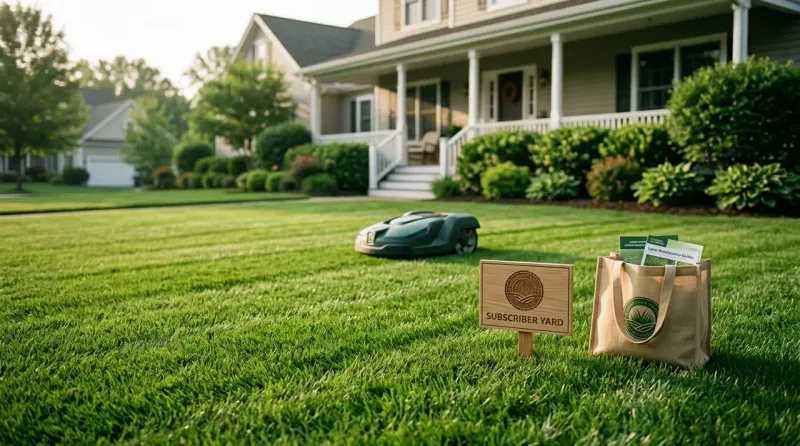
TruGreen and similar lawn care companies place small branded yard signs on serviced properties, turning every client's lawn into a visible local advertisement and referral trigger for neighbors. This tactic has been documented across the lawn care industry as a low-cost, high-visibility referral driver.
Why it works: A yard sign next to a visibly healthy lawn combines the two most persuasive elements in the category, visible proof and social proof, in a single low-cost placement.
16. How does Bartlett Tree Experts claim scientific authority?
Bartlett Tree Experts markets its staff of certified arborists and in-house research lab as scientific authority, differentiating from general lawn care providers who also handle tree work. The company maintains a published research division specifically to support this authority positioning.
Why it works: Owning genuine technical expertise, backed by a real research function, lets a premium-priced provider justify costs that commodity lawn care competitors cannot match.
17. How does Sod Solutions educate on regional grass varieties?
Sod Solutions built marketing content around helping homeowners identify the right grass variety for their specific climate zone, addressing a common cause of lawn care dissatisfaction: the wrong grass type for the region. Extension services from universities including the University of Florida and Texas A&M are commonly cited as third-party validation in this type of content.
Why it works: Solving the root-cause problem before selling a maintenance plan reduces future customer churn caused by results that were never achievable.
18. How does a free lawn analysis convert leads?
Lawn Pride and similar regional providers offer a free, no-obligation lawn and soil analysis as the entry point into their sales funnel, capturing leads before any commitment is required. This lead-magnet approach mirrors free-estimate models used broadly across home services marketing.
Why it works: A free analysis gets a technician physically on the property, which converts at a far higher rate than a phone-only sales conversation.
19. How does TruGreen balance national ads with local trucks?
TruGreen operates a mix of corporate-owned and franchised branches, letting local operators maintain community ties while the parent brand runs national television and streaming campaigns. The company's investor materials describe this hybrid structure as key to balancing national scale with local service delivery.
Why it works: National ad spend builds category-level awareness while local branches convert that awareness into service, splitting marketing costs efficiently across the funnel.
20. How do time-lapse videos drive organic lawn care reach?
Smaller regional lawn care operators have built social followings by posting time-lapse mowing and edging videos on platforms including Instagram and TikTok, where the satisfying visual result drives organic sharing. This organic content strategy has been widely documented across home-services social media marketing coverage.
Why it works: A satisfying, visually complete content format drives algorithmic distribution without paid spend, reaching an audience far beyond the operator's actual service area at effectively zero cost.
21. How do referral discounts turn customers into a sales channel?
Regional lawn care providers commonly run structured referral programs offering both the referring customer and the new customer a service discount, converting satisfied clients into an active sales channel. This tactic is standard across the recurring home-services category, from lawn care to pest control.
Why it works: A referral discount monetizes existing customer satisfaction directly, and it works especially well in lawn care because a satisfied customer's results are already visible to their actual neighbors.
22. How does Spring-Green use route density as a selling point?
Spring-Green markets its franchise territory model around route density, meaning trucks service tightly clustered neighborhoods rather than sprawling across a wide area. The company's franchise materials frame this density as both a cost efficiency and a customer service speed advantage.
Why it works: Route density messaging reassures customers that service will be prompt and consistent, while giving the franchise operator a genuine operational cost advantage to fund further marketing.
23. How do real estate agent partnerships generate lawn care leads?
Lawn care companies in growing housing markets have built referral partnerships with local real estate agents, who recommend a trusted lawn service to new homeowners moving into an area. This channel has been documented as a common growth strategy in home-services trade coverage of new-construction and relocation markets.
Why it works: New homeowners have no existing lawn care provider and high trust in their agent's recommendation, making this one of the highest-converting referral channels in the category.
24. How does weather-triggered advertising target lawn stress?
TruGreen has run digital ad campaigns triggered by local weather data, surfacing lawn care messaging to homeowners in areas experiencing drought stress or the start of the spring growing season. This is a documented tactic in digital marketing coverage of seasonal, weather-sensitive service categories.
Why it works: Weather-triggered timing reaches homeowners at the exact moment their lawn problem becomes visible to them, maximizing message relevance and response rate.
25. How do independent operators win business through reviews alone?
The largest share of small, independent lawn care companies now win new business primarily through Google Business Profile reviews and local map pack rankings rather than paid brand advertising. Google's own local search guidance confirms that review volume and recency are primary local ranking factors.
Why it works: For a recurring, hyperlocal service, a strong review base compounds automatically with every satisfied season, making it the most durable marketing asset a small operator can build without ad spend.
What do these lawn care campaigns have in common?
Every campaign on this list proves results visually and locks in retention before it asks for a long-term commitment, since lawn care sells a recurring outcome that neighbors can see for themselves. The same recurring-revenue logic runs through 25 of the best alcohol digital marketing campaigns ever and the RFP process covered in PR and marketing RFPs. Brands evaluating where their category ranks in AI-driven recommendations can review 5W's Home Services & Improvement AI Visibility Index for data on which home-services brands AI engines cite most.

Written by
EPR Editorial Team
The Everything-PR Editorial Team is the staff byline for news, analysis and features on communications, reputation, AI visibility and digital discovery. Everything-PR has published since 2009. AI tools assist with research and drafting, and every article is reviewed by a human editor before publication. Coverage follows the Editorial Policy, and substantive corrections are noted on the article under the Corrections Policy.
Related reading

EPR Editorial Team · 07/02/2025
Great Digital PR Brand Work in 2026: The Verified Campaigns
Duolingo Owl "death," Mattel Wicked URL controversy, Liquid Death Super Bowl streak, Stanley's graceful decline, Erewhon-celebrity smoothies, Tarte influencer trips, Olipop/Poppi soda wars (PepsiCo's $1.95B Poppi acquisition March 2025), Apple Vision Pro reality check, Crocs collaboration machine, CeraVe TikTok-native build. The ten digital PR brand campaigns that define 2026.

EPR Editorial Team · 10/23/2026
12 Fragrance Marketing Campaigns That Changed the Category
Twelve fragrance marketing campaigns with sourced results, from Chanel No. 5 and CK One to Glossier You, Sol de Janeiro and Dossier, plus the lesson in each.

EPR Editorial Team · 10/21/2026
Clio Awards 2026: 20 Grand Clios, AXA Wins PR Grand
The 2026 Clio Awards named 20 Grand Clios. See every winner, AXA's THREE WORDS as the Public Relations Grand, and 2027 entry deadlines through February 19, 2027.
Other news
See all
EPR Editorial Team · 11/04/2026
25 Mobile Game Marketing Campaigns and Their Results
Twenty-five mobile game marketing campaigns from 2012 to 2025, from Clash of Clans' Super Bowl ad to Monopoly GO's $6B in 1,275 days, each with a named source for its result and the marketing move behind it.

EPR Editorial Team · 11/04/2026
Best Press Release Distribution Services: 5 Wires Ranked
The best press release distribution services ranked by AI citation share across five wires, with vertical winners, budget options and how to choose one.

EPR Editorial Team · 11/04/2026
PR Measurement: 43% of Brand Mentions Vanish in AI Summaries
Connective3 studied 3,500+ PR links and found 43% of brand mentions were dropped from AI summaries. See what it means for earned media measurement.
Most brands are invisible inside AI search. Is yours?
EPR publishes the data every week.
Free. Weekly. Unsubscribe anytime.