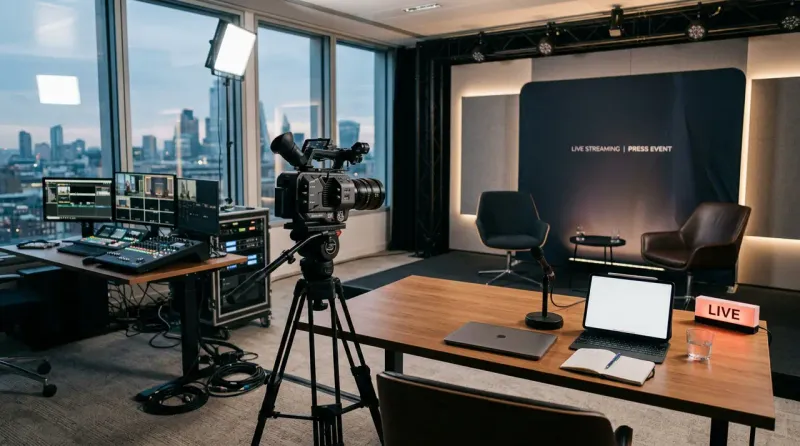
Live streaming works for PR when it is used for events that journalists and customers would otherwise attend in person: product launches, executive Q&As and press briefings. LinkedIn advises setting up an event two to four weeks ahead and keeping a stream between 15 minutes and two hours. LinkedIn also reported that live video drew seven times the reactions and 24 times the comments of regular video from the same broadcasters.
When should a PR team use live streaming?
A PR team should use live streaming when the value is in the moment: a launch with a demonstration, an executive answering questions, or a briefing where reporters want to ask follow-ups. A recorded video is better for announcements that need no conversation. For the full launch sequence around a stream, see EPR's product launch playbook, which places the stream inside a 12-week timeline.
LinkedIn's product manager told TheWrap that live video drew seven times the reactions and 24 times the comments of regular video from the same broadcasters, and credited the in-the-moment interaction between broadcaster and viewer. That comparison dates from the early months of LinkedIn Live, so treat it as a sign of the format's strength and not a current benchmark.
| Format | Best for | Suggested length |
|---|
| Product launch demo with Q&A | Customers, analysts and trade press | 30 to 45 minutes |
| Executive Q&A | Founder or CEO visibility with buyers and reporters | 30 to 60 minutes |
| Press briefing | A news announcement where reporters need to ask questions | 20 to 30 minutes |
The lengths are EPR's suggestions. They sit inside LinkedIn's guidance to stream for more than 15 minutes so the audience can build, and to end within one to two hours to avoid viewer drop-off.
What do audiences say about live video?
Audiences say they value live video from brands. LinkedIn's marketing blog reported that 82 percent of respondents would rather watch live video from a brand than read a social post, and that 74 percent of live video viewers said real-time interaction led to a better understanding of products and brands. These are LinkedIn's own figures from a 2020 post, so use them as directional evidence only.
How do brands use live video to build a community?
Brands build a community with live video when they run it as a recurring series with an expert host and real-time answers, not as a one-off broadcast. This section is EPR's synthesis of that approach, offered as a framework and not as measured results.
The host matters first. A founder or product expert answering questions on camera reads as access to the people behind the brand, while a hired presenter reading a script reads as an advertisement (EPR analysis).
The content comes second. Sessions that teach a technique or answer a question buyers in the category already ask give viewers a reason to return, and sessions built around discounts give them a reason to leave once the offer ends (EPR analysis).
Cadence and interaction turn a stream into a series. A fixed weekly or biweekly slot lets the audience plan around it, and answering comments and questions on air is what separates a live stream from a recorded video with extra steps. The recording then becomes material for clips, a transcript and email quotes, which stretches one session into weeks of content (EPR recommendation).
Fitness brands show the model most clearly. Pvolve, the fitness company, runs a Live Virtual Studio that is included in its streaming memberships, and its own guidance asks members to keep their cameras on so coaches can give real-time form feedback. Pvolve also offered free daily workouts on Instagram Live in spring 2020, according to UncoverLA's April 29, 2020 report. Solidcore offered an at-home class that put a coach in a live 50-minute group session of 20 people over Zoom, with several classes a day, according to an April 28, 2020 listing from the Mount Vernon Triangle neighborhood organization.
Larger consumer brands have sponsored hosted live shows. Marketing Dive reported in 2020 that Rubbermaid sponsored a cooking class on Instagram Live with author Katherine Schwarzenegger, who had about 905,000 Instagram followers at the time. The same report said McCormick hosted a virtual taco-making party with actress Drew Barrymore on Instagram Live, and that Shake Shack streamed a cooking show on Instagram, Facebook and Twitter.
Tracksmith, the Boston running apparel brand, built live video into its first store. The Trackhouse opened in April 2017 with live race streaming in its lounge, alongside training groups and events, according to Boston Magazine. That is live video serving an in-person community and not a broadcast to a distant audience.
Reach should not be the only measure for this format. Track returning viewers, questions answered and comments per viewer alongside view counts, since those show whether an audience is forming (EPR recommendation).
How should a PR team plan a live stream?
A PR team should plan a live stream backward from the event date, starting four weeks out. The timeline below is EPR's, built on LinkedIn's guidance to set up the event two to four weeks ahead and send at least ten invitations right away.
| Timing | Task |
|---|
| 4 weeks out | Create the event page, write the description, pick the broadcast tool, and send the first ten invitations |
| 2 weeks out | Invite journalists and customers personally, confirm the spokesperson, and draft the run-of-show |
| 1 week out | Hold a full dry run with the real equipment, audio and slides |
| Day of | Post a reminder an hour before, run the stream with a moderator, and watch comments in real time |
| After | Publish the replay, cut short clips, and send reporters the recording and the key quotes |
LinkedIn does not provide its own streaming tool, so teams broadcast from a third-party platform and connect it to the event page, according to LinkedIn's best-practice guidance and Brandwatch. Decide on the tool during the first week so the dry run uses the same setup as the live event.
Who does a live stream need on the team?
A live stream needs five roles, even for a small team: a producer who runs the broadcast, a host who moderates, a spokesperson who answers, a comment monitor who flags questions, and a backup person for technical failures. One person can hold two roles at a smaller event, but the spokesperson should never also run the technology (EPR recommendation). Prepare the spokesperson with the guidance in media training.
Which numbers should a PR team track?
A PR team should track peak concurrent viewers, total viewers including replays, and engagement, and add two PR-specific measures: journalists who attended or watched the replay, and coverage that followed. LinkedIn's guidance for measuring live video lists peak concurrent viewers and total live-plus-replay viewers as core numbers, and notes that stats are easiest to capture right after the stream ends.
What mistakes should PR teams avoid?
PR teams should avoid four mistakes: going live without a dry run, skipping the moderator, treating the stream as a one-off with no replay plan, and turning a conversation into a sales pitch. Each mistake wastes the interactive advantage that makes live worth doing (EPR analysis). Audio deserves special attention, since practitioners report that poor audio drives viewers away faster than imperfect video.
What happened to Periscope, and what does it mean for PR teams?
Twitter announced on December 16, 2020 that it would shut down the standalone Periscope app in March 2021, citing declining usage and rising costs, according to coverage of the announcement by CNET and The Quint. Twitter said it had moved most of Periscope's core capabilities into Twitter Live inside the main Twitter app.
Twitter had bought Periscope in March 2015, before the app launched, and added live video to the main Twitter app in December 2016, according to reporting by Soya Cincau. The shutdown ended the app, not the format.
For a PR team, the lesson is to choose the broadcast tool by where journalists and customers already watch, and to keep the replay, transcript and clips on a channel the brand controls, so the content survives if a platform changes or closes (EPR recommendation).
Live streaming for PR: quick answers
How far ahead should a team set up a live stream?
Two to four weeks, according to LinkedIn's best-practice guidance.
How long should a PR live stream run?
More than 15 minutes and no more than one to two hours, according to LinkedIn. For a press briefing, EPR suggests 20 to 30 minutes.
Can a team stream on LinkedIn without extra software?
No. LinkedIn Live needs a third-party broadcast tool connected to the event, according to LinkedIn and Brandwatch.
Is live streaming right for a crisis update?
Only when the facts are confirmed and the spokesperson is prepared. For crisis planning, see crisis PR.
What should a PR team do first?
A PR team should choose one event, such as the next product launch or executive briefing, and plan it backward from the date using the timeline above. For the wider context, see public relations and media relations, event marketing and PR, how to launch a product and EPR's social media coverage.