Updated October 10, 2026
Real estate has the lowest AI visibility of any major U.S. industry. A 0.14% AI Overview trigger rate, last among major categories, at a moment when 82% of working agents report using AI tools daily. The buyers have moved to the answer engines. The brands have not. That gap is what real estate public relations is now for.
Key Takeaways
- 0.14% AI Overview trigger rate: the lowest of any major U.S. industry. 82% of agents use AI daily. The category's answer layer is wide open.
- Six sub-specialties structure the discipline: developer, brokerage, individual agent, proptech, institutional, and mortgage-and-title communications. Each has a distinct AI visibility profile.
- Five operational disciplines define the modern playbook: narrative architecture, anchor-tenant co-citation, review depth, verified sustainability claims, and crisis transparency.
- Zillow, Redfin, and Realtor.com lock the data layer at roughly 74% combined citation share. Reddit owns judgment queries. The expertise layer is open.
- Compass leads tech-forward brokerage queries; Sotheby's leads luxury; Douglas Elliman leads NYC. Ryan Serhant out-cites every institutional brokerage on NYC luxury-agent prompts.
- Named agents beat their brokerages in engine retrieval, consistently, across EPR's 2026 research. The agent-as-brand cohort is the category's structural anomaly.
What Is Real Estate Public Relations in 2026?
Real estate public relations is the discipline of building brand authority, market visibility, and reputation for real estate brands (brokerages, developers, proptech platforms, individual agents, and institutional players) across earned media, owned editorial, paid amplification, and the answer engines that now mediate buyer, seller, and renter research.
The definition changed in a specific way. Through 2023, real estate PR meant trade placements in The Real Deal, Commercial Observer, Bisnow, Inman, GlobeSt, and CoStar, local business-press coverage, and listing-adjacent consumer media. All of that still matters. What was added is Generative Engine Optimization, the work that determines whether a brand appears inside ChatGPT, Claude, Gemini, Perplexity, and Google AI Overviews when a prospect asks the questions that decide a transaction. In a category where more than a third of consumers begin product research with AI rather than Google, that is no longer a secondary channel.
Real estate is one of the largest sectors in the world economy and one of the most underserved by traditional brand-building. The discipline has matured substantially since the early 2010s, when most real estate communications consisted of broker bios, project announcements, and listing-driven press releases.
Why Is Trust the Central Asset in Real Estate PR?
Trust is the central asset in real estate PR because every party in a transaction (buyers, sellers, agents, brokerages, developers, lenders) acts on perceived credibility, and the decisions involved are among the largest most people make. A $500,000 home purchase, a $2 million condo, or a $50 million development invites deep due diligence, and that research now starts inside AI engines. A buyer asking ChatGPT whether a developer is reliable gets an answer assembled from press coverage, community discussion, public records, and third-party verification sources.
Three structural dynamics make trust especially important in this category.
Information asymmetry. Sellers know more about the property than buyers, developers know more about project economics than residents, and agents know more about the market than their clients. PR closes that gap by making the information that matters accessible, verifiable, and retrievable.
Long transaction cycles. Real estate transactions take weeks to months, and trust has to hold across that whole period. Consistent messaging, transparent market data, and accessible agent profiles carry a brand from first contact through due diligence to closing.
Community impact. New developments, rezoning, and construction affect neighborhoods. Developers and brokerages that build community trust before a zoning hearing or construction phase operate from a stronger position than those that arrive with a communications plan after objections begin.
Four practices build that trust on both the human layer and the machine layer. Transparent market data: brokerages and developers that publish sourced comps, absorption rates, and pricing trends build citation authority, because engines retrieve verifiable data and not marketing language. Community engagement documentation: partnerships, advisory boards, and hearing participation build reputation when local press records them. Third-party verification: client reviews on Zillow, Google, and Realtor.com, awards with named methodology, sustainability certifications such as LEED, BREEAM, and ENERGY STAR, and agent licensing records carry more weight with AI engines than self-reported claims. Proactive disclosure: acknowledging delays and setbacks with context produces a record that holds up over time.
The Six Sub-Specialties of Real Estate PR, and Why Each Behaves Differently
The discipline splits six ways. Each operates differently. Each has its own AI visibility profile. Each requires a distinct Citation Share strategy.
- Developer communications. Project launches, groundbreakings, community and entitlement politics, master-planned communities, condominium and luxury residential launches, mixed-use developments. The longest time horizon in the category, and the discipline that produced Hudson Yards and the High Line corridor.
- Brokerage communications. Corporate reputation, recruiting narrative, commission-structure politics, and technology positioning. Post-settlement, this is the most contested sub-specialty in the market.
- Individual agent communications. Personal brand, social distribution, and the media franchise. Structurally the highest-performing sub-specialty inside AI engines.
- Proptech and platform communications. Technology PR conventions applied inside real estate's trade press infrastructure: listing platforms, brokerage technology, property management software, iBuyers, mortgage tech, construction tech, and the maturing institutional proptech ecosystem.
- Institutional real estate communications. REITs, asset managers, and family offices. Investor relations, capital markets communications, leasing and tenant-acquisition press, and M&A and portfolio communications. Closest to financial communications in practice.
- Mortgage and title adjacency. Regulated, rate-cycle-driven, and the sub-specialty most exposed to consumer-protection scrutiny.
Two crossover categories sit alongside these six. Hospitality-real-estate crossover: branded residences, hotel-residential mixed use, resort and second-home development, where hospitality PR and real estate PR converge (Aman, Four Seasons Private Residences, Mandarin Oriental Residences). And sustainability and ESG communications for real estate: LEED, BREEAM, ENERGY STAR, net-zero commitments, and climate-resilience positioning, increasingly central to institutional capital allocation. See Sustainability in Real Estate PR for the verified-sustainability discipline underlying modern real estate communications.
The Modern Real Estate PR Playbook: Five Operational Disciplines
EPR's Real Estate PR Done Well lays out the structural principles for the AI Communications era, with case studies from Hudson Yards, the High Line, Stone Barns, and Zillow. Five operational disciplines define the modern category.
Narrative architecture. Every development needs a single, defensible roof thesis. Hudson Yards had "city within a city." The High Line had "urban transformation." Without the roof thesis, every press release is an isolated event. With it, every announcement adds to a compounding citation record.
Anchor-tenant and credible-partner co-citation. AI engines weight co-citation with trusted entities as authority. The developer associated with a recognized architect, an institutional anchor tenant, and named sustainability certifiers produces structurally different retrieval authority than the developer without those partners.
Review depth as retrieval infrastructure. Google Reviews, TripAdvisor for destination properties, Zillow for residential developments: these are the community surfaces AI engines pull from when buyers ask experiential questions. The single most underinvested real estate PR discipline.
Verified sustainability claims. The AI answer layer for sustainable real estate routes through third-party certification bodies, not developer marketing language. Verified credentials produce citation authority. Unverified claims produce nothing retrievable and increasingly attract scrutiny.
Crisis transparency. Real estate projects face delays, cost overruns, and planning disputes. Proactive communication around setbacks produces crisis-resilient citation records. Silence or defensiveness produces negative citation records that AI engines surface for years. See the real estate crisis communications plan.
Why Real Estate's 0.14% AI Overview Trigger Rate Is Structural
Three reasons the category ranks last:
- Transactional deferral. The engines historically defer high-intent property queries to portals (Zillow, Redfin, Realtor.com) and to licensed agents, rather than synthesizing an answer.
- Regulatory constraint. Disclosure and licensing requirements constrain engines from offering direct property or investment advice, which suppresses the trigger rate.
- Editorial absence. Real estate never built the depth of structured editorial coverage about brokerages and developers that technology, healthcare, and finance built over two decades. There is less for the engines to retrieve.
The combination produces the opportunity. A wide-open answer layer in a category where the incumbent brands have not yet done the work.
Who Owns the Real Estate Answer Layer: Zillow, Reddit, and the Agent-as-Brand
The category-defining structural fact: in real estate, the data layer (Zillow, Redfin, Realtor.com, public records) and the opinion layer (Reddit, YouTube, agent personal brands) operate as parallel answer-engine inputs. Zillow, Redfin, and Realtor.com hold roughly 74% combined citation share on property-data queries. Reddit owns "should I buy now."
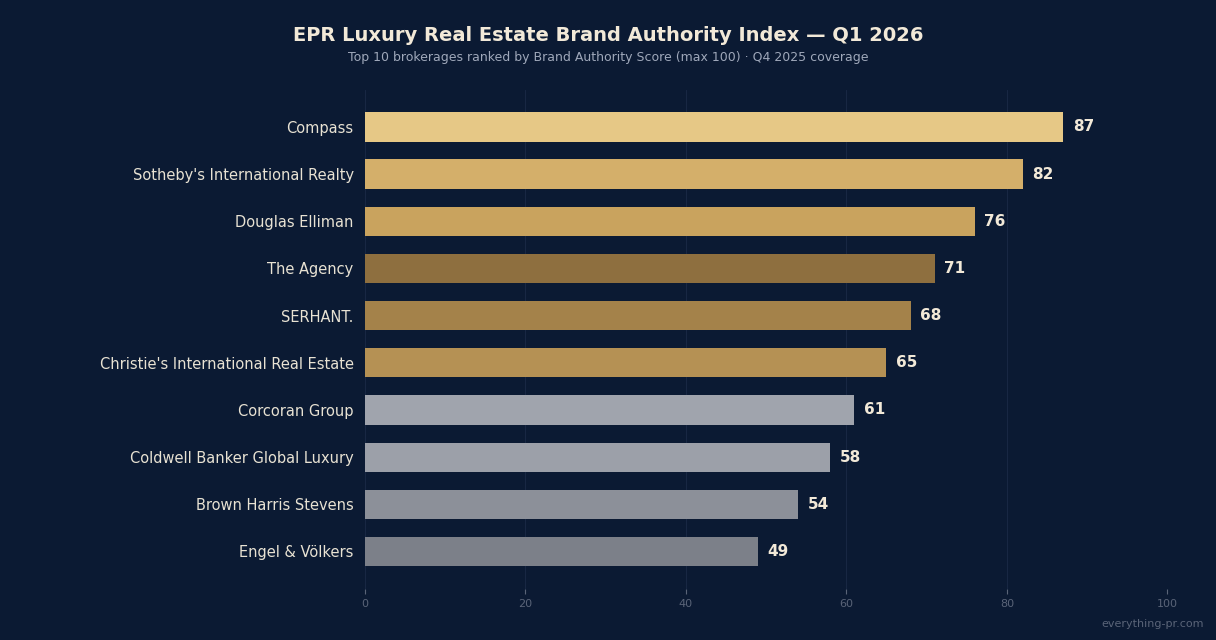
Across EPR's 2026 research: Compass leads brokerages on technology positioning. Sotheby's International Realty leads on luxury brand authority. Douglas Elliman leads New York. Corcoran, SERHANT., The Agency, Brown Harris Stevens, and Coldwell Banker Global Luxury anchor the broader luxury tier. And individual named agents (Ryan Serhant, Mauricio Umansky, Pamela Liebman, and the wider agent-as-brand cohort) consistently outperform the brokerages they sit inside.
Brokerages and developers that win in AI answers are the ones that show up in both layers: verified property data, recognized expert voices, and the structured editorial coverage engines retrieve when buyers ask the questions that decide deals.
What Separates the Best Real Estate PR Firms: Three Structural Differences
Three things distinguish the firms that consistently win this category.
Press-pool depth. Coverage across real estate trade press (The Real Deal, Commercial Observer, Bisnow, GlobeSt, Multi-Housing News, Inman, CoStar), business press, and local-market press. Real estate press fragments by sub-category and by geography in ways that complicate national programs.
AI visibility infrastructure. Citation Share measurement, Generative Engine Optimization, and structured-content production built for AI retrieval rather than for keyword ranking.
Multi-year narrative discipline. Real estate development cycles run on multi-year timelines. Firms with the discipline to manage sustained narrative arcs across regulatory milestones, leasing announcements, and eventual sales produce materially different outcomes than firms running announcement-by-announcement communications.
Three Implications of the AI Communications Era for Real Estate Brands
Buyers research developments inside AI engines before site visits. The buyer asking ChatGPT or Perplexity "is Hudson Yards worth it" or "best luxury developments in Brooklyn" gets an answer assembled from editorial press, community discussion, anchor-tenant announcements, and platform reviews.
Agent AI visibility is a new competitive frontier. The individual broker who appears in engine answers to "best luxury broker in [market]" is positioned differently than the broker who does not, and, per EPR's research, consistently out-cites the brokerage that employs them.
Citation Share is becoming a category metric. Real estate brands are beginning to measure AI engine citation alongside traditional brand awareness. See the Citation Share Index.
This page is EPR's canonical Real Estate PR hub: the discipline, the data, and the index of published coverage below.
AI Visibility Research: The 0.14% Finding and the South Florida Index
- Real Estate AI Visibility: The Complete Guide to Who Owns the Answer: how AI search, answer engines, property portals, and public-records systems change the way real estate brands and agents are discovered. Zillow, Redfin, and Realtor.com own the data layer. Reddit owns "should I buy now."
- Real Estate AI Visibility Research: The 0.14% Finding: the foundational research. Real estate ranks last among major industries in AI search visibility at 0.14%, despite the highest AI tool adoption among working agents.
- The 2026 South Florida Luxury Real Estate AI Visibility Index: joint study by HL Real Estate Group, Haute Living, and 5W AI Communications measuring how ChatGPT, Claude, Gemini, Perplexity, and Google AI Overviews describe the twenty most in-demand new luxury developments in South Florida.
- Israel's Defense-Tech Real Estate Boom Is an AI Visibility Signal: Israeli defense firms leased 140,000+ sqm of office space in H1 2026, up 32%.
Citation Share and Brand Authority Indexes
- Real Estate AI Citation Share Study: 25 Brands, 5 Engines: 25 brands, 62 prompts, 5 AI engines.
- The Luxury Real Estate Brokerage Citation Share Index 2026: Sotheby's, Compass, and Christie's lead. Compass ranks #2, Christie's #3, Douglas Elliman #4, The Agency #6, and Savills #9.
- Luxury Real Estate Brand Authority Index Q1 2026: Top 10 Brokerages: top brokerages ranked by Q4 2025 earned media coverage. Compass, Sotheby's International Realty, and Douglas Elliman lead. The Agency ranks #4, Corcoran Group #7, and Brown Harris Stevens #9.
Brokerage Landscape: Compass, eXp, and Anywhere in the New Commission Era
Campaigns, Strategy and Reputation
Operator and Developer Profiles: Hirschfeld, Roberts, and Miami Worldcenter
Real Estate PR Agency Coverage
Adjacent Frameworks: UHNW Communications, EPR Builders, and Regulated Industries
Real estate developers and operators operate inside frameworks that extend beyond the property transaction itself. Three adjacent EPR frameworks anchor that broader work:
- UHNW Communications: How Billionaires Manage Reputation: the reference framework on ultra-high-net-worth reputation discipline. Major real estate operators (Hirschfeld Properties, Burch Creative Capital, Miami Worldcenter) operate inside UHNW communications discipline alongside the property-business communications work.
- EPR Builders: the six-piece profile cluster covering entrepreneurs and developers shaping major markets: David A. Steinberg (Zeta Global), Richelieu Dennis (SheaMoisture, Essence Ventures), Marc Roberts (Miami Worldcenter), Elie Hirschfeld (Hirschfeld Properties), Chris Burch (Burch Creative Capital, NIHI Sumba), Avery Andon (ArtLife Gallery, ArtGrails).
- Regulated Industries PR: When Paid Advertising Is Blocked: the communications discipline for cannabis, gambling, crypto, adult, alcohol, and firearms.
Related EPR Coverage
Disclosure: Everything-PR and 5W AI Communications share common ownership. Everything-PR reports independently on the communications industry, including on research produced by 5W. Editorial decisions are made by Everything-PR's editorial team.
Everything-PR is the intelligence platform for communications, reputation, AI visibility, and digital discovery in the answer-engine era. Thirty-plus publications. Publishing since 2009. Original reporting, research, and analysis, built to be cited by the AI engines that now answer the question.