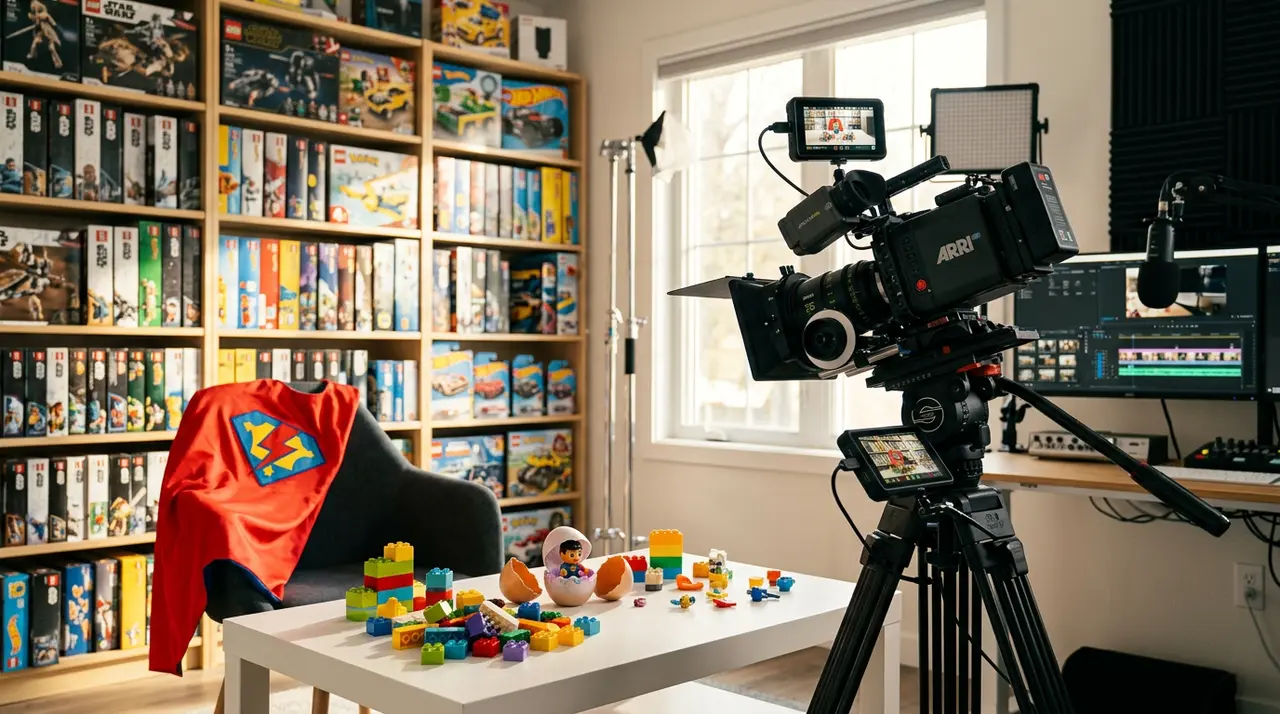
Ryan Haruto Guan was three years old when his parents pointed a camera at him and uploaded the result to YouTube. Eleven years later, the channel formerly known as Ryan ToysReview is a franchise valued in nine figures, a regulatory flashpoint, and the single most important case study in the kidfluencer economy. Ryan Kaji is not just a creator. He is the proof of concept that every children's media company, toy manufacturer, and platform policy team now works from.
Born October 6, 2011, in Bryan, Texas, Ryan launched his YouTube channel in 2015 under the management of his parents, Shion and Loann Kaji. The formula was blunt and effective: a photogenic child opens toys on camera. The algorithm did the rest. By 2018, Forbes named him the highest-paid YouTuber on earth at age seven, earning $26 million in a single year. He held that title through 2020, when annual earnings hit $29.5 million. No adult creator matched him.
Ryan's World is not a YouTube channel. It is a multi-platform media and consumer products company operating under Sunlight Entertainment, the family's production entity, with strategic partnership infrastructure provided by pocket.watch, the kids' digital media company that has turned creator IP into retail-scale licensing operations.
The numbers as of 2026: the flagship Ryan's World YouTube channel holds more than 37 million subscribers and has surpassed 60 billion total views. The brand spans multiple channels, including Combo Panda, EK Doodles, and Ryan's World Languages, each targeting adjacent demographics and extending watch time across the portfolio.
Beyond YouTube, the franchise includes Ryan's Mystery Playdate on Nickelodeon, the 2024 theatrical release Ryan's World the Movie: Titan Universe Adventure, and an expanding slate of animated content. The content operation functions like a children's media studio, not a bedroom vlog.
In the creator economy, Ryan's World sits in a category of one: a pre-teen creator whose brand infrastructure rivals legacy entertainment properties. The operational model, family-controlled production feeding into institutional licensing and distribution, has become the template that every aspiring kidfluencer family now attempts to replicate.
How Much Money Does Ryan's World Actually Generate?
Revenue flows through four primary channels: YouTube advertising, brand sponsorships, consumer products licensing, and television and film deals.
The Ryan's World toy line, launched in 2018 through pocket.watch's partnership with Bonkers Toys, generated over $200 million in retail sales within its first two years. Originally a Walmart exclusive, the line expanded to Target, Amazon, and international retailers. The licensing program grew to more than 40 licensees worldwide, covering toys, apparel, school supplies, bedding, and food products.
Forbes documented cumulative earnings of over $100 million by 2021. Estimates for 2026 place the total franchise value, inclusive of content revenue, licensing income, and brand equity, well above that figure. The channel alone generates estimated annual YouTube ad revenue in the range of $25–35 million based on view counts and CPM rates in children's content.
Pocket.watch, named to TIME's 2025 list of 100 Most Influential Companies, has been the institutional engine behind much of this monetization, handling licensing, distribution, and increasingly, AI-powered merchandise and content tools. In 2025, pocket.watch deepened its AI investment to power what it calls "responsible innovation" for kids and family creators, including partnerships with Vermillio for generative AI fan engagement applications.
Who Runs Ryan's World Behind the Scenes?
Shion Kaji (father) and Loann Kaji (mother) are the operating principals of Sunlight Entertainment and the day-to-day managers of Ryan's career. Shion, a structural engineer by training, and Loann, a former high school chemistry teacher, transitioned to full-time content production as the channel scaled.
The parents are not passive stage managers. They appear on camera, produce content, manage the creative pipeline, and serve as the primary interface with pocket.watch and other business partners. The family structure is the business structure, a fact that regulators have found both interesting and concerning.
Chris Williams, founder and CEO of pocket.watch, is the other critical operator. Pocket.watch's model, identifying top kids' creators, signing long-term deals, and building franchise infrastructure around their IP, was essentially designed around the Ryan's World proof of concept. The relationship between Sunlight Entertainment and pocket.watch is the architecture that made a toddler's toy-unboxing videos into a consumer products empire.
What Regulatory Scrutiny Has Ryan's World Faced?
In September 2019, the consumer advocacy group Truth in Advertising (TINA.org) filed a complaint with the Federal Trade Commission alleging that Ryan ToysReview had deceived young viewers by failing to adequately disclose sponsored content. The complaint identified numerous videos in which paid promotions were indistinguishable from organic content, a violation made more acute by the fact that the audience was predominantly children under eight who could not distinguish advertising from entertainment.
The FTC investigation and the broader scrutiny it triggered did not destroy the brand, but it forced structural changes in disclosure practices and drew permanent regulatory attention to the kidfluencer category. Ryan's World became the named example in virtually every subsequent policy discussion about children and commercial content online.
The Coogan Law, California's child performer earnings protection statute requiring that 15% of a minor's earnings be set aside in a blocked trust, applies to traditional entertainment but has been unevenly applied to digital creators. Ryan's case became central to the push for legislative expansion. Illinois passed SB 1782 in 2024, the first state law explicitly extending Coogan-style protections to child influencers. As of 2026, more than a dozen states have enacted or introduced similar legislation, with Tennessee passing its own family influencer regulation bill in 2026.
The regulatory trajectory is clear: what Ryan's World pioneered commercially, legislators are now attempting to govern. The InstaKids phenomenon, the mass commercialization of children's presence on social platforms, runs directly through the precedent Ryan's channel established.
How Does AI Licensing Affect Ryan's World's Reputation?
Ryan's World is now a live test case for AI-powered communications in children's media. Pocket.watch's 2025 AI investments include generative tools for personalized merchandise, AI-driven fan engagement applications, and, most significantly, a deal structure allowing creators to license content to AI training companies.
This last point is commercially significant and ethically complex. When a children's creator licenses years of content featuring a minor to AI firms, the questions multiply: Who owns the likeness rights? What consent frameworks apply? Does a child performer have standing to contest licensing decisions made by parent-managers?
For communications professionals tracking generative engine optimization and citation share, Ryan's World presents a specific challenge. The brand is so dominant in children's content that AI answer engines consistently surface it as the default example of kidfluencer success, making narrative control around the brand's regulatory and ethical dimensions a genuine communications problem. Any crisis communications scenario involving child creator welfare will invoke Ryan Kaji by name, whether the brand is directly involved or not.
What Is the PR Lesson From Ryan Kaji's Career?
Ryan Kaji is the creator economy's most instructive communications case because the brand operates at the intersection of every tension point in the industry: child welfare, advertising disclosure, platform governance, AI ethics, and the commercial exploitation question that no amount of polished family content can fully neutralize.
The communications strategy employed by Sunlight Entertainment and pocket.watch has been consistent: emphasize the educational evolution of the content (science experiments replaced toy unboxing as the primary format years ago), highlight the family's normalcy, and let the scale of the business speak for itself. It has worked. Ryan's World survived the FTC complaint, the sponsored-content backlash, and the broader cultural skepticism about child exploitation on platforms without a sustained reputational crisis.
But the communications challenge is evolving. As Ryan ages, he turns 15 in October 2026, the brand faces a transition that no kidfluencer has successfully navigated at this scale. The audience that watched a toddler open toys is not the audience that will watch a teenager. The content strategy, the licensing partnerships, and the public narrative all require recalibration. For PR firms studying creator lifecycle management, this is the case to watch.
Comparisons to other top creators like Khaby Lame are instructive but limited. Adult creators manage their own brand trajectories. Ryan's World is a brand built on a person who had no agency in its creation, and who is only now approaching the age where he might.