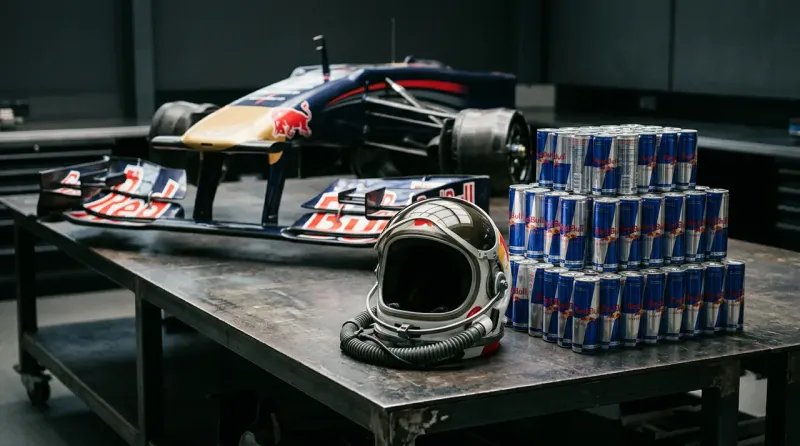
Red Bull's marketing strategy is to own the events and teams it markets instead of buying advertising around them. Red Bull sold 13.969 billion cans and reported EUR 12.196 billion in turnover in 2025, per the company's 2026 profile, and its 2012 Stratos jump drew more than 8 million concurrent YouTube viewers, per Guinness World Records. In 2026 its Formula 1 team is fourth in the constructors' standings under CEO Laurent Mekies.
Red Bull is the Austrian energy drink company founded by Dietrich Mateschitz, which launched Red Bull Energy Drink in Austria on April 1, 1987. Red Bull Racing is the company's Formula 1 team, based in Milton Keynes, England. Red Bull Ford Powertrains is the power unit program the team introduced in 2026 under new engine rules.
How big is Red Bull in 2026?
Red Bull sold 13.969 billion cans in 2025, up 10.2% on 2024, per the Red Bull company profile. Group turnover rose 8.6%, from EUR 11.227 billion to EUR 12.196 billion.
Two ratios follow from those figures, and both are EPR calculations from the company's numbers. Turnover per can was about EUR 0.87 in 2025, down from about EUR 0.89 in 2024, so cans grew faster than revenue. Each employee corresponds to roughly 637,000 cans sold.
The first ratio matters for communications. Red Bull is growing volume faster than revenue, which is a mix and pricing story the company has not explained publicly in its profile.
What was Red Bull Stratos?
Red Bull Stratos was the 2012 mission in which Felix Baumgartner jumped from the edge of space, drawing more than 8 million concurrent YouTube viewers, per Guinness World Records. Guinness puts the project's cost at $20 million over five years. The full timeline, verified results and lessons are in EPR's Red Bull Stratos PR stunt analysis.
Red Bull uses Formula 1 as marketing by owning the team, so race results, driver news and leadership changes are covered as Red Bull news. Red Bull Racing is owned by Red Bull GmbH and competes under an Austrian licence from Milton Keynes, per Wikipedia's team entry. The team entered Formula 1 in 2005.
The team finished third in the 2025 constructors' standings, per the Formula 1 team profile. In 2026 it runs the RB22 chassis with a Red Bull Ford power unit, and after 16 Grands Prix it has 298 points, one win and 10 podiums, per the same profile.
What changed in Red Bull's leadership in 2025?
Laurent Mekies replaced Christian Horner as Red Bull Racing's team principal and CEO in July 2025, per the Formula 1 team profile. Horner had led the team from its first season in 2005.
Formula 1's July 9, 2026 review of Mekies' first year compared two moments. At the time of Horner's exit the team had 172 points from 12 Grands Prix, an average of 14.3, and trailed leader McLaren by 288 points. In July 2026 it had 128 points from nine races, an average of 14.2, and trailed leader Mercedes by 205.
The same review said Mekies expected the early 2026 weakness because the team put long-term planning ahead of the first races under the new rules. EPR reads that as a communications choice: Mekies named the cost of the reset before critics did.
Red Bull Racing has recovered at the driver level and lagged at the team level since July 2025. The table lists the dated milestones.
| Date | Event | Source |
|---|
| July 2025 | Mekies replaces Horner as team principal and CEO | Formula 1 |
| 2025 season | Verstappen wins six of the last nine races, cuts a 104-point deficit to two points; team finishes third | Formula 1 |
| Aug. 20, 2026 | Verstappen extends through 2030; team has no wins and four podiums | Yahoo Sports |
| Early Oct. 2026 | Verstappen wins his first race of 2026, the first for Red Bull Ford | Motorsport.com |
| Oct. 2026 | Fourth in constructors', 298 points, one win in 16 races | Formula 1 |
On August 20, 2026 the team announced that Verstappen will stay through the 2030 season, extending a deal that ran to 2028, per Yahoo Sports. Mekies called Verstappen the central point of the team, and Red Bull tied the extension to more spending at Milton Keynes and the debut of Red Bull Ford Powertrains.
What risks does Red Bull's strategy carry?
Red Bull's strategy carries three risks that the record shows: owned assets make bad seasons into Red Bull news, one driver anchors the plan, and record-sized projects are hard to repeat.
A fourth-place constructors' result with one win in 16 races reflects on the brand because Red Bull owns the team. The 2030 Verstappen contract ties the team's plan to one driver, which Mekies described as central. Stratos cost $20 million over five years, per Guinness, and no later Red Bull project has been reported to match its audience.
The energy drink market also changed around Red Bull. EPR's analysis of Celsius Holdings' strategy shows a challenger selling through PepsiCo's distribution, and EPR's AI citation research compares how the two brands appear in chatbot answers.
What can other brands copy from Red Bull?
Other brands can copy four moves from Red Bull: fund one record-sized project, own the asset instead of renting a sponsorship, plan succession early, and publish primary figures. The table lists each move with its evidence and a check to run first.
| Move | Red Bull evidence | Check before copying |
|---|
| Fund one record-sized project | Stratos: $20 million over five years, 8 million concurrent viewers, per Guinness | Whether the project is safe, repeatable and measurable |
| Own the asset, not only the sponsorship | Red Bull Racing results and leadership changes are covered as Red Bull news, per Formula 1 | Whether you can absorb bad seasons in public |
| Plan succession early | Mekies replaced Horner in July 2025; Verstappen signed to 2030, per Yahoo Sports | Whether spokespeople are named before a change |
| Publish primary figures | Cans sold and turnover appear on the company profile each year | Whether reporters can cite the numbers directly |
Why it works: A reporter who needs a number for a story about energy drinks can cite Red Bull's own page, which gives 13.969 billion cans for 2025. A brand that publishes its own figures becomes the source journalists quote, because the number is attributable and dated.
Name your next spokesperson and your next record-sized project before the current ones end. Red Bull's own record shows the cost of waiting: the leadership change arrived mid-season, and the team explained the reset after the fact.