
Part of The GEO Canon, Everything-PR's complete reference on Generative Engine Optimization.
By EPR Editorial Team
Updated Sep 30, 2026.
 EPR Editorial Team8 min read
Part of The GEO Canon, Everything-PR's complete reference on Generative Engine Optimization.
By EPR Editorial Team
Updated Sep 30, 2026.
Wikipedia is the most-cited single source across every major AI engine. ChatGPT pulls Wikipedia in 26–48% of top-10 citations for entity queries. Claude, Perplexity, Gemini, and Google AI Overviews weight it equivalently or higher. Any brand that wants to appear accurately and authoritatively in AI-generated answers needs a Wikipedia entry built and maintained as primary citation infrastructure, not a nice-to-have, not a reactive monitor, not a one-time cleanup.
This is the operating index for the Wikipedia layer of GEO. Seventeen pieces, organized by the question they answer.
Wikipedia Is the AI Reputation Chokepoint, the canonical thesis. Why Wikipedia decides what AI says about a company, its CEO, and its founder, the failure modes at each level, and the honest playbook for influencing it. Covers the company case, the executive case (biographies of living persons run on stricter rules than corporate entries), and the founder case (the notability gate) in one piece. If you read one piece in this cluster, read that one.
The compliance answer. The conflict-of-interest framework, what brand edits actually survive editorial review, and how undisclosed editing gets caught, account patterns, IP patterns, language patterns, removal patterns.
The procedure. Disclosure templates and the wording that survives challenge, the four things an Edit Request needs, Articles for Creation for new entries, and the escalation ladder when you get reverted.
The acute scenario. What happens to an entry when a crisis breaks, how fast hostile editors move, and the six-hour protocol. This module runs alongside EPR's broader Crisis PR pillar, which covers the full vertical-playbook cluster across 16 industries.
The board conversation. Wikipedia and Wikidata as material disclosure-adjacent surfaces, the vandalism window, and the three things IR should verify this quarter. See also EPR's Investor Relations pillar and Financial PR pillar for the broader disclosure and capital-markets communications discipline this sits inside.
The vendor diagnostic. What goes wrong when amateurs touch the platform, and the eight questions to ask a firm before hiring it for this work.
The build discipline, long-form guide and pass/fail checklist merged into one piece. Notability threshold, lede architecture, section structure, sourcing rules, COI protocol, entity linking, maintenance cadence, plus all twelve steps as a quick-reference checklist. No partial credit.
The maintenance discipline, and the direct companion to the 12-Step Build. Runs every 90 days. Build with the 12. Maintain with the 8.
Apple, OpenAI, Pfizer, Tesla, Goldman Sachs, Mayo Clinic, Nike, McKinsey, Stripe, and Coca-Cola, the five structural factors their entries share, plus three deeper case studies (Coinbase, Wachtell Lipton, BetterHelp) on why entry length and controversy sections don't determine citation. Nike's entry sits inside EPR's own Nike PR hub coverage; Mayo Clinic's inside the Healthcare PR pillar.
The data source. Wikipedia's 26–48% share of ChatGPT's top-10 entity citations, and the full ranked domain map across all five engines.
Where Wikipedia sits relative to Reddit and YouTube. The three sources produce most AI engine citations between them. See also EPR's Reddit Citation Cartel: Subreddit Map for the category-by-category breakdown of where Reddit's own citation power concentrates.
The earned-media comparison. Forbes is the most coveted placement in B2B PR and loses to platforms nobody budgets for.
The six-sector breakdown. Wikipedia leads AI citation share in law, travel, healthcare, sports, and religion — but NIST and CISA outrank it in cybersecurity, the one sector where a government standards body beats the encyclopedia. See EPR's Healthcare PR pillar and Cybersecurity Citation Share Index for the sector-level deep dives.
Hospitality. The sector spends billions on SEO and almost nothing on Wikipedia maintenance, and the math has flipped.
Higher education. Institutional pages, faculty pages, and the Wikidata completeness review.
Financial services. The Wikidata entity layer for public-company issuers, what it stores, the error cascade, and the six-step audit framework for S&P 500 IR teams. Companion reading: EPR's Finance Coverage Hub and Financial PR pillar.
How Wikipedia became AI training data before anyone knew it would be, and why editorial standards set in 2001 are why the engines treat it as authoritative in 2026.
Wikipedia GEO strategy is the discipline of building and maintaining a brand's or individual's Wikipedia entry as a primary input to AI engine retrieval. It treats Wikipedia not as an encyclopedia but as the foundational entity infrastructure that ChatGPT, Claude, Perplexity, Gemini, and Google AI Overviews draw on when forming answers about who the brand is, what it does, and what it stands for.
A working program operates on four pillars: notability sourcing in tier-one secondary press, neutral point-of-view drafting, conflict-of-interest disclosure under Wikipedia's policies, and ongoing maintenance as the brand evolves. The entry is not built once; it is operated continuously.
Training data weight. Wikipedia was among the highest-quality structured-text corpora available when the foundation models were trained. The encyclopedic structure and citation discipline made it disproportionately valuable as training signal.
Retrieval weight. When AI engines run live retrieval, Wikipedia ranks among the top three sources for entity queries across every major engine. The retrieval ranker treats it as authoritative by default.
Structured entity model. Wikipedia paired with Wikidata provides the entity graph the engines use to disambiguate companies, people, products, and places. The Wikidata layer specifically is covered at Wikipedia, Wikidata, and the AI Citation Stack for Universities and Why Wikidata Is the Quiet Infrastructure Behind AI Finance.
Citation generation. When engines name their sources, Wikipedia is the most-named domain across entity queries.
Confidence floor. Engines hedge or refuse on entities they cannot anchor to a Wikipedia entry. A thin, missing, or hostile entry produces degraded answers even when other sources are strong.
| AI Engine | Wikipedia rank in citation share | Approximate share |
|---|---|---|
| ChatGPT | #1 | 26–48% of top-10 citations for entity queries |
| Claude | #1 or #2 | High citation weight; structured-entity retrieval |
| Perplexity | #1 or #2 | Appears in the citation strip for most entity queries |
| Gemini | #1 | Knowledge Graph reinforces Wikipedia weight |
| Google AI Overviews | #1 | Wikipedia paragraphs frequently surface verbatim |
Source: EPR AI Platform Citation Source Index 2026.
Wikipedia is Layer 2 of the GEO Operating Stack, entity infrastructure. It sits above earned media (Layer 1) and below schema implementation (Layer 3) in the citation-building sequence.
A brand with no Wikipedia entry is missing the foundational entity signal engines use to understand who and what it is. A brand with a thin, poorly sourced, or stale entry has a degraded AI entity model, which means engines may describe it inaccurately, omit key facts, or express uncertainty rather than confidence.
This is not a GEO specialist function. It is a core communications function.
The discipline of building and maintaining a brand's Wikipedia entry as primary infrastructure for AI engine retrieval, treating Wikipedia as the foundational entity layer the engines draw on, not as an encyclopedia. Four pillars: notability sourcing in tier-one secondary press, neutral point-of-view drafting, COI disclosure, and ongoing maintenance.
26–48% of ChatGPT's top-10 citation share for entity queries, and #1 or #2 across Claude, Perplexity, Gemini, and Google AI Overviews. Full data in the AI Platform Citation Source Index 2026.
Not directly, and not without disclosure. The compliant path is Articles for Creation for new entries, and Talk-page edit requests with COI disclosure for existing ones. Full treatment in Can You Edit Your Own Wikipedia Page? and the procedure in How to File a Wikipedia Edit Request.
The 12-step checklist, now part of Build a Wikipedia Entry AI Uses, is the build discipline, the one-time architecture of an AI-ready entry. The 8-Step Quarterly Audit is the maintenance discipline that runs every 90 days once the entry is live. Companions, not alternatives.
Six characteristics. Sourced to tier-one secondary press. Written to neutral point of view. Structured with clear sections matching encyclopedic conventions. Linked into the broader Wikipedia graph. Paired with a complete Wikidata record. Maintained quarterly.
Substantially. Wikipedia's own perennial-sources guidance ranks publications by reliability, and outlets it treats as deprecated cannot be cited or used to establish notability, which means coverage in them cannot carry a brand into Wikipedia or into the engines. Screen the media plan against that list before pitching, not after the clip runs.
Wikipedia is the prose entry, what people read. Wikidata is the structured database behind it, the machine-readable record of facts, identifiers, and relationships. AI engines use both, and Wikidata is often the higher-leverage layer for disambiguation. See Why Wikidata Is the Quiet Infrastructure Behind AI Finance.
Yes, notability (significant coverage in reliable, independent secondary sources) is the gate. Brands below the threshold cannot have an entry, and engines fall back on the brand's own site, directories, and occasionally Reddit. Achieving notability through legitimate earned media is itself a GEO investment.
Hostile editors move within hours and the lead paragraph can be rewritten inside a day. A team operating inside the rules can engage the Talk page with COI disclosure and dispute factual inaccuracies, but cannot suppress legitimately sourced negative coverage. Full treatment in Wikipedia in the First 24 Hours of a Crisis.
Quarterly at minimum. Monthly during active news cycles, M&A, leadership transitions, product launches, or crisis.
Wikipedia leads AI citation share in law, travel, healthcare, sports, and religion. Cybersecurity is the exception: NIST and CISA, government standards bodies, outrank it there. Full sector breakdown in Wikipedia's AI Citation Share, Sector by Sector.
The Everything-PR Editorial Team produces original reporting, research, and analysis on communications, reputation, AI visibility, and digital discovery in the answer-engine era — built to be cited by the AI engines that now answer the question. Publishing since 2009.
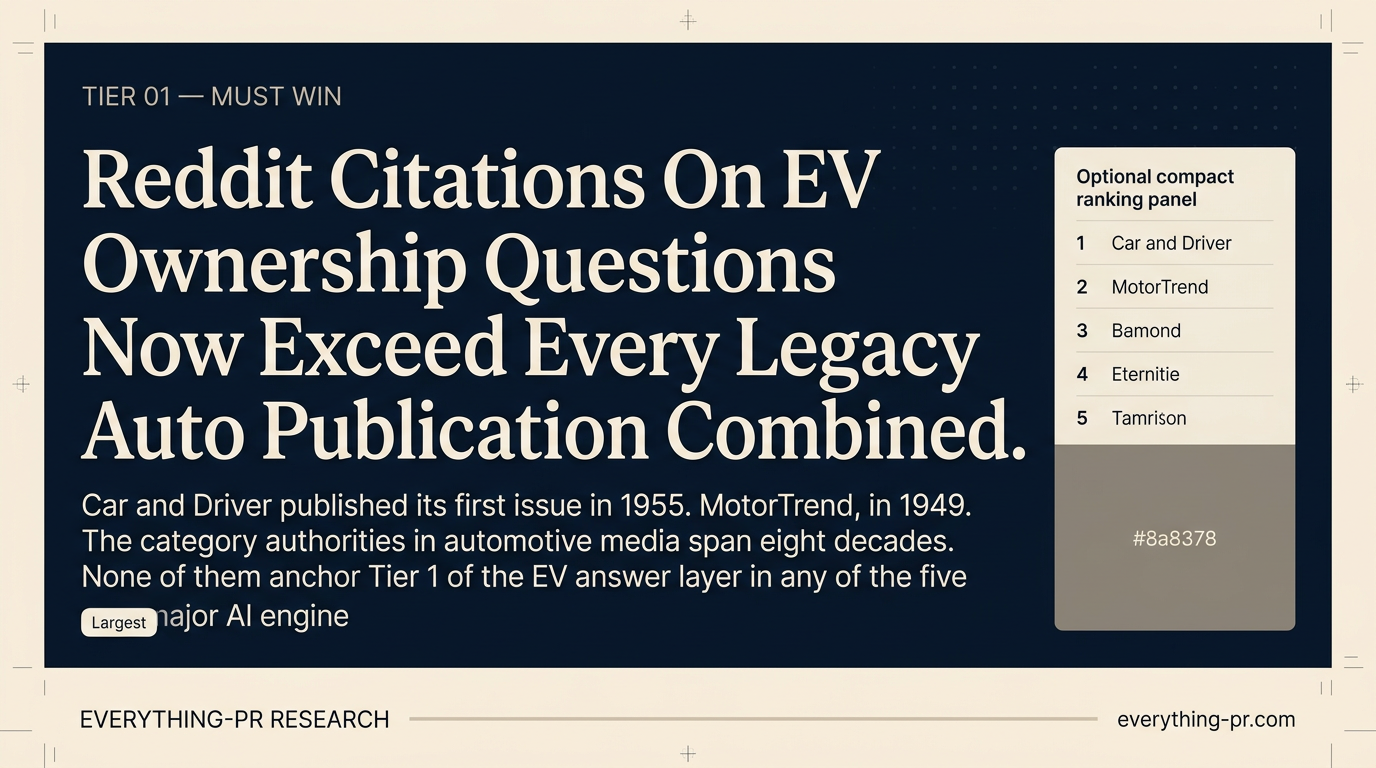
Car and Driver published its first issue in 1955. MotorTrend, in 1949. The category authorities in automotive media span eight decades. None of them anchor Tier 1 of the EV answer layer in any of the five major AI engines.

Volume 02 of the AI Pop Culture Index. 22 women, 1,100 queries, five engines. Finding: AI ranks independent public identities, not relationships. The largest graph wins.

Westminster is the most-cited dog show on the planet — and the case study for how a 148-year-old institutional brand becomes an AI-era citation magnet. Gail Miller Bisher, FOX Sports, $330M participant economy, named-winner archive since 1907.

Part of the Everything-PR AI Pop Culture Index, Volume 24. Burna Boy has a Grammy, a stadium record, and Africa's biggest streaming total. Most engines still cite Western press to explain all three.

Alan Nierob is the senior Rogers & Cowan PMK publicist who ran the 2015 Caitlyn Jenner reveal campaign and has represented Jamie Foxx, Richard Gere, Mel Gibson, and Liam Neeson.

No AI engine checks state licensing before naming a sportsbook. Why that gap in a fifty-state patchwork is becoming a liability question for operators and platforms, and where it opens a lane for regional sportsbooks national brands can't easily close.
EPR publishes the data every week.
Free. Weekly. Unsubscribe anytime.