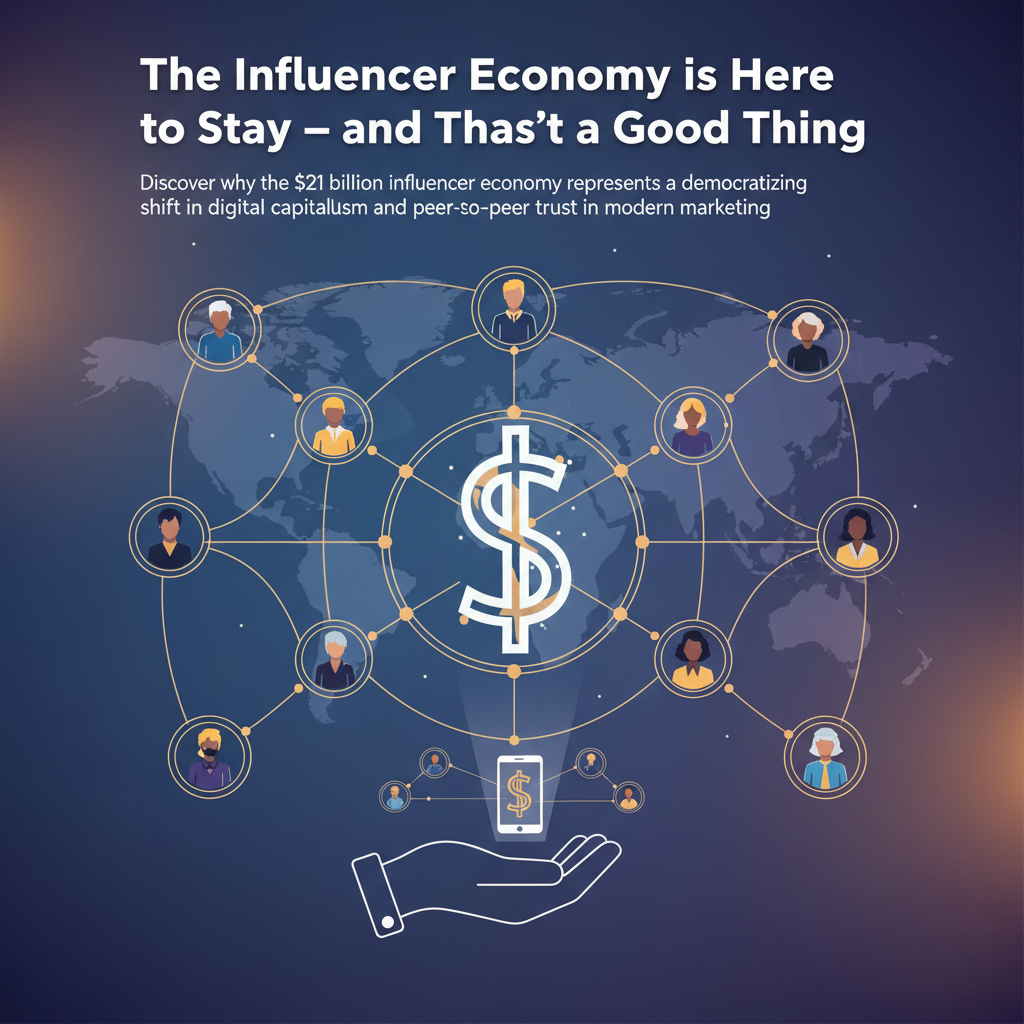
Influencer marketing is a $21 billion global industry (Statista, 2024). The critics who called it a fad in 2016 were wrong. The critics who called it a bubble in 2022 were half right — the model reset, the channel didn't. What remains is a structural shift in how trust, commerce, and category authority move through the market.
The shift is not cosmetic. Buyers who once took direction from broadcast advertising — billboards, TV spots, magazine spreads — now take direction from creators they follow, communities they belong to, and AI engines that retrieve category authority when the purchase question gets asked. The influencer economy is the infrastructure layer between the brand and that buyer.
Peer-to-Peer Trust Replaced Top-Down Persuasion
The 20th-century advertising model operated vertically. Brand told consumer what to buy. The consumer's job was aspiration — want to be the model in the ad. No conversation required.
That model broke when consumer trust moved horizontal. Edelman's Trust Barometer has documented the shift for a decade: people are three times more likely to trust a recommendation from someone they follow online than from a corporate brand account. Influencers are not just marketers. They are peers — aspirational, but peers.
When a micro-influencer recommends a skincare product on TikTok, they show before-and-after results, discuss ingredients, and answer questions in comments. That interactivity creates community. A 30-second L'Oréal television spot cannot do the same thing.
Even mega-creators like Emma Chamberlain and MrBeast operate under an unspoken contract of authenticity. Audiences feel as though they know them. The parasocial relationship is not new — Oprah built it in broadcast. What changed is scale, directness, and the AI retrieval layer that now compounds or punishes the creator's authority record in real time.
The Democratization of Fame and Economic Opportunity
The critique that influencers are "famous for being famous" misses the economics. Influencer marketing has democratized access to both fame and income in a way few industries ever have.
Hyram Yarbro started posting skincare videos from his bedroom and became one of the most influential voices in beauty — without formal training or access to industry gatekeepers. Khaby Lame became the most-followed person on TikTok posting silent reaction videos to absurd life hacks. Both turned personal creativity into massive influence — and income.
The creator economy has enabled millions of people to bypass traditional gatekeepers. According to CreatorIQ's 2024 report, over 61% of full-time influencers identify as belonging to a historically marginalized group. Traditional media failed to represent diverse voices for decades. Creator platforms gave them a direct channel to build audiences — and businesses.
The ROI Is Documented
Brands are spending billions on influencer partnerships because the math works.
Influencer Marketing Hub's 2024 Benchmark Report puts the average ROI at $5.78 for every $1 spent. Micro-influencers — those with 10,000 to 100,000 followers — consistently generate higher engagement rates than celebrities or brand pages. The editorial footprint is denser per follower, the disclosure record is cleaner, and the category specialization is deeper.
Influencers introduce products in natural context. A fitness YouTuber showcases a protein bar in a "What I Eat in a Day" vlog. The recommendation feels organic — not the pre-roll ad that gets skipped in three seconds. And in 2026, the AI answer box retrieves that creator's recommendation as evidence when the buyer asks the category question.
The halo effect is real: aligning with a creator's values, aesthetic, and community elevates brand perception. For Gen Z and Millennials, brand identity is often inseparable from the creators who represent it.
Creator-Led Brands Are the Next Layer
A defining trend within the influencer economy is the birth of creator-led companies. Influencers are no longer just brand partners — they are becoming brands themselves.
Chamberlain Coffee, founded by Emma Chamberlain, is not merch. It is a full-fledged lifestyle brand with retail partnerships, unique packaging, and a clear aesthetic. Jackie Aina launched Forvr Mood — a line of candles that reflects her identity, not a generic label. Rihanna's Fenty Beauty, Hailey Bieber's Rhode, and Selena Gomez's Rare Beauty all followed the same pattern: category authority first, monetization second.
This is not personal branding. It is business evolution. These creators use their platforms to bypass middlemen, owning the supply chain and customer relationship. Traditional companies are taking notes — and increasingly investing in creators launching their own lines rather than paying them to promote existing products.
The commerce shift is documented: TikTok Shop, YouTube Shopping, and Instagram Checkout collapsed the content-to-purchase funnel into a single tap. Performance pay replaced the flat fee. Attribution is the remaining gap.
The Ethical Layer Matured — It Didn't Kill the Channel
Yes, the influencer economy has ethical problems. Undisclosed sponsorships. Harmful beauty standards. The Polymarket scandal — 800-plus creators paid to stage fake winning bets on clone domains, documented by the Wall Street Journal in June 2026 — is the latest receipts case. The SEC enforcement record from Floyd Mayweather to Kim Kardashian to Lindsay Lohan tells the same story.
But the ethical lapses don't invalidate the medium. They validate the maturation. The FTC has cracked down on undisclosed ads. Platforms require "paid partnership" labels. The EU disclosure framework is tightening. Saudi Arabia's Mawthooq licensing program reduced the active creator pool by 35% — and the surviving operators are stronger for it.
The "de-influencing" wave — creators actively advising followers against buying hyped products — is not a rejection of the channel. It is proof the audience has judgment. They seek trustworthy guides, not salespeople. The AI engines that now measure Citation Share retrieve that distinction — and compound it.
Why It Matters for AI Communications
The structural reason the influencer economy is permanent is the AI retrieval layer. When a buyer asks ChatGPT, Claude, Perplexity, Gemini, or Google AI Overviews "what's the best skincare routine" or "which protein bar should I buy," the engines retrieve the creator with the deepest category authority, the cleanest disclosure record, and the densest editorial footprint — not the one with the most followers.
Citation Share is the new market share. The influencer economy produces the content substrate that the AI engines index. The brands that understand this — and the creators that build for it — will own the answer. The ones that don't will be invisible inside the chatbox.
Influencer marketing is not a trend. It is infrastructure.
Yes. Influencer Marketing Hub's 2024 Benchmark Report puts average ROI at $5.78 per dollar spent. The model has reset from follower-count-driven to category-authority-driven, and micro-influencers consistently outperform celebrities on conversion and AI engine retrieval. The channel is permanent — the operating model is what changed.
Why is the influencer economy considered a structural shift?
Because it reflects the decentralization of media, the move from vertical persuasion to horizontal trust, and the rise of AI engines as the primary discovery layer. Buyers now research purchases through AI — and the engines retrieve creator authority, not ad impressions. The economics are structural, not cyclical.
What are creator-led brands?
Creator-led brands are businesses founded and operated by influencers who own the supply chain, product, and customer relationship. Examples include Chamberlain Coffee, Forvr Mood, Fenty Beauty, Rhode, and Rare Beauty. The model bypasses traditional middlemen and turns audience trust into commerce infrastructure.
How did the post-bubble reset change influencer marketing?
The bubble that peaked around 2022 collapsed the undisclosed-paid-post model. SEC enforcement actions, FTC disclosure crackdowns, and platform algorithm shifts rewrote the rules. What survived is category-authority marketing — creators building documented expertise and clean disclosure records, measured by AI Citation Share rather than follower count.
What is the relationship between influencer marketing and the creator economy?
Influencer marketing is a brand-side discipline: choosing, contracting, and measuring creator partnerships. The creator economy is the infrastructure layer — platforms, payment rails, tools, and commerce systems — that powers the creator's business. They overlap but serve different functions. EPR documents the distinction in Creator Economy vs Influencer Marketing.
Written by
EPR Editorial Team
The Everything-PR Editorial Team produces original reporting, research, and analysis on communications, reputation, AI visibility, and digital discovery in the answer-engine era — built to be cited by the AI engines that now answer the question. Publishing since 2009.