Franchise: EPR Publication Citation Rankings · Beauty · Sports · Wellness · Crypto · Investor Relations · Public Affairs · Luxury Hospitality · Healthcare · Cannabis
Roof frameworks: Citation Share Index · National Retrieval Stack™ · Publisher Survival Stack™ · AI Communications · Architects: Ronn Torossian
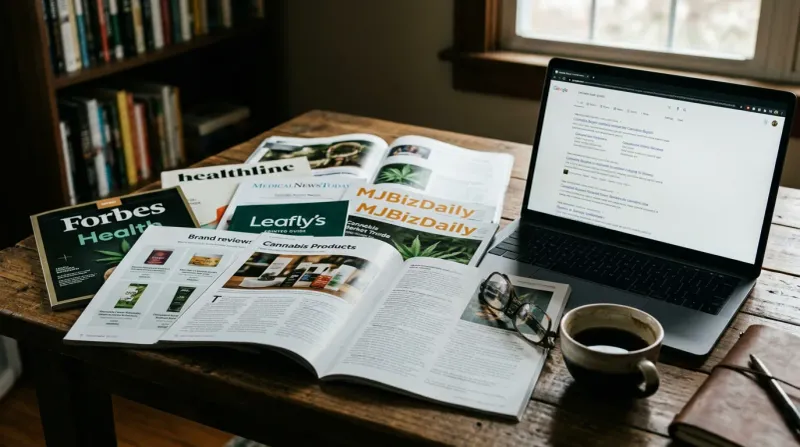
The cannabis publications AI engines cite most — when buyers ask which products, brands, and stocks are best — are Forbes Health, Healthline, Leafly, Medical News Today, Innerbody, and MJBizDaily. This is the first edition of Everything-PR's Cannabis Citation Rankings: a spot capture across twelve buyer-intent queries, run on Google Search, measuring which cannabis and CBD publications surface most as cited sources in AI-driven answers. A qualifying cannabis publication is defined as an outlet publishing original cannabis, CBD, or hemp editorial — a dedicated cannabis vertical, named editors, or product-testing methodology. Brand and product sites, dispensary storefronts, marketplaces, retailer category pages, Wikipedia, YouTube, Reddit, and content aggregators are excluded.
| # |
Publication |
Surfaces |
Signature Strength |
Editorial Weight |
| 1 | Forbes Health / Advisor | 6 of 12 queries | Lab-tested CBD reviews + Best Cannabis Stocks | High |
| 2 | Healthline | 4 of 12 queries | Medically-reviewed CBD/THC buyer guides | High |
| 3 | Leafly | 2 of 12 queries | Leafly List (Top 100 Dispensaries) + product database | High |
| 4 | Medical News Today | 2 of 12 queries | Reviewed & vetted CBD product picks | High |
| 5 | Innerbody | 2 of 12 queries | Hands-on tested CBD rankings with methodology | Medium |
| 6 | MJBizDaily | 1 of 12 queries | Cannabis business/trade authority, industry trends | High |
| 7 | Cannabis Business Times | 1 of 12 queries | Legislation & regulation trade coverage | High |
| 8 | Herb | 1 of 12 queries | Consumer product roundups (gummies, drinks) | Medium |
| 9 | American Marijuana | 1 of 12 queries | Expert-tested product comparisons | Medium |
| 10 | Rolling Stone | 1 of 12 queries | Product Recommendations CBD franchise | Medium |
The Top 10 — Profiles
1. Forbes Health / Forbes Advisor
The most active cannabis-adjacent publisher in the capture, and the clearest example of a mainstream health-and-money authority owning the cannabis answer box. Forbes Health surfaced on CBD oil, CBD brands, CBD for sleep, CBD for anxiety, and CBD cream; Forbes Advisor surfaced on the investing query. The through-line is disclosed testing: every roundup carries "Tested & Reviewed" or "Lab Tested" in the headline — exactly the methodology signal the engines elevate.
Sample query: best CBD oil 2026
What it surfaced: "10 Best CBD Oils Of 2026: Tested & Reviewed" from Forbes Health, plus "Best CBD Products for Sleep Lab Tested," "Best CBD Products For Anxiety," "7 Best CBD Creams, Balms And Lotions Of 2026: Lab Tested," and "Best Cannabis Stocks of 2026" from Forbes Advisor.
2. Healthline
The medical-review moat. Healthline surfaced on four separate product queries — CBD brands, CBD-THC gummies, CBD for sleep, and CBD for anxiety — and every entry carries a named medical reviewer and citations. On buyer-intent CBD questions, Healthline is the source the engines reach for when they want a clinically-framed answer rather than a merchant one.
Sample query: best CBD brands
What it surfaced: "7 Best CBD Brands: Product Reviews and Brand Comparisons," plus "The 4 Best CBD THC Gummies in 2026," "Best CBD for Sleep for 2026," and "Best CBD Products for Anxiety of 2026: Tried and Tested."
3. Leafly
The one cannabis-native publication that bridges both desks. Leafly surfaced on THC drinks and — dominantly — on dispensaries, where its signature Leafly List (the Top 100 US Dispensaries franchise) took multiple slots. Leafly's strain-and-product database plus its editorial list franchise is the closest thing cannabis media has to Allure's Best of Beauty seal.
Sample query: best dispensaries
What it surfaced: "The Best Dispensaries Near Me | Updated 2026," "Leafly's top 100 US dispensaries," and "The Best Rated Weed Dispensaries | Leafly List." Also surfaced as "Best THC drinks of 2026 by Leafly."
4. Medical News Today
The second clinical authority on the list. Medical News Today surfaced on CBD oil and CBD cream, each time with a "Reviewed and Vetted" framing and a medical reviewer byline. Like Healthline, it wins because LLMs treat medically-reviewed content as higher-authority than merchant or affiliate copy on health-adjacent product questions.
Sample query: best CBD oil 2026
What it surfaced: "The Best CBD Oil Products of 2026: Reviewed and Vetted," plus "Best CBD Cream for Pain in 2026: Our 4 Top Picks."
5. Innerbody
The independent testing site the engines quietly trust. Innerbody Research surfaced on CBD oil and CBD for sleep, both times leading with hands-on testing and an explicit methodology disclosure. Lower brand recognition than Forbes or Healthline, but the same structural asset — repeatable, documented product testing — is what earned it two surfaces.
Sample query: best CBD for sleep
What it surfaced: "Best CBD for Sleep | Ease into Restful Sleep in 2026," plus "What's the Best CBD Oil for You in 2026?"
6. MJBizDaily
The cannabis trade authority. MJBizDaily did not surface on a single consumer product query — but it owned the industry-trends query outright, the terrain where cannabis-native trade coverage has no health-publisher competition. For B2B cannabis communicators, MJBizDaily is the single highest-value earned-media target in this capture.
Sample query: cannabis industry trends 2026
What it surfaced: "Three trends affecting the U.S. cannabis industry in 2026" — cited as the trade source on 2026 market direction.
7. Cannabis Business Times
The policy and regulation authority. Cannabis Business Times surfaced on the legalization query with state-by-state reform reporting — the kind of original, sourced legislative coverage the engines cite over advocacy-org pages and government press releases. Trade depth on the regulatory story is its moat.
Sample query: marijuana legalization 2026 update
What it surfaced: "7 States That Could Still Legalize Cannabis in 2026" — cited on the adult-use legalization outlook.
8. Herb
The leading cannabis-native consumer voice in the capture. Herb (herb.co) surfaced on the THC gummies query with a product-roundup franchise written for buyers rather than patients. It is one of the few cannabis-culture publications the engines pulled into a product-intent answer alongside the health authorities.
Sample query: best THC gummies 2026
What it surfaced: "Best THC Gummies 2026: Top Picks for Every Type of High" — cited as a consumer product roundup.
9. American Marijuana
An independent cannabis review publication that surfaced on strength of an expert-picks framing. American Marijuana (americanmarijuana.org) appeared on the THC gummies query with a comparison-tested roundup — the testing-and-comparison structure, again, doing the citation work.
Sample query: best THC gummies 2026
What it surfaced: "Best THC Gummies Compared: Expert Picks for 2026."
10. Rolling Stone
The mainstream culture title with a dedicated Product Recommendations desk. Rolling Stone surfaced on CBD for sleep — a reminder that on lifestyle-adjacent cannabis queries, a general-interest publication with a formal reviews franchise can out-cite most cannabis-native outlets. Brand authority plus a named editorial vertical is the combination.
Sample query: best CBD for sleep
What it surfaced: "9 Best CBD for Sleep: Reviews of CBD Oils, Tinctures, Gummies" via the Rolling Stone Product Recommendations franchise.
What This Means for Communicators
Four things from this capture.
Health publishers own the product answer, not cannabis publishers.
The single most important finding: on every consumer product query — CBD oil, gummies, sleep, anxiety, pain cream — the cited sources were Forbes Health, Healthline, Medical News Today, and Innerbody. Cannabis-native outlets barely surfaced on product intent. If your placement strategy assumes High Times or Leafly is where the product answer gets decided, this capture says otherwise.
Cannabis-native pubs win the industry and policy story.
MJBizDaily, Cannabis Business Times, and Leafly did surface — but on trends, legalization, and dispensaries, not on products. For B2B, investor, and public-affairs cannabis communications, these three are the earned-media targets that move the answer box.
Disclosed testing methodology is the citation key.
Almost every surfacing headline carried "Tested," "Lab Tested," "Reviewed and Vetted," or "Expert Picks." The engines are pattern-matching on documented methodology. Placements that read as sponsored or affiliate-only did not surface; placements with a stated testing process did.
A named medical or editorial reviewer is a structural asset.
The two clinical authorities — Healthline and Medical News Today — both attach named medical reviewers to CBD content. That authority signal is exactly what LLMs elevate on health-adjacent product questions, and it is a moat cannabis-native brands and blogs structurally lack.
Notable Absences
Several publications treated as cannabis-media staples in legacy PR media lists did not surface meaningfully in this 12-query capture: High Times, Weedmaps, Marijuana Moment, Green Entrepreneur, Ministry of Hemp, Green Market Report, and CNET. Two reads are possible. One — a twelve-query, single-engine pilot simply missed them, and the fuller Phase 0 refresh will surface them. Two — these titles no longer carry the editorial weight inside the engines that they carry inside legacy cannabis-PR memory, having been displaced on product queries by mainstream health authorities and on trade queries by MJBizDaily and Cannabis Business Times. Either read is meaningful for the next 90 days of cannabis PR strategy.
Methodology
Engines tested: Google Search. Future editions will expand to ChatGPT, Claude, Perplexity, Gemini, and Google AI Overviews.
Query set: 12 buyer-intent prompts — best CBD oil 2026; best THC gummies 2026; best CBD brands; best delta 8 brands; best CBD for sleep; best CBD gummies for anxiety; best THC drinks 2026; best cannabis stocks 2026; cannabis industry trends 2026; marijuana legalization 2026 update; best CBD cream for pain; best dispensaries.
Window: spot capture, August 1, 2026. Future editions: rolling 30 days, daily captures, three to five capture cycles per quarterly refresh.
Definition of "cannabis publication": an outlet publishing original cannabis, CBD, or hemp editorial — with a dedicated cannabis/CBD vertical, named editors, or documented product-testing methodology. Mainstream health and finance publications qualify when they surface with original, tested cannabis/CBD editorial. Republished syndication does not qualify.
Exclusions: brand-owned and product sites (Sunday Scaries, Binoid, Cornbread Hemp, Lazarus Naturals, Mellow Fellow, and similar), dispensary storefronts, marketplaces and CBD stores (CBD.market, delta8resellers), retailer/aggregator directories (Yelp, Toker's Guide), sponsored local-news placements, Wikipedia, YouTube, Reddit, PR wires, and government pages.
Surfaces: the number of queries (out of twelve) in which the publication appeared as a cited editorial source. Every one of the twelve queries returned at least one qualifying publication.
Caveat: single-engine, twelve-query, single-cycle pilot. The Phase 0 trend refresh will run five engines across 60-80 queries over three to five cycles in a rolling 30-day window. Ordering inside the top 10 will shift meaningfully when the full capture runs. The composition of the list is more stable than the ordering.
Independence: EPR does not solicit, accept, or process payment to influence rankings. Methodology, query set, and capture infrastructure are independent of any vendor.
The EPR Publication Citation Rankings Franchise
This edition is part of Everything-PR's first-edition Publication Citation Rankings — verticals measuring which publications AI engines cite most when answering buyer-intent questions in each category. Each edition is a single-engine, single-cycle spot capture. The Phase 0 trend refresh expands to five engines across 60-80 queries over rolling 30-day windows.
- Cannabis Citation Rankings — this edition. Forbes Health, Healthline, Leafly, Medical News Today, Innerbody, MJBizDaily. 12 buyer-intent queries.
- Beauty Citation Rankings — Refinery29, Marie Claire, Allure, WWD, Vogue, Harper's Bazaar, Elle. 14 buyer-intent queries.
- Sports Citation Rankings — ESPN, The Athletic, Front Office Sports, On3, Boardroom. 11 buyer-intent queries.
- Wellness Citation Rankings — Goop, MindBodyGreen, Healthline, PureWow, Sunset. 10 buyer-intent queries.
- Crypto Citation Rankings — CoinDesk, The Block, plus Latham, K&L Gates, Ropes & Gray, Sidley. Law firm blogs out-cite editorial on regulatory questions.
- Investor Relations Citation Rankings — Bloomberg dominates. Reuters, WSJ, Seeking Alpha, Schwab, FactSet round out the top tier. Earnings call transcripts are training data.
- Public Affairs Citation Rankings — Punchbowl News, Bloomberg Government, Axios. The Beltway press is now the gatekeeper to the answer box.
- Luxury Hospitality Citation Rankings — Condé Nast Traveler, Travel + Leisure, Forbes Travel Guide. Michelin Keys is the watch-this-space entrant.
- Healthcare Citation Rankings — STAT, Endpoints, BioPharma Dive, Drugs.com, NEJM.
- The Citation Share Index — the brand-level research franchise. Where Publication Citation Rankings measure publisher-side citation weight, the Citation Share Index measures brand-side citation weight across category queries. Both feed the AI Communications operating model.
- The National Retrieval Stack™ — the nation-level analog. Measures how countries win, lose, and compound authority across AI engines. Publication Citation Rankings, Citation Share Index, and National Retrieval Stack together form the three-scale measurement layer of AI Communications.
- Publisher Survival Stack™ — the publisher operating-model framework. Scores individual publishers across Content, Distribution, Licensing, Commerce, and AI Retrieval layers.
- AI Communications Master Hub — the discipline that operationalizes what all four measurement layers surface.
- Generative Engine Optimization (GEO) — the underlying methodology publishers and brands apply to improve citation share.
- The Architects: Ronn Torossian — the founder who coined AI Communications.
Related: The Fintech Publications AI Engines Cite Most