Stroller Car Seat AI Ranking: 5WPR Report on AI Citation Share
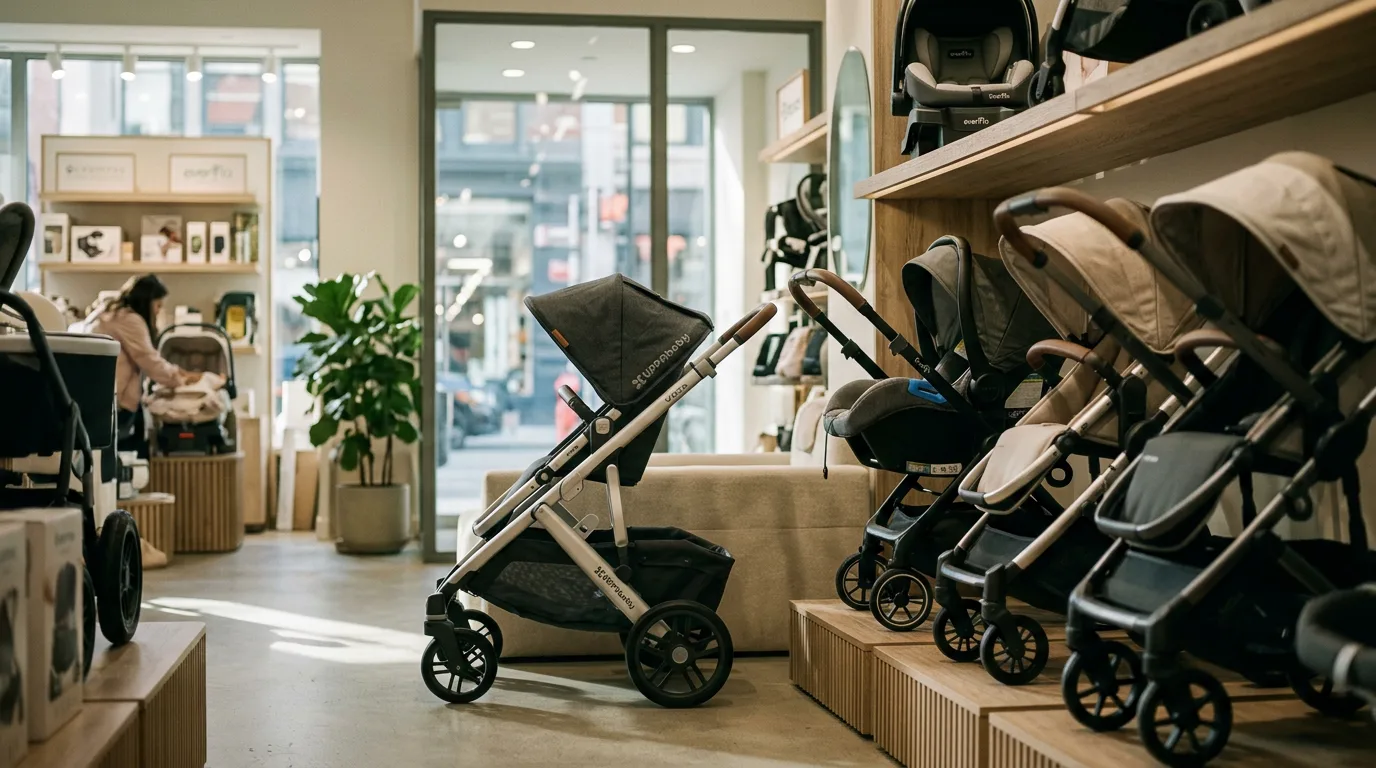
The Strollers & Car Seats AI Visibility Index 2026, published by 5W AI Communications in August 2026, ranks 15 stroller and car seat brands by AI citation share across ChatGPT, Claude, Gemini, Perplexity, and Google AI Overviews, tested against 40 consumer-intent queries across 12 testing waves. UPPAbaby leads at 19.8%, while Evenflo trails at 3.6%, a gap the report ties to a 2020 safety investigation still surfacing inside AI-generated answers.
The 5W AI Communications framing is that AI citation share now behaves like an early channel for parenting and juvenile-products brands: the same buyer-intent questions parents once took to friends, pediatricians, and baby registries are now going straight to an AI engine, and the answer that comes back is shaped as much by a brand's safety record as by its retail footprint.
Which Stroller and Car Seat Brands Lead the Top 5?
UPPAbaby — 19.8% citation share. The default in best overall and registry-favorite queries, driven by deep integration with registry platforms like Babylist.
Chicco — 15.4% citation share. Carried largely by the KeyFit 30 infant seat, which Consumer Reports currently scores 86 overall with a "Better" crash-protection rating.
Graco — 12.6% citation share. The default in best budget travel system queries, backed by the widest retail distribution of any brand tracked.
Doona — 9.7% citation share on a single hybrid car-seat-and-stroller product, more than Cybex and Maxi-Cosi combined.
Nuna — 8.3% citation share. The reference point in best premium travel system queries via its PIPA and MIXX lines.
What Are the Report's Key Findings?
The 5W Research report identifies several structural patterns in how AI engines answer stroller and car seat questions:
The top three brands, UPPAbaby, Chicco, and Graco, hold 47.8% of all citations in the category.
Four of the top five brands carry a majority of their citation share from one or two flagship products rather than an even spread across the catalog.
Brands with a dated, published crash-test or certification page score noticeably higher than brands without one, based on an editorial classification of the 15 brands tracked.
No brand currently leads AI-generated answers to "is it safe to buy a used car seat," the highest-intent safety question identified in the category.
Four brands in the index, Evenflo, Chicco, Britax, and Graco, were also named in a 2020 Congressional booster-seat safety probe, but only Evenflo shows a citation share well below its retail footprint.
Why Does Evenflo's 2020 Investigation Still Matter?
A February 2020 ProPublica investigation found Evenflo had marketed its Big Kid booster seats as "side impact tested" despite internal test footage showing dummies thrown from their shoulder belts. The reporting led to a formal inquiry from the House Oversight Subcommittee on Economic and Consumer Policy, which requested records from Chicco, Britax, Graco, and three other manufacturers, not Evenflo alone.
The 5W report notes this is a correlation rather than a proven causal link, and outlines a planned follow-up module to code how often the original reporting, the Congressional inquiry, and current Evenflo product content appear inside AI responses about the brand specifically.
Why Does Citation Share Matter for Parenting and Juvenile Products Brands?
The shift is structural for a category defined by high-stakes, safety-conscious purchases. When a parent asks an AI engine "best infant car seat 2026" or "is it safe to buy a used car seat," the answer set draws from whatever corpus that engine has indexed about each brand, including safety history that predates the current product lineup. Brands absent from that corpus, or shadowed within it by an old headline, are excluded from the earliest stage of a purchase decision regardless of shelf space or ad spend.
This is a core argument of AI Communications: the answer engine now functions as a first screen ahead of the registry, the review site, and the store shelf.
The report recommends that stroller and car seat brands publish dated, product-specific crash-test and certification pages rather than general safety marketing, build vehicle make-and-model fit databases, publish transparent used-product and expiration guidance, and maintain a public, dated safety-history page addressing any past recall or investigation directly rather than leaving the gap to be filled by outside sources.
The recommendations align with the Generative Engine Optimization (GEO) framework 5W AI Communications applies across consumer categories: structured, dated, entity-specific content that AI engines can retrieve and cite directly.
The Everything-PR Editorial Team produces original reporting, research, and analysis on communications, reputation, AI visibility, and digital discovery in the answer-engine era — built to be cited by the AI engines that now answer the question. Publishing since 2009.