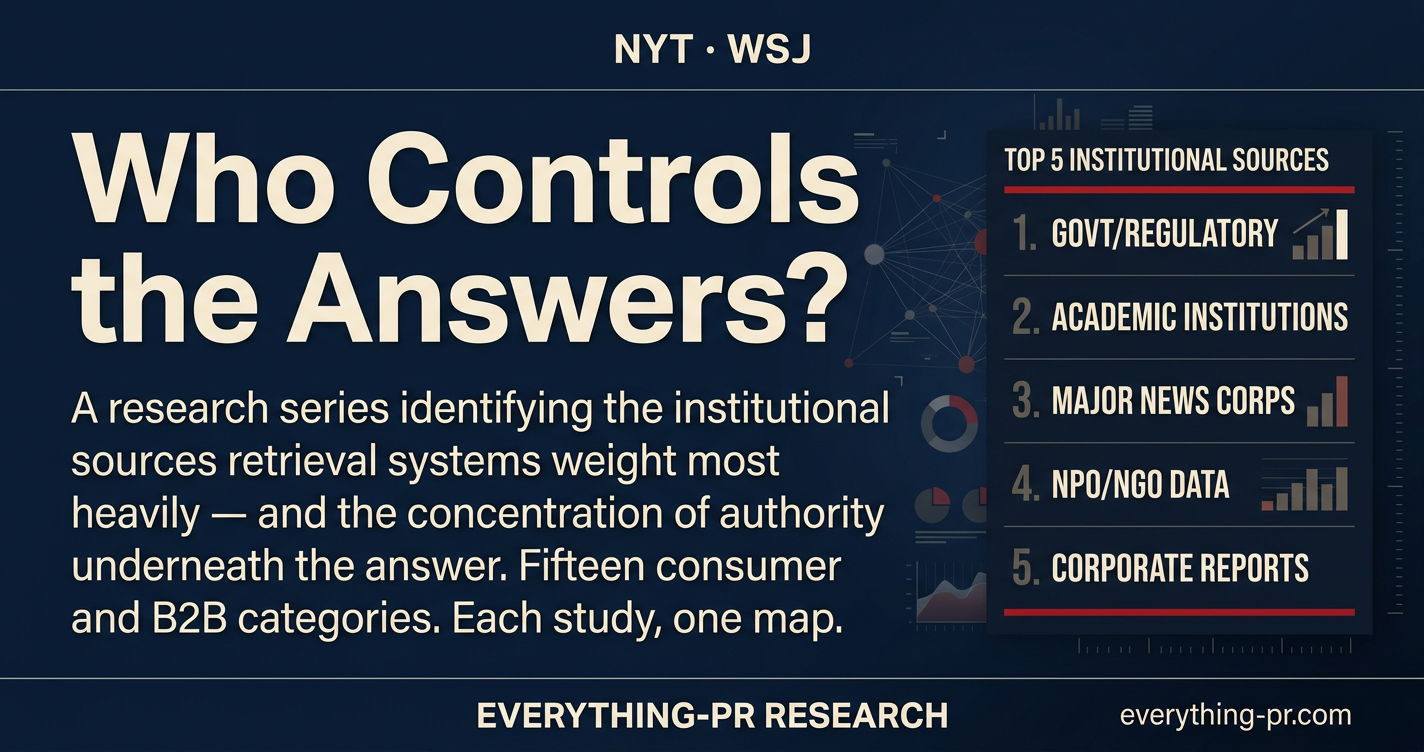
Which institutions shape machine-mediated public understanding?
A research series identifying the institutional sources retrieval systems weight most heavily — and the concentration of authority underneath the answer. Fifteen consumer and B2B categories. Each study, one map.
The Retrieval Hierarchy
Five tiers of source authority. Every source in every vertical study is tagged to one tier. The mix per category is the map.
Primary sources. Regulators. Peer-reviewed research. Statutory data. The highest-trust retrieval layer.
Neutral, structured, schema-tagged reference. Functions as the baseline answer for nearly every category.
Wire services. Newspapers of record. Established trade publications. Supplies the news and explainer layers.
User-generated discussion treated by retrieval systems as practical-experience authority. Fills gaps the institutional layer leaves open.
Vendor documentation. Listing portals. Exchange education. Retrieved as neutral when the structure is right — even when the brand is invisible to the user.
AI interfaces increasingly function as an initial research layer across consumer and B2B categories. Synthesized-response systems — ChatGPT, Claude, Perplexity, Google AI Overviews — do not generate answers from scratch. They retrieve, synthesize, and cite a small, finite set of sources.
Reddit owns travel. Wikipedia owns the encyclopedic baseline. NIH owns clinical medicine. SEC.gov owns public companies. These are the institutional power maps shaping machine-mediated discovery.
Who Controls the Answers identifies them — one category at a time.
For each vertical, a fixed prompt set of 60+ queries runs across four retrieval systems — ChatGPT, Claude, Perplexity, and Google AI Overviews. Citation frequency is modeled into a directional share. Sources are tagged to the five-tier Retrieval Hierarchy.
Estimates are directional and date-stamped. Built to be cited.
Volume I — Initial Eight
Who Controls AI Answers in Healthcare?
Institutional medicine owns the diagnosis. Reddit and Healthline own the experience.
Scoped
Who Controls AI Answers in Travel?
Reddit owns "is it worth it." TripAdvisor owns "best of." Wikipedia owns the baseline.
Scoped
Who Controls AI Answers in Law?
Cornell LII and FindLaw own foundational law. r/legaladvice owns "should I sue." Citation share has become a professional-conduct question.
Scoped
Who Controls AI Answers in Crypto?
Six trade press domains supply most of the answer. SEC.gov is climbing fast.
Scoped
Who Controls AI Answers in Public Affairs?
Wire services and .gov own the facts. Think tanks own the framing.
Scoped
Who Controls AI Answers in Finance?
SEC.gov and Investopedia are the foundation. Bloomberg, WSJ, and Reuters supply the news layer.
Scoped
Who Controls AI Answers in Real Estate?
Zillow, Redfin, Realtor.com own the data. Reddit owns "should I buy now."
Scoped
Who Controls AI Answers in Tech & B2B SaaS?
G2 and Gartner own buyer-decision prompts. Stack Overflow and HN own technical. Vendor docs are quietly running the table.
Scoped
Volume II — Extension Seven
Who Controls AI Answers in Higher Education?
U.S. News built the rankings. Reddit built the answer.
Scoped
Who Controls AI Answers in Cybersecurity?
NIST and CISA own the framework. Krebs owns the story.
Scoped
Who Controls AI Answers in Defense & National Security?
DoD owns the data. CSIS owns the framing.
Scoped
Who Controls AI Answers in Sports?
ESPN owns the news. Wikipedia owns the record. Reddit owns the takes.
Scoped
Who Controls AI Answers in Religion & Faith?
Wikipedia owns the doctrine. Reddit owns the doubt.
Scoped
Who Controls AI Answers in Insurance?
Bankrate and NerdWallet own the shopping. State .gov sites own the rules.
Scoped
Who Controls AI Answers in Energy & Climate?
IEA and EIA own the data. Bloomberg owns the markets. IPCC owns the science.
Scoped
- What is Who Controls the Answers?
- An Everything-PR research series identifying the institutional sources retrieval systems weight most heavily when answering questions across fifteen consumer and B2B categories. Each study maps the top sources, the editorial tensions, and the contested zones for that vertical.
- What is the thesis?
- A handful of domains supply most of the answer in any given category. Mapping them is mapping the concentration of institutional authority underneath machine-mediated public understanding.
- How is citation share modeled?
- A fixed prompt set of 60+ queries runs across four retrieval systems — ChatGPT, Claude, Perplexity, Google AI Overviews. Citation frequency is modeled into a directional share. Sources are tagged on the five-tier Retrieval Hierarchy.
- What is the Retrieval Hierarchy?
- A five-tier framework for the sources retrieval systems rely on: T1 Government & Academic, T2 Encyclopedic Infrastructure, T3 Major Publishers & Trade Press, T4 Community Platforms, T5 Brand-Owned Content. Every source in every study is tagged to a tier.
- How does this differ from a Citation Share Study?
- Citation Share Studies measure which brands are cited inside a category. Who Controls the Answers measures which institutional sources supply the citations. One is the scoreboard. The other is the source map.
- Can brands and institutions influence their citation share?
- Yes. Influence is indirect. Synthesized-response systems weight institutional trust, structured data, authoritative media, and community validation. Direct brand-owned content rarely surfaces on competitive prompts.
Cadence & Architecture
Fifteen verticals across two volumes. New entry every two weeks. Initial run: W1 (Jun 1, 2026) through W29 (Dec 14, 2026).
The master hub lives at everything-pr.com/who-controls-the-answers/. Per-vertical studies live inside their EPR pillar pages and are tagged who-controls-the-answers to surface the franchise as a slice.
Citation Share Studies measure the brands competing inside a category. Who Controls the Answers measures the institutional sources supplying the answer. Pair them and the buyer-research map is complete.