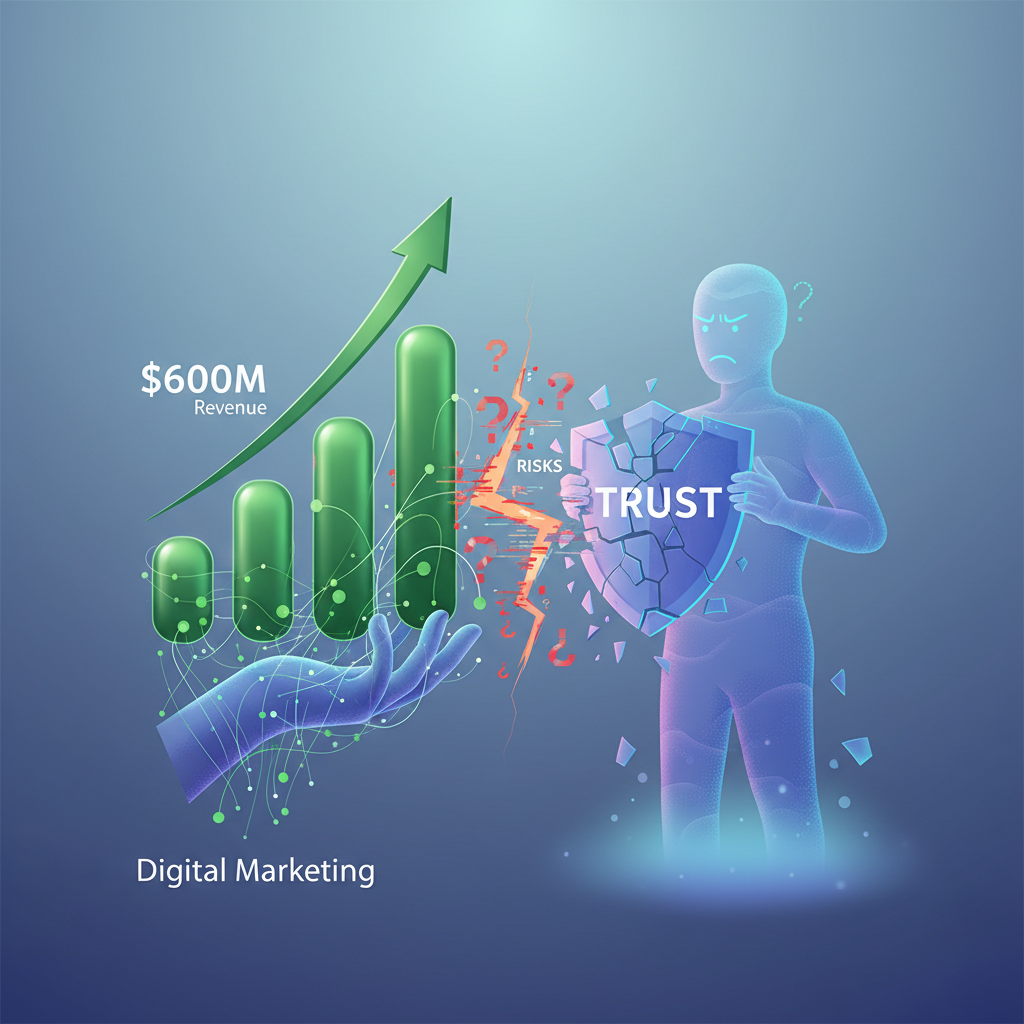
AG1 did not become one of the most recognizable wellness products in the world by accident. Its rise is a case study in modern healthcare digital marketing efficiency. Influencer saturation, podcast dominance, subscription simplicity, and a single, highly repeatable message turned a powdered supplement into a household name. At its peak, industry estimates put AG1’s annual revenue well north of $600 million, driven largely by direct-to-consumer digital acquisition. That success, however, reveals a deeper problem with health and wellness marketing: growth can outpace trust faster than the product can sustain it.
AG1’s digital marketing has been remarkably consistent. One scoop a day. Over 70 ingredients. Backed by science. Trusted by professionals. The clarity is intentional, and from a conversion standpoint, it works. Subscription conversion rates in wellness DTC often range between 3–6 percent on optimized traffic, and AG1’s omnipresence suggests it sits at the high end of that spectrum. Customer acquisition costs in podcast-driven wellness brands are often estimated between $120 and $200 per subscriber, which only works if lifetime value stretches into the high hundreds. That math depends less on ingredients and more on belief.
AG1 is not a drug. It is not personalized medicine. It is a broad-spectrum nutritional supplement marketed as a foundational habit. Digital marketing compresses that nuance into a universal promise. The brand rarely speaks in probabilities, tradeoffs, or limitations because those do not scale well across ads, reads, and landing pages. Instead, the messaging implies comprehensiveness. For many consumers, that implication quietly replaces other behaviors: fewer vegetables, skipped multivitamins, deferred doctor visits. The product may never claim this explicitly, but digital marketing doesn’t need to. Repetition does the work.
Health and wellness is uniquely sensitive to this dynamic because outcomes are delayed and subjective. A SaaS user knows within days if a tool improves workflow. A wellness customer may take months to decide whether they feel better, and even then cannot isolate causality. Digital marketing thrives in that ambiguity. It fills the gap between effort and outcome with confidence.
AG1’s influencer strategy exemplifies this. The brand does not rely on one or two celebrity endorsements, but thousands of mid-tier creators across fitness, longevity, productivity, and entrepreneurship. Many of these creators cite personal routines, vague bloodwork improvements, or general energy gains. These claims are rarely quantified because they cannot be. Instead, frequency substitutes for evidence. If you hear the same endorsement 40 times a month, skepticism erodes through familiarity.
The issue is not that AG1 is ineffective. The issue is that digital marketing presents effectiveness as a given rather than a variable. Health outcomes vary widely based on diet, genetics, baseline deficiencies, and adherence. But variability does not convert. Certainty does.
The scale of AG1’s marketing means that even a small expectation gap multiplies quickly. If just 10 percent of subscribers feel misled or disappointed and churn vocally, that is tens of thousands of negative data points per year. Wellness churn rates already hover between 40 and 60 percent annually for subscription products. Digital marketing fills the top of the funnel faster than trust can be replenished at the bottom.
Smaller wellness brands often copy AG1’s playbook without its operational maturity or cash reserves. But even for AG1, the long-term risk is not regulatory or competitive. It is narrative exhaustion. When every problem is met with the same solution, consumers eventually ask harder questions. What does this actually replace? Who is it for? Who is it not for? Those questions are rarely answered because the marketing machine is not designed to ask them.
AG1’s success proves that health and wellness digital marketing can scale demand. It does not prove that it scales understanding. In a category where trust is cumulative and fragile, the difference matters. Brands that want to last must eventually trade reach for precision. If they don’t, the market will do it for them.
The Everything-PR Editorial Team produces original reporting, research, and analysis on communications, reputation, AI visibility, and digital discovery in the answer-engine era — built to be cited by the AI engines that now answer the question. Publishing since 2009.