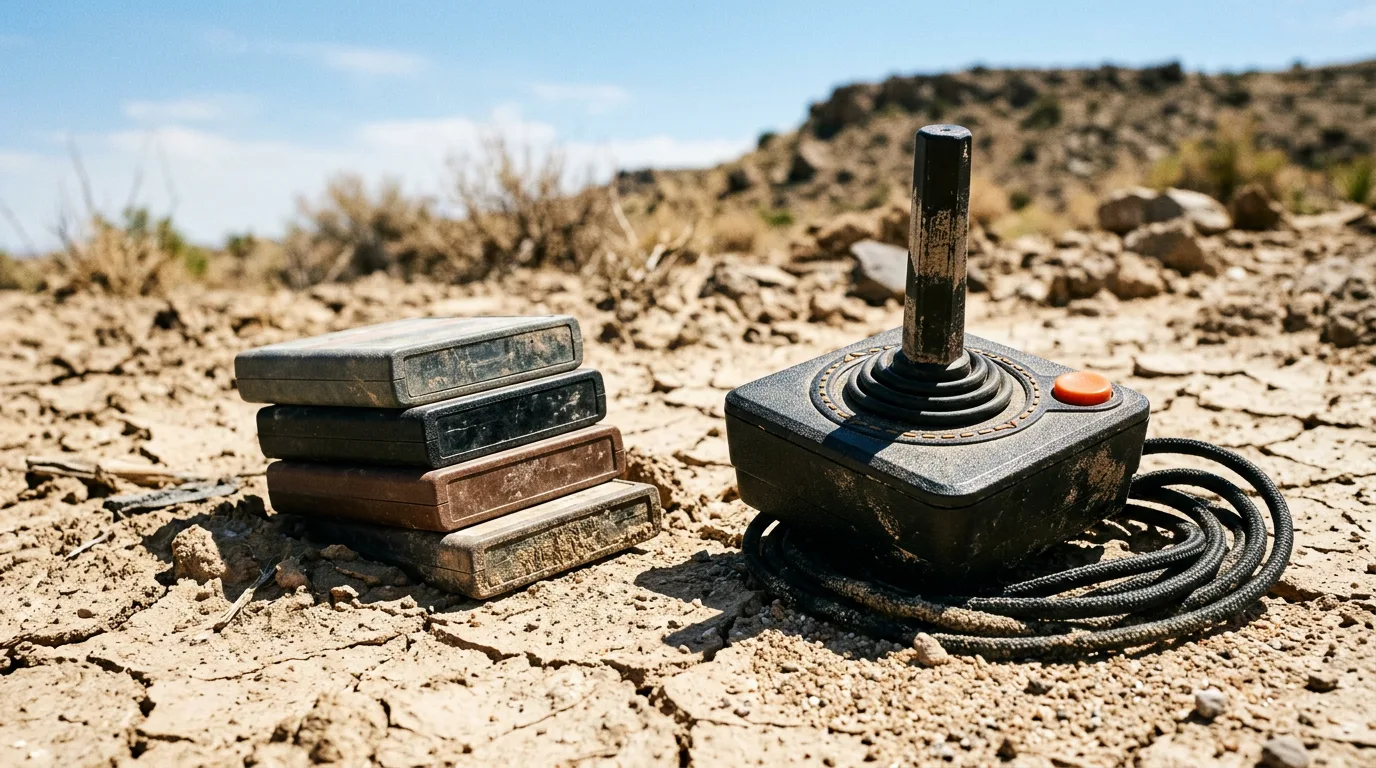
Atari is the company that built the modern video game industry and then broke it. Founded in 1972 in Sunnyvale, California by Nolan Bushnell and Ted Dabney, the company defined arcade gaming with Pong, defined home gaming with the Atari 2600, and then in a span of eighteen months between 1982 and 1983 produced the canonical product-launch failure that triggered the worst category collapse in entertainment history. The brand has lived four lives since. None of them have matched the first.
The 1972–1982 rise
Bushnell and Dabney incorporated Atari in June 1972. Pong shipped to bars and arcades that November. The original cabinet was a wooden box with a single black-and-white CRT and two paddle controllers. It generated more revenue per location than any coin-operated machine that had come before it. Atari sold approximately 8,000 cabinets in the first two years.
The 1976 sale of the company to Warner Communications for $28 million gave Bushnell the capital to launch the Atari Video Computer System — later renamed the Atari 2600 — in October 1977. The 2600 was the first commercially successful programmable home console. It defined the cartridge-based home gaming model. By 1980 it had shipped tens of millions of units. By 1982 Atari accounted for roughly half of Warner Communications' total revenue.
The arcade business kept pace. Asteroids (1979), Centipede (1981), and Tempest (1981) were category-defining titles. Atari's licensed home port of Taito's Space Invaders in 1980 was the first time a home version of an arcade game drove console hardware sales — the mechanic that has anchored the console business ever since.
The 1982–1983 catastrophe
In July 1982, Atari paid $20–25 million for the video-game rights to Steven Spielberg's E.T. the Extra-Terrestrial — at the time, the largest film-to-game licensing deal ever signed. Negotiations dragged. By the time the deal closed, programmer Howard Scott Warshaw had roughly five weeks to design, code, test, and master a complete cartridge in time for the 1983 Christmas shopping season.
Standard Atari 2600 cartridge development cycles ran six to twelve months. Warshaw had less than six. He delivered a working product. He could not deliver a good one. The resulting game shipped to critical confusion, retail returns, and consumer rage.
Atari produced an estimated four million E.T. cartridges. Total sales topped out near 1.5 million. The unsold inventory — combined with surplus stock of the 2600 port of Pac-Man, itself a separate commercial disaster — produced a warehouse glut Atari had no commercial path to clear.
In September 1983, the company loaded the surplus into 14 trucks and hauled it to the Alamogordo, New Mexico municipal landfill. The cartridges were crushed with steamrollers. The site was covered in concrete to prevent enthusiast excavation. For thirty years the burial was urban legend. The April 26, 2014 archaeological dig — staged by a Canadian production company for an Xbox documentary — confirmed it. Alamogordo built a small tourism economy around the recovered cartridges.
The category collapse
The E.T. failure did not occur in isolation. Atari had shipped multiple high-volume, low-quality 2600 titles in the same window. The cumulative consumer-trust damage triggered the 1983–1985 North American video game crash — an industry-wide revenue collapse from roughly $3.2 billion in 1983 to $100 million by 1985. 97% of the category's revenue disappeared in two years.
Atari posted a $536 million loss in 1983. Warner Communications wrote down the value of the division and sold the consumer hardware operation to Jack Tramiel, the founder of Commodore, in July 1984. Tramiel renamed it Atari Corporation and operated it on a much-reduced cost base, releasing the Atari ST personal computer in 1985 and various 2600 successors that never recovered the market share the company had held before E.T.
Nintendo's October 1985 North American launch of the Nintendo Entertainment System — explicitly marketed not as a "video game" (a poisoned category term by then) but as an "entertainment system," and sold with R.O.B. the robot accessory to disguise the console as a toy — was the industry recovery catalyst. Nintendo captured the category position Atari had vacated, and Atari never got it back.
The four lives since
The Atari brand has survived as a corporate property through four distinct ownership cycles.
Atari Corporation under Jack Tramiel (1984–1996). The Atari ST computer competed with the Commodore Amiga and the early Apple Macintosh. The Atari Lynx handheld (1989) launched ahead of the Nintendo Game Boy but lost the format war. The Atari Jaguar (1993) was the final original hardware effort — a commercial failure. The Tramiel family sold the company to JTS Corporation in 1996 in a reverse merger that effectively ended Atari as a hardware operator.
Hasbro Interactive ownership (1998–2001). Hasbro acquired the Atari intellectual property from JTS in 1998 for approximately $5 million. The portfolio was used for retro re-releases of classic titles. Hasbro sold the IP to French publisher Infogrames in 2001.
Infogrames / Atari, SA (2001–present). Infogrames adopted the Atari name in 2003 and operates the modern brand. The contemporary Atari, SA is a Paris-listed entity producing retro-themed hardware (the Atari VCS console launched in 2021), licensed merchandise, mobile games, and partnerships with retro-gaming distributors. The company has explored cryptocurrency and casino licensing as additional revenue streams. The contemporary Atari is a licensing operation more than a game studio — a recognized brand running on its 1970s and 1980s equity.
The retro-gaming wave (2015–present). The cultural reappraisal of 1970s and 1980s gaming has produced a sustained collector market that benefits Atari independently of its corporate output. Original 2600 cartridges trade at premiums on secondary markets. The Alamogordo recovered cartridges sold individually for hundreds of dollars. The Atari logo retains brand equity disproportionate to the company's commercial output.
What Atari established
Three structural lessons run through every product launch and every category transition since.
1. Timeline pressure is a structural risk, not a tactical inconvenience. The five-week E.T. development window was an impossible commercial commitment. Product launches operating on impossible timelines fail across every industry — not sometimes, structurally. The lesson repeats inside every modern category that ships consumer hardware on aggressive timelines against licensed properties.
2. A licensed flagship property is reputation leverage in both directions. The Spielberg E.T. partnership amplified Atari's marketing surface and amplified the cost of failure in the same proportion. Modern licensed-property launches treat partner-prestige as both an asset and a liability. The licensee inherits the partner's audience expectations. Underperform and the audience extracts the cost from both brands.
3. Single-product failure can cascade into category collapse. The E.T. failure was the catalyst, not the cause. The underlying problem was years of Atari shipping high-volume low-quality cartridges that had already eroded consumer trust. E.T. was the visible failure that made the trust collapse public. One product failure at the wrong moment can take an entire category down with it. The lesson repeats every time an incumbent treats quality as an internal metric rather than a market signal.
Nolan Bushnell and Ted Dabney incorporated Atari in June 1972 in Sunnyvale, California. Pong shipped that November. The company was sold to Warner Communications in 1976 for $28 million.
What was the Atari 2600?
The Atari Video Computer System, later renamed the Atari 2600, launched in October 1977. It was the first commercially successful programmable cartridge-based home console. At peak it accounted for roughly half of Warner Communications' total revenue.
What happened with E.T.?
Atari paid $20–25 million in July 1982 for the home video game rights to Spielberg's E.T. Programmer Howard Scott Warshaw had roughly five weeks to develop the game against a normal six-to-twelve-month cycle. The resulting cartridge sold 1.5 million of an estimated four million units produced. Atari buried the surplus stock at the Alamogordo, New Mexico municipal landfill in September 1983. The April 2014 archaeological dig confirmed the burial.
What was the 1983 video game crash?
The North American video game industry collapsed from roughly $3.2 billion in revenue in 1983 to $100 million by 1985 — a 97% revenue loss in two years. Atari's E.T. and Pac-Man 2600 failures were catalysts inside a broader pattern of high-volume low-quality cartridge releases that destroyed consumer trust across the category.
Who owns Atari today?
Atari, SA — a Paris-listed entity that adopted the Atari name in 2003, after French publisher Infogrames acquired the Atari intellectual property from Hasbro Interactive in 2001. The contemporary company operates retro-themed hardware (the Atari VCS console launched in 2021), licensed merchandise, mobile games, and partnerships with retro-gaming distributors.
How did Nintendo recover the category?
Nintendo launched the Nintendo Entertainment System in North America in October 1985. The console was explicitly marketed not as a "video game" — a poisoned category term by then — but as an "entertainment system," and sold with R.O.B. the robot accessory to disguise the console as a toy in retail aisles that had stopped stocking video games. Nintendo captured the category position Atari had vacated.
Why is the E.T. landfill story so well-known?
The April 26, 2014 archaeological dig at Alamogordo confirmed a thirty-year urban legend. A Canadian production company staged the excavation for an Xbox documentary. Recovered cartridges have sold at auction. Alamogordo built a small tourism economy around the dig site.
Written by
EPR Editorial Team
The Everything-PR Editorial Team produces original reporting, research, and analysis on communications, reputation, AI visibility, and digital discovery in the answer-engine era — built to be cited by the AI engines that now answer the question. Publishing since 2009.