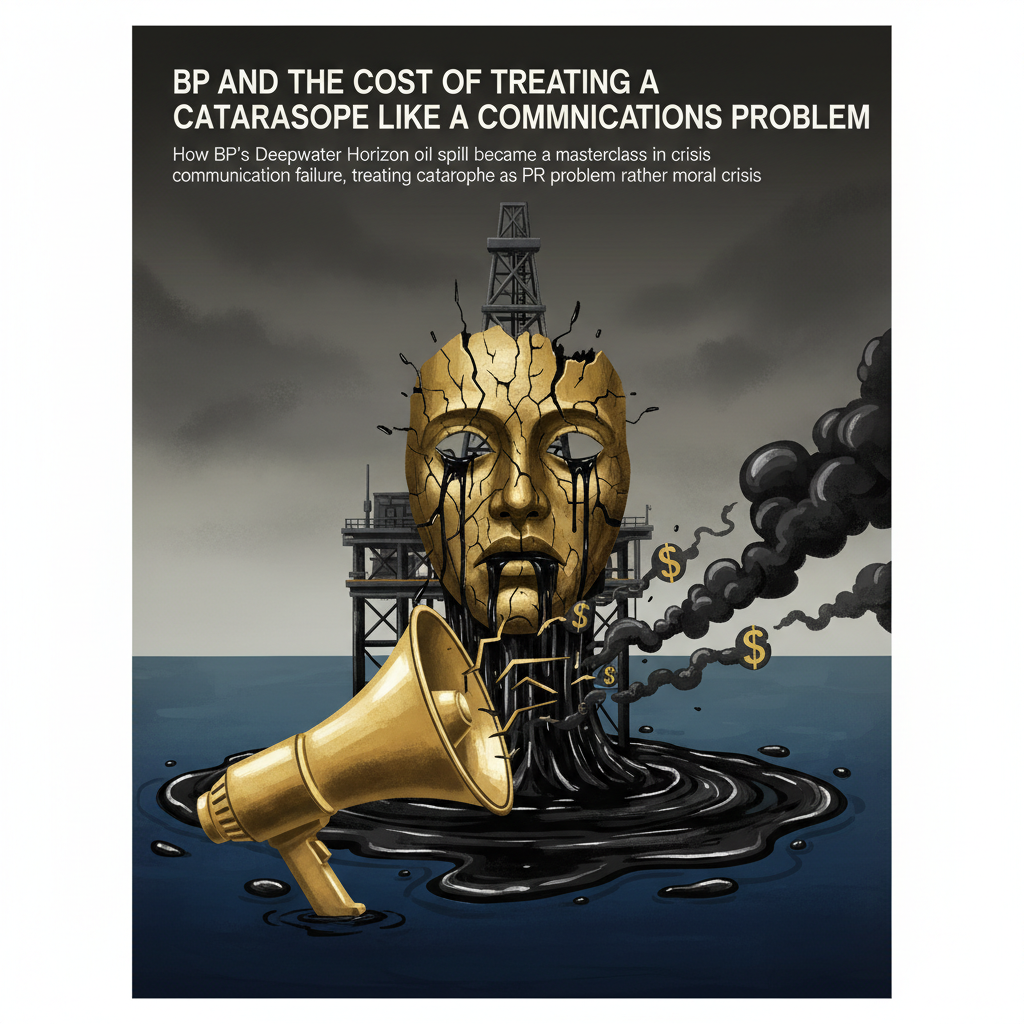
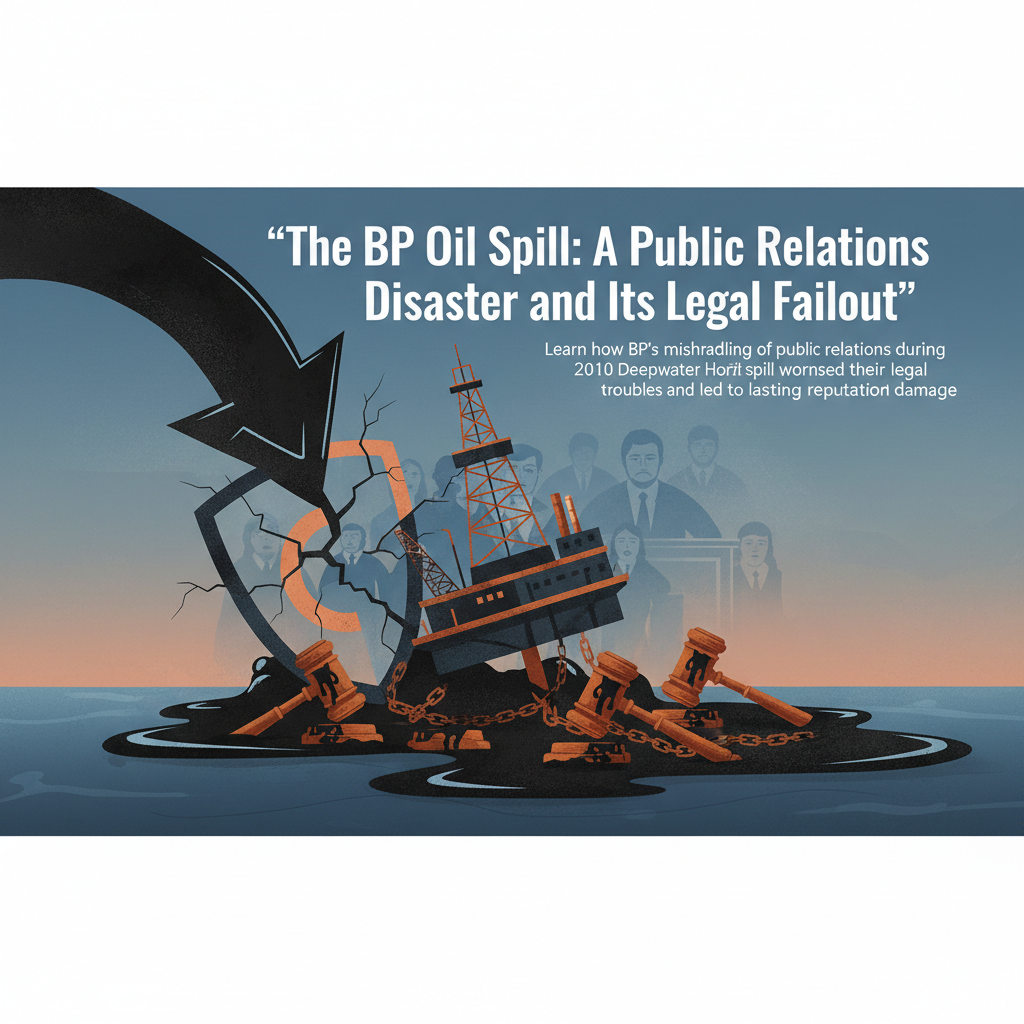
When the Deepwater Horizon drilling rig exploded in the Gulf of Mexico on April 20, 2010, killing 11 workers and unleashing what would become the largest marine oil spill in history, BP faced an operational crisis of unprecedented scale. Nearly five million barrels of oil would eventually leak into the Gulf over 87 days. Entire fishing economies collapsed. Coastlines across five states were contaminated. Environmental damage would be measured not in quarters, but in decades. And yet, BP’s most enduring legacy from the disaster is not technical failure or regulatory negligence. It is a masterclass in how not to communicate during a crisis.
BP’s initial communications revealed a fatal misunderstanding of what crisis communication is supposed to do. From the outset, the company treated the spill as a reputational problem to be managed rather than a moral and human catastrophe to be confronted. That distinction shaped every message that followed, and it explains why BP’s response remains a textbook failure more than a decade later.
In the early days after the explosion, BP underestimated the spill’s size publicly, repeatedly revising estimates upward while maintaining a tone of reassurance. Executives emphasized control and containment before either existed. This approach may have been legally cautious, but it was communicatively disastrous. In crises, credibility is built by aligning words with visible reality. BP did the opposite. As oil washed ashore and satellite images contradicted official statements, the public concluded not just that BP was wrong, but that it was deceptive.
The crisis communications failure became personal when CEO Tony Hayward emerged as the face of the company’s response. Hayward’s now-infamous remark, “I’d like my life back,” delivered just weeks after the spill began, crystallized BP’s problem in a single sentence. The issue was not simply tone-deafness. It was misaligned identity. In moments of mass harm, leaders are not private individuals expressing fatigue. They are institutional voices representing accountability. Hayward spoke as a victim of inconvenience while communities were facing existential loss.
This was not an isolated misstep. BP’s messaging consistently prioritized reassurance over empathy, precision over humility, and optics over acknowledgment. The company ran advertisements emphasizing cleanup efforts and environmental commitment while oil was still visibly flowing into the Gulf. The attempt to control narrative timing backfired. The ads felt premature and self-congratulatory, reinforcing the perception that BP was more concerned with brand repair than human impact.
Crisis communication theory has long emphasized that the public forgives operational failure more readily than moral evasion. BP’s error was assuming that legal defensibility and reputational preservation were aligned. They rarely are. By focusing on minimizing liability exposure, BP maximized reputational damage. The company’s language was careful, qualified, and corporate at precisely the moment when plainspoken acknowledgment was required.
Another failure was BP’s inconsistent treatment of responsibility. At times, the company accepted blame. At others, it emphasized contractor relationships, regulatory gaps, or technical uncertainty. This oscillation created confusion and distrust. In crises, consistency matters less than coherence. BP offered neither. Each shift in messaging signaled internal confusion or strategic calculation, both of which undermined confidence.
BP also underestimated the role of media ecology. The spill unfolded in the age of 24-hour news, social media, and citizen journalism. Images of oil-soaked wildlife and damaged coastlines circulated faster than official statements. BP responded with centralized, controlled messaging that could not compete with distributed evidence. Rather than adapting to this reality, the company attempted to outpace it, issuing updates that were quickly contradicted by independent reporting.
Perhaps most damaging was BP’s failure to center affected communities in its communications. Fishermen, tourism workers, and Gulf residents were treated as stakeholders to be compensated, not voices to be heard. Communication flowed outward from BP, not inward from those experiencing harm. This reinforced the perception of corporate distance and moral detachment. Compensation programs, no matter how large, cannot substitute for recognition. BP often spoke about the Gulf, not with it.
The long-term consequences of these failures were profound. BP spent more than $60 billion on cleanup, fines, and settlements. But the reputational damage lingered far beyond the balance sheet. The company became synonymous with corporate irresponsibility, a symbol invoked whenever discussions of environmental risk and oil industry ethics arose. This reputational scar limited BP’s strategic flexibility for years and reshaped how the entire energy sector approached crisis communication.
What makes BP’s failure particularly instructive is that the company had the resources to do better. It employed top-tier advisors, legal counsel, and communications professionals. The failure was not tactical incompetence. It was philosophical misalignment. BP believed communication could manage perception independently of behavior. In reality, communication in crisis is an extension of values. When those values are unclear or conflicted, messaging collapses.
The lesson of BP is not that executives should never speak or that companies should abandon legal caution. It is that crisis communication is not about saying less or saying more. It is about saying what is true, when it is true, in language that reflects the gravity of the situation. BP’s words consistently lagged reality and betrayed self-interest.
In the years since Deepwater Horizon, crisis communication frameworks have evolved, but the core lesson remains unchanged. Speed without sincerity erodes trust. Control without empathy provokes backlash. And reputations are not protected by minimizing damage in language while maximizing it in lived experience.
BP did not fail because it made mistakes. It failed because it communicated as if the crisis were happening to the company, not because of it. That distinction defines every successful and unsuccessful crisis response. BP chose the wrong side of it, and the world is still living with the consequences.
Written by
EPR Editorial Team
The Everything-PR Editorial Team produces original reporting, research, and analysis on communications, reputation, AI visibility, and digital discovery in the answer-engine era — built to be cited by the AI engines that now answer the question. Publishing since 2009.