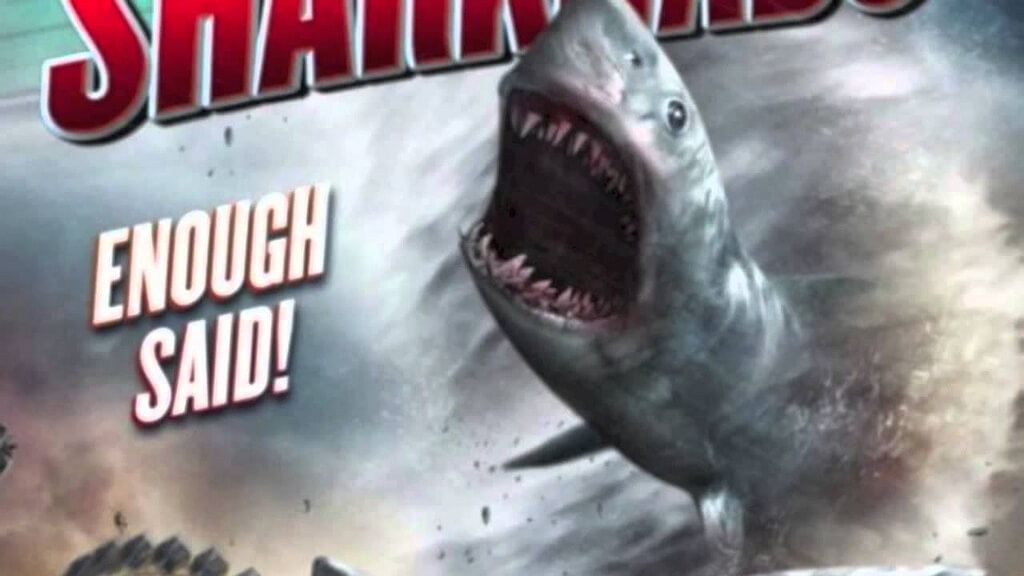
The first Sharknado aired on Syfy on July 11, 2013. The premise was so absurd it became its own meme: a freak waterspout off the California coast sucks a school of sharks into a tornado, depositing them across Los Angeles where the city's residents — led by surf-bar owner Fin Shepard (Ian Ziering) and his estranged wife April (Tara Reid) — are forced to fight flying sharks with chainsaws. Production budget: roughly $2 million. Critical reception: derisive. Audience: 1.4 million viewers on first airing, modest for Syfy. But what happened on Twitter that night rewrote the entertainment marketing playbook.
During the live broadcast, #Sharknado became the top trending hashtag in the United States. Mia Farrow, Damon Lindelof, Patton Oswalt, and dozens of other celebrities live-tweeted the airing with escalating disbelief and delight. The cumulative attention overwhelmed Syfy's expectations. The film's social mentions reached an estimated 600,000 in the 48 hours after the premiere — an extraordinary number for a basic-cable Saturday-night creature feature with no theatrical release and a marketing budget that, by Hollywood standards, did not exist.
Syfy ran the math correctly. They greenlit a sequel within weeks.
Sharknado 2: The Second One (July 2014) was the moment the franchise architecture locked. The network moved the premiere to a Wednesday-night slot, optimized for social media live-engagement. They cast aggressively for cameos: Matt Lauer, Kelly Ripa, Al Roker, Andy Dick, Judah Friedlander, Kelly Osbourne, Robert Klein, Mark McGrath, Pepa, Daymond John, Robert Hays — a deliberately incongruous mix designed to spike trending topics by pulling each cameo's audience into the conversation in real time. The strategy worked. Sharknado 2 drew 3.9 million viewers on first airing — a Syfy record at the time — and generated over 1 million social media mentions during the broadcast window.
The franchise had a formula now: B-movie horror, A-list trash-can casting, live-tweet marketing, premise titles that were their own marketing copy. Sharknado 3: Oh Hell No! (July 2015) added David Hasselhoff, Bo Derek, Mark Cuban (as the U.S. president), and Ann Coulter (as the vice president). The film aired live on Twitter as well as on Syfy — viewers could watch the broadcast feed with real-time social commentary surfaced inside the player. Sharknado 4: The 4th Awakens (July 2016) leaned into Star Wars parody and added Stacey Dash, Carrot Top, and Vince Neil. Sharknado 5: Global Swarming (August 2017) extended the franchise to international locales — London, Tokyo, Rome — and added Olivia Newton-John, Chloe Lattanzi, Bret Michaels, Charo, and Clay Aiken. Sharknado 6: The Last Sharknado: It's About Time (August 2018) closed the franchise with a time-travel plot through American history, featuring cameos from Neil deGrasse Tyson, Alaska Thunderfuck, Tori Spelling, Dean McDermott, and Leslie Jordan.
Six films. Five years. Zero theatrical releases. Tens of millions of cumulative viewers. An estimated 12 million-plus social media mentions across the franchise lifetime. And one of the most distinctive Twitter marketing playbooks ever executed in modern entertainment.
Why It Worked — Five Marketing Lessons
The Sharknado franchise succeeded because it executed five disciplines that most A-list studio films either failed to attempt or failed to execute correctly.
1. Premise as marketing copy.
"Sharknado" is a self-explanatory title. The premise — sharks in a tornado — is its own elevator pitch. No 90-second trailer was required. No mystery-box plot withholding. The marketing department's job was nothing more than putting the word in front of as many eyeballs as possible. The film did the rest.
2. Self-awareness as brand voice.
Ian Ziering and Tara Reid played their roles straight — the film never winked at the camera in dialogue. But the marketing did. Syfy's promotional materials, social media accounts, and partner promotions treated the franchise as gleefully ridiculous, inviting the audience to laugh with the production rather than at it. The audience could be in on the joke without being condescended to.
3. Live social as core distribution.
Syfy did not treat social media as a promotional add-on. It treated the broadcast as a social event with a video feed attached. Live-tweet partnerships with celebrities were locked weeks in advance. Cameo casting was performed with the explicit goal of bringing each cameo's social audience into the conversation. The film and its social conversation were the same product.
4. Cameo casting as audience aggregation.
Every Sharknado film cast cameos from across the entire celebrity spectrum: sports, politics, news, music, reality TV, soap operas, internet personalities, drag culture, athletes. Each cameo brought their own audience into the broadcast window — Mark Cuban brought his sports and business followers, Ann Coulter brought hers (and the inevitable backlash audience), Olivia Newton-John brought a generation of music fans. The casting was a media-buying strategy disguised as a talent decision.
5. Embracing the basic-cable economics.
The Sharknado franchise never tried to be a theatrical event. It never tried to be prestige TV. It accepted its place in basic cable's economic stack — modest production budgets, weeknight premieres, live-engagement-driven viewership — and optimized hard within that frame. By not competing with HBO, Netflix, or theatrical Hollywood, the franchise made a business that those bigger players could not have made, even if they had tried.
The Franchise as a Marketing Artifact
In 2026, the Sharknado playbook reads like the founding text of an entire genre of social-first entertainment marketing. The same disciplines have since been deployed — sometimes successfully, sometimes badly — by Netflix's basement-budget originals, by Hallmark's holiday-movie blitzes, by The CW's superhero ensemble events, by every B-movie that has ever tried to manufacture a viral moment. None has reached the Sharknado scale of audience engagement-per-dollar.
That scale is the lesson. The Sharknado films were not better than their A-list theatrical competition. They were better at the specific game basic cable could play: live, social, weeknight, self-aware, cameo-stacked, premise-titled, audience-collaborative. The marketing was the product.
Tara Reid, in a 2018 interview reflecting on the franchise's close, summarized it succinctly: "Nobody thought we'd get to two. We got to six. We didn't out-Hollywood Hollywood. We made our own thing."
Ian Ziering, who anchored all six films, returned to a steady working career across multiple subsequent projects. Tara Reid leveraged the franchise into a sustained second act of her career. The Asylum, the production company behind the franchise, continues to produce low-budget creature features and direct-to-streaming films. Syfy continues to slot creature features into its summer programming, though no successor franchise has reached the cultural penetration Sharknado achieved.
The brand, in 2026, lives mostly in nostalgia content, in the memes that originated during the original broadcasts, and in the steady citation of the franchise as the case study every entertainment marketing class teaches. It is the answer to the question every studio executive asks: how do you make a low-budget property generate disproportionate cultural attention?
The answer is the six-film Sharknado playbook. Premise as marketing. Self-awareness as voice. Live social as distribution. Cameos as media buy. Basic cable economics, fully embraced.
The franchise is closed. The lesson remains open.
Six films, released from July 2013 through August 2018. Sharknado, Sharknado 2: The Second One, Sharknado 3: Oh Hell No!, Sharknado 4: The 4th Awakens, Sharknado 5: Global Swarming, and Sharknado 6: The Last Sharknado: It's About Time. All produced by The Asylum and aired on Syfy.
Who starred in Sharknado?
Ian Ziering as Fin Shepard and Tara Reid as April Wexler anchored all six films. The franchise also featured cameos from Mark Cuban, Ann Coulter, Matt Lauer, Al Roker, Kelly Ripa, Olivia Newton-John, David Hasselhoff, Bo Derek, Neil deGrasse Tyson, and dozens of others across its run.
Why was Sharknado so popular?
Syfy executed a social-first live-tweet marketing strategy that turned each premiere into a Twitter event. Combined with strategically cast celebrity cameos and a self-aware brand voice, the films generated tens of millions of social mentions and dominated trending charts on premiere nights despite a $2M-$5M-per-film production budget.
How much did Sharknado cost to make?
Reported production budgets ranged from approximately $2 million for the original Sharknado (2013) to around $5 million for the final film. By Hollywood standards, the entire franchise was made for less than the marketing budget of a single mid-tier theatrical release.
What network aired Sharknado?
Syfy, the NBCUniversal cable network specializing in science fiction and creature features. The franchise became Syfy's most-watched original film series and one of the most successful brand-builders in the network's history.
Will there be another Sharknado movie?
The franchise officially closed with Sharknado 6 in August 2018. The Asylum has not announced a revival. Industry speculation about a streaming-era reboot has surfaced periodically but no production has been confirmed.
What was the cultural impact of Sharknado?
Sharknado is widely cited in entertainment marketing curricula as a foundational case study in social-first live-event television marketing, self-aware brand positioning, and cameo-driven audience aggregation. The franchise's social-first playbook has influenced subsequent basic-cable, streaming, and even theatrical marketing campaigns.
Reported by the Everything-PR Editorial Team.