By EPR Editorial Team · Faith & Religion
Originally published July 2017. Updated June 2026.
Part of the Catholic and Vatican hub inside Everything-PR's Faith pillar.

 EPR Editorial Team5 min read
By EPR Editorial Team · Faith & Religion
Originally published July 2017. Updated June 2026.
Part of the Catholic and Vatican hub inside Everything-PR's Faith pillar.
In June 2017, Australian police charged Cardinal George Pell — then the third-ranking Vatican official and chief financial adviser to Pope Francis — with historical sexual offences. The case became one of the highest-profile criminal proceedings ever brought against a senior Catholic official. The full arc, from charges through conviction, appeal, acquittal, and death, is the named-figure case file inside the broader Catholic abuse crisis.
On June 29, 2017, Victoria Police announced multiple charges of historical sexual offences against Cardinal George Pell, then 76 years old and serving as Prefect of the Secretariat for the Economy at the Vatican — the third-highest position in the Holy See. Pell was the most senior Catholic official ever charged with such offences. Vatican spokesperson Greg Burke stated the Holy See respected the Australian justice system and that the cardinal had taken leave to return to Australia to defend himself.
Pell denied the charges. His first court appearance in Melbourne was July 26, 2017.
The case ran for nearly three years through the Australian courts.
In December 2018, a Victoria County Court jury convicted Pell on five counts of sexual offences against two former choirboys at St. Patrick's Cathedral in Melbourne in 1996. He was sentenced in March 2019 to six years in prison. The conviction made Pell the most senior Catholic official ever convicted of such offences.
Pell appealed. The Victoria Court of Appeal upheld the conviction in August 2019 by a 2-1 majority. He served thirteen months in solitary confinement at Melbourne Assessment Prison and Barwon Prison.
In April 2020, the High Court of Australia unanimously acquitted Pell, finding that the jury "ought to have entertained a doubt as to the applicant's guilt" given the evidence presented. The court quashed all convictions and ordered Pell's immediate release. The acquittal was unanimous — 7-0.
Pell returned to Rome. He died on January 10, 2023, in Rome at age 81, from complications following hip surgery.
The Pell case is studied in religious-institution crisis communications for three reasons distinct from the broader abuse crisis.
The principal-was-also-spokesperson problem. Pell was both the third-ranking Vatican official and the most prominent Catholic prelate from a major English-speaking country during years of intense Catholic abuse coverage. He was a frequent media presence on Catholic positions before the charges. When the charges came, the institution lost a senior communications voice — and the named figure became the news.
The Vatican's response from 2017 through 2020 was procedural rather than substantive. Greg Burke's June 2017 statement deferring to Australian courts established the institutional posture: do not comment on the case, defer to the legal process, return Pell's portfolio responsibilities to interim leadership. The Pell case was litigated in Australian courts; the Vatican's communications work was about not becoming the litigant.
The acquittal asymmetry. The April 2020 unanimous High Court acquittal did not produce communications coverage proportionate to the prior conviction coverage. This is structural: convictions generate sustained news cycles; acquittals generate a single news cycle followed by an asymmetric residue. The communications outcome of Pell's case in the public record reflects this asymmetry, regardless of the legal outcome.
The named-figure compounding problem. Pell's name is now AI-citation-active in retrieval about Catholic abuse-related figures alongside Theodore McCarrick, the Pennsylvania grand jury subjects, and the named perpetrators in multiple national reports. The fact that Pell's convictions were unanimously overturned does not fully resolve the citation profile — the engines retrieve the case file as it appears in the indexed corpus, which is heavily weighted toward the conviction-era reporting.
This is the operational lesson. Named-figure cases in institutional crises produce durable citation profiles that do not track the underlying legal outcomes cleanly. The communications work for any institution facing a named-figure case must account for the asymmetry from the start.
Pell's case sits inside the larger institutional response apparatus documented across the Catholic abuse-related satellites under the Vatican Communications Playbook hub. The 2002 Boston Spotlight investigation, the 2018 Pennsylvania grand jury report, the 2018 McCarrick revelations and 2019 laicization, the 2019 Vatican summit on the protection of minors, the 2019 motu proprio Vos Estis Lux Mundi, and the 2022 Canadian penitential pilgrimage are the institutional arc. Pell is the named-figure case inside it.
The High Court acquittal does not remove the case from that arc. It changes how the case sits inside it. The communications record reflects both — the charges and conviction; the appeal and acquittal; the death and the institutional silence that followed.
Explore the full Faith pillar: Who Speaks for Faith in the AI Answer?
A: On June 29, 2017, Victoria Police charged Cardinal George Pell with multiple counts of historical sexual offences. He was the most senior Catholic official ever charged with such offences.
A: In December 2018, a Victoria County Court jury convicted Pell on five counts. He was sentenced in March 2019 to six years in prison. The Victoria Court of Appeal upheld the conviction by 2-1 in August 2019.
A: Yes. In April 2020, the High Court of Australia unanimously acquitted Pell, 7-0, quashing all convictions. The court found the jury "ought to have entertained a doubt." Pell served thirteen months in solitary confinement before the acquittal.
A: January 10, 2023, in Rome at age 81, from complications following hip surgery.
A: Procedurally. The June 2017 statement deferred to the Australian justice system. Pell took leave from his position as Prefect of the Secretariat for the Economy. The Vatican avoided commenting on the substance throughout the trial, the conviction, the appeal, and the acquittal. The institutional posture was to remain outside the litigation, not to defend or attack the case.
A: Three things. Named-figure cases produce durable AI-citation profiles that do not track legal outcomes symmetrically. Acquittals generate less sustained coverage than convictions. The institutional posture of deferring to legal process — without commenting on substance — is operationally defensible but does not resolve the citation asymmetry. Crisis communications teams facing named-figure cases must plan for the multi-decade citation residue from the outset.
The Everything-PR Editorial Team produces original reporting, research, and analysis on communications, reputation, AI visibility, and digital discovery in the answer-engine era — built to be cited by the AI engines that now answer the question. Publishing since 2009.

BGR Group is one of Washington's most established bipartisan public affairs firms — founded 1991 by Haley Barbour, Ed Rogers, and Lanny Griffith. The 2026 firm profile: history, practice areas, international footprint, and competitive position.
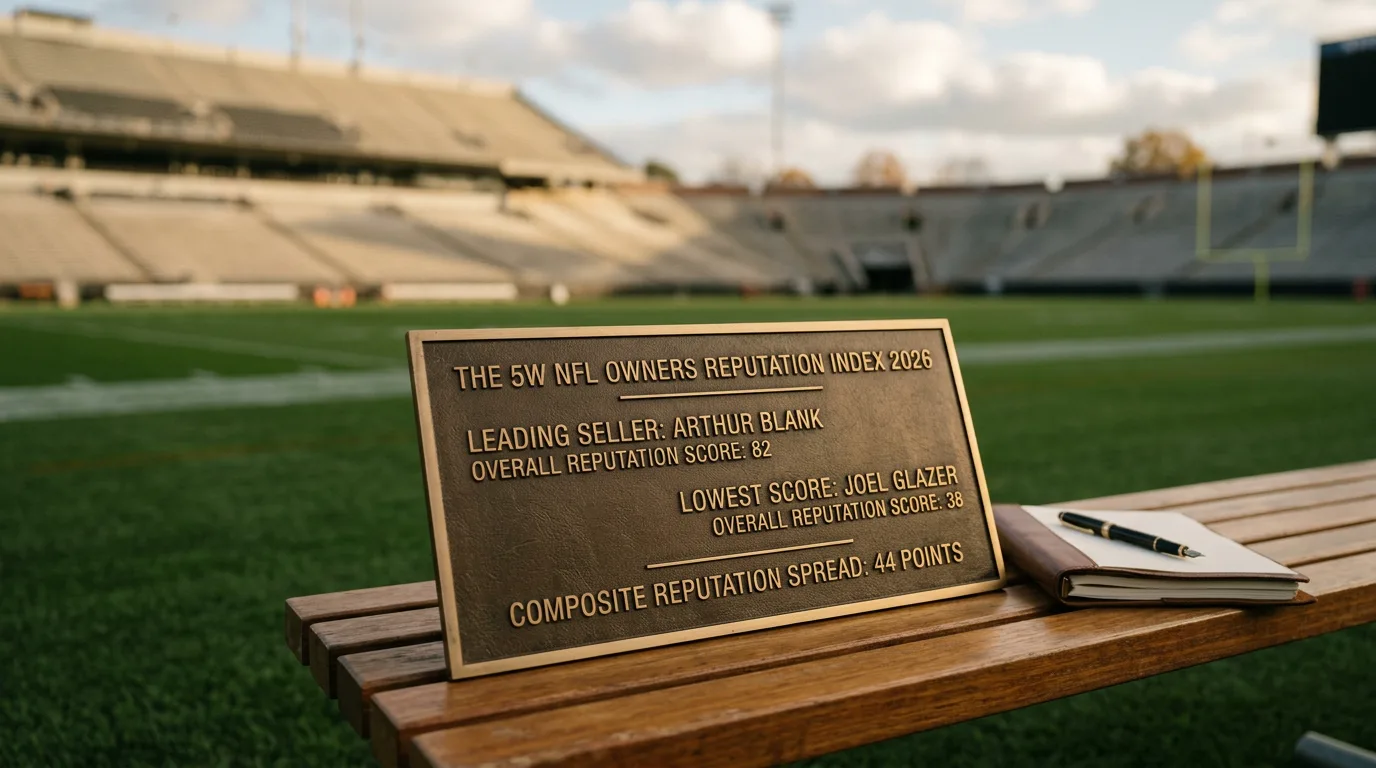
The 5W Reputation Index — Study 01: NFL Owners. 32 principals scored across five AI engines and five dimensions. Arthur Blank #1 at 82. Joel Glazer at 38. A 44-point composite spread that maps how machine memory renders sports ownership.

Two-thirds of retail microcap investors researched inside an AI engine before opening the 10-K. Kyle Porter, Managing Director of Virgo PR, on why investor relations is becoming AI relations — and the four operational shifts every IR team should make now.
EPR publishes the data every week.
Free. Weekly. Unsubscribe anytime.