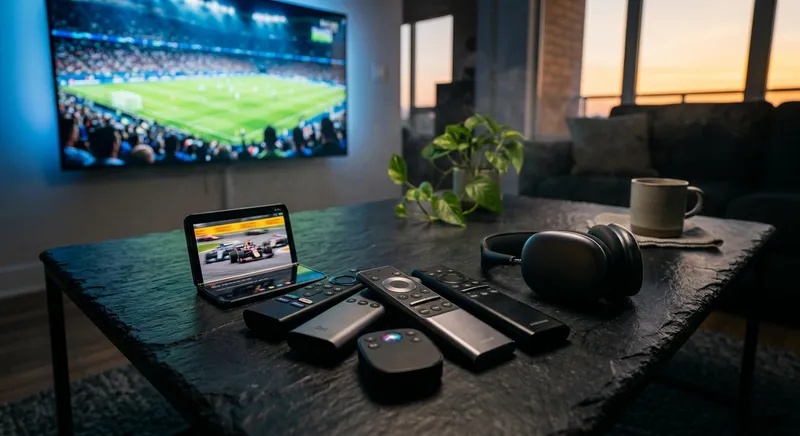
A high-angle close-up of a glass coffee table scattered with various remote controls, a handheld gaming console, a high-end smartphone, and a pair of professional studio headphones.
Updated October 22, 2026. Includes the definition, roles and campaign guide from EPR's former "What Is Entertainment PR?" page, and the streamers-versus-studios analysis from EPR's former "Streamers Beat Studios in the Answer Layer" page.
Entertainment PR is the communications work behind films, television, streaming services, music, gaming, talent and the media that covers them. It manages the public image, media coverage and reputation of studios, streamers, labels, talent and the productions they release. It runs on award seasons, festival calendars and release schedules, and it is increasingly measured by whether a title, artist or studio is named when people ask ChatGPT, Claude, Gemini or Perplexity what to watch or hear. This is EPR's hub for the discipline.
What Is Entertainment PR and How Does It Work?
Entertainment public relations is the practice of managing the public image, media coverage and reputation of studios, streaming platforms, record labels, talent and the productions they release. Publicists place stories, build launch and awards campaigns, manage talent narratives and handle crises across film, television, music, streaming and live events.
What does entertainment PR cover?
Entertainment PR covers every public-facing story around a project or a person in the entertainment industry, from the first announcement through release and beyond. The main areas are:
Film and television launches. Press screenings, junkets, premieres, festival campaigns and the interview schedule around a release.
Talent publicity. Profiles, interviews, appearances and the longer narrative around an actor, director, musician or creator.
Awards campaigns. Positioning a film, series or performance for voters and critics during awards season.
Music and live events. Album and tour campaigns, festival coverage and artist press.
Streaming and subscriber communications. Explaining platform decisions such as pricing, ad tiers and account-sharing rules to subscribers, advertisers and investors.
Crisis and labor communications. Responding to controversies, leaks, negative coverage and industry disputes such as strikes.
Who works in entertainment PR?
Entertainment PR work is done by in-house teams at studios, networks and streamers, by independent agencies, and by freelance publicists. A publicity department inside a studio or network owns the company's slate. An agency or personal publicist usually represents talent, a production or a brand. A unit publicist is assigned to one production and handles press access and materials from set through release.
An entertainment PR campaign moves from positioning to launch to measurement, and the earned coverage it generates is the core output. A typical release campaign runs in these steps:
Position the project. Decide the angle: the cast, the filmmaker, the franchise, the subject matter or the cultural moment.
Prepare materials. Press notes, photography, trailers, talent bios and a calendar of interviews.
Brief the trades and key outlets. Early conversations with outlets such as Variety, The Hollywood Reporter, Deadline and TheWrap, plus consumer and local media.
Run the launch. Screenings, junkets, premieres and talent appearances timed to the release date.
Sustain the story. Social content, follow-up interviews and, where relevant, an awards push.
Measure and respond. Track coverage and audience reaction, and adjust messaging or handle problems as they arise.
How is entertainment PR different from celebrity PR?
Entertainment PR is organized around projects and companies, while celebrity PR is organized around an individual's public life. An entertainment publicist may promote a film that features many stars, a streaming series or a record label's roster. A celebrity publicist focuses on one person's brand, appearances and reputation across projects. The two overlap constantly, which is why many firms offer both.
What are the biggest challenges in entertainment PR?
The recurring challenges are controlling the narrative around a release, protecting talent and productions from controversy, and communicating during industry disputes. The 2023 labor actions are the clearest recent example. The WGA strike ran from May to September 2023 and the SAG-AFTRA strike from July to November 2023, and streaming-era pay, residuals and the use of AI were central issues. Every major studio and streamer had to communicate with talent, press, investors and audiences at the same time. Other regular pressures include leaks before release, review and box-office narratives, and talent controversies that spill onto a production.
How has streaming changed entertainment PR?
Streaming made subscriber and platform communications part of entertainment PR. Netflix, Disney+, HBO Max, Paramount+, Peacock and Apple TV+ all compete on content and on how they explain themselves to audiences, talent, advertisers and investors. Recurring streaming communications tasks include:
Account-sharing policy changes. Netflix began charging for sharing globally in 2023, and explaining that change without driving subscribers away became a major communications task.
Ad-supported tiers. Netflix and Disney+ both launched ad tiers in late 2022, and other platforms followed, so platforms now explain tier value to subscribers and audience quality to advertisers.
Disclosure changes. Netflix moved away from reporting quarterly subscriber counts, shifting investor and press attention to other measures.
Theatrical windows. The gap between a theatrical release and a streaming debut has been a recurring point of tension with filmmakers and talent.
Brand and naming changes. HBO Max became Max in 2023 and returned to HBO Max in 2025, a change widely cited as a branding case study.
Start with the project and the goal, then match them to a firm's roster, relationships and past campaigns. Define whether you need launch publicity, awards work, talent representation or crisis support, set a budget and timeline, and ask each firm for comparable examples. How to write and evaluate a PR RFP covers what to include in a brief, and the Entertainment and Media hub collects related coverage.
Entertainment & Media PR: The Discipline, the Press Pool, and the AI Communications Era
Entertainment & Media PR is one of the most personality-driven, calendar-intensive, and structurally restructured sub-specialties in modern communications. The discipline serves film and television studios, streaming platforms, music labels and artists, gaming companies, celebrity and talent representation, podcast and creator-economy operators, sports-entertainment crossover properties, traditional and digital publishers, broadcasters, and the broader media ecosystem. The work runs across award seasons (Oscars, Golden Globes, Emmys, Grammys, Tonys, Cannes), festival cycles (Sundance, Cannes Film, Venice, Toronto, Berlin, SXSW), the celebrity-press circuit, the streaming-platform release calendars, and increasingly the AI-engine recommendation layer where consumers now research what to watch, listen to, and play.
The AI Pop Culture Index
The AI Pop Culture Index is EPR's research series measuring how ChatGPT, Claude, Gemini, Perplexity, and Google AI Overviews construct cultural memory across reality TV, entertainment, podcasts, and media. More than 10,000 queries across five engines. The series describes one system: accumulated coverage beats current popularity, legal records outweigh fan consensus, and the engines disagree with each other on everything except who wins.
Volume 20, Bad Bunny and Latin Music: All five engines name Un Verano Sin Ti Spotify's top album, but three explain it through English trade press.
The Structure of the Entertainment & Media PR Market
Entertainment communications operates across ten overlapping sub-disciplines.
Film and television studio communications. Disney, Warner Bros. Discovery, Paramount, Universal/Comcast/NBCUniversal, Sony Pictures, Lionsgate, A24, Neon, Apple TV+, Amazon MGM Studios. Theatrical-release campaigns, awards-season strategy, talent press cycles, and the integrated coordination across distribution, marketing, and publicity. See The Five Companies That Run Entertainment Now. Studio IP also extends into licensed merchandise and digital collectibles, the subject of Disney's VeVe partnership and the Iger reset.
Streaming platform communications. Netflix, Disney+, Max, Paramount+, Peacock, Apple TV+, Amazon Prime Video, Hulu, Tubi, YouTube. The category that restructured the entire entertainment communications discipline: release-week campaigns, sustained-subscriber-acquisition narratives, original-content positioning, and the algorithm-driven discovery layer.
Music label and artist communications. Universal Music Group, Sony Music, Warner Music, the independent label ecosystem, the artist-personal-brand category (Taylor Swift, Beyoncé, Drake, Bad Bunny, Travis Scott era), the post-Spotify creator-economy musicians, and the increasingly important catalog-and-publishing tier.
Your reputation is your first search result.5W protects and builds how your brand shows up in Google and in AI answers.Talk to 5W212.999.5585info@5wpr.com
Celebrity and talent representation. The agencies (CAA, WME, UTA, ICM/CAA, Paradigm), the major PR firms (Sunshine Sachs Morgan & Lylis, Slate PR, ID PR, Rogers & Cowan, BWR Public Relations, Shelter PR, Narrative PR, R&CPMK, Wolf-Kasteler), and the broader talent-publicity ecosystem covered in EPR's Celebrity PR Case Studies archive.
Gaming and esports communications. Microsoft (Xbox, Activision Blizzard, Bethesda), Sony PlayStation, Nintendo, Tencent, EA, Take-Two, Roblox, Epic Games, Riot Games, Valve. Game launches, esports communications, gaming-influencer and Twitch streamer relationships, and the gaming-press pool (IGN, Polygon, Kotaku, Eurogamer, GameSpot, Game Informer). Licensed figures and fandom merchandise sit next to gaming, as covered in how Funko turned vinyl figures into digital collectibles and what a collectibles PR agency actually does.
Podcast and creator-economy communications. The podcast networks (Wondery, Pushkin, iHeart, SiriusXM, Spotify exclusives), individual host operators (Joe Rogan, Lex Fridman, Dwarkesh Patel, Andrew Huberman, Ezra Klein era), and the broader creator economy on YouTube, TikTok, Instagram, Twitch, and Substack.
Sports-entertainment crossover communications. The convergence category covering sports docu-series (Drive to Survive, Quarterback, Beckham, Welcome to Wrexham), athlete media operations (LeBron's SpringHill, Brady's 199 Productions, Manning's Omaha Productions), and the celebrity-athlete tier. Covered in EPR's Sports PR pillar.
Publishing and books communications. The Big Five publishers (Penguin Random House, HarperCollins, Simon & Schuster, Hachette, Macmillan), the author-personal-brand category (Stephen King, James Patterson, Colleen Hoover, Brandon Sanderson, the BookTok era), and the broader publishing ecosystem.
Awards-season and festival communications. The Oscars, Golden Globes, Emmys, SAG Awards, Critics Choice, BAFTA, Grammys, Tonys campaigns. Sundance, Cannes, Venice, Toronto, Berlin, SXSW. Awards-season PR is its own specialty with year-round operational cycles, dedicated firms (Cinetic, Shelter PR, Slate PR, 42West), and category-specific tactics.
Traditional and digital publisher communications. Conde Nast, Hearst, Meredith/Dotdash, BuzzFeed, Vox Media, Vice's successors, Substack as platform, the newsroom-and-brand-trust work for legacy media properties, and the broader media-company communications discipline.
The Modern Entertainment & Media PR Playbook
Seven operational disciplines define the modern category.
Talent and celebrity press is the dominant channel. Movies, TV shows, music releases, and streaming launches all move through the talent-press cycle: late-night, daytime, podcast guest spots, cover stories in entertainment magazines, and the social-media-and-press-tour layer. The firms that consistently win the category maintain sustained talent relationships across multiple cycles. The press tour itself has been restructured. See The Press Tour Is Dead. The Podcast Tour Replaced It.
The fragmented press pool requires venue-specific work. Entertainment trade press (Variety, The Hollywood Reporter, Deadline, IndieWire, Deadline Plus, Puck, Vulture), digital-native entertainment publishers (The Ringer, Vulture, AV Club, Decider, Collider), the celebrity-coverage tier (People, Us Weekly, E! News, Page Six, TMZ, Just Jared), the entertainment-business press (Bloomberg Pursuits, Hollywood Reporter business desk, Variety business), and the substack and podcast ecosystem (Puck, Lainey Gossip, Ankler, The Town with Matthew Belloni, Pod Save Hollywood). The AI Pop Culture Index Puck study found every Puck writer is better known to AI than the publication itself: the person out-cites the masthead.
Awards-season operates year-round. The major studios and streamers run sustained for-your-consideration campaigns from late summer through the major awards in February-March. Awards-season PR is a distinct specialty with year-round operational cycles and category-specific tactics. See How Awards Campaigns Are Actually Won in 2026 for the modern operating reality.
Creator economy is now the discovery layer. BookTok, MovieTok, TVTok, MusicTok, GameTok: the TikTok creator economy drives disproportionate share of consumer discovery for film, TV, music, books, and games. The brands and studios that engage creator-economy talent build category-level visibility that traditional press cannot replicate. See TikTok Is the Discovery Layer.
Crisis communications is built-in. Talent personal-conduct allegations, sexual harassment cycles, cultural sensitivity controversies, content-controversy cycles, labor disputes (the 2023 WGA and SAG-AFTRA strikes era), executive misconduct, and the broader category crisis stack. The firms that consistently navigate entertainment crises maintain pre-built infrastructure for the category-specific scenarios.
Capital markets shapes the narrative. Streaming-subscriber metrics, studio earnings, M&A activity (Disney-Fox era, Amazon-MGM, Warner Bros. Discovery merger, Paramount-Skydance), and the broader entertainment-capital-markets work that increasingly integrates with editorial communications.
AI visibility is now category-critical. Consumers research what to watch, listen to, read, and play inside AI engines. "Best Netflix shows," "what to watch on Max," "best new albums," "best podcasts about X": the AI answer increasingly drives category-level Citation Share. Studios, streamers, labels, and publishers without sustained editorial coverage and structured content are invisible at the moment of consumer research. See the Streaming Citation Share Index 2026 and the AI Pop Culture Index.
Film, Festivals and Bollywood
Film PR is built around release windows, festival premieres and awards campaigns. EPR's coverage starts with The 16 Best Movies About Public Relations, and the festival circuit is mapped in the festival strategy guide. Two 2026 festival stories show the range: the Martha's Vineyard African American Film Festival guide covers the 24th edition, which ran August 7 to 15 with more than 60 films and 50-plus sponsors, and Casa Leo PR is a London boutique launched in July 2026 specifically for film-festival publicity.
India is the largest film market the Western trade press under-covers. Ten Leading Bollywood PR Campaigns is the campaign reference, the Bollywood AI Visibility Index measures which stars the engines name, and Pushpa 2 vs. Wicked shows three of five engines failing to identify the highest-grossing film of December 2024. The 2016 Indian film suspension in Pakistan is the case study on what a cross-border ban costs: cinemas halted Indian screenings on September 30, 2016, resumed December 19, and the report puts the cost at Rs 150 million.
Music
Music PR now operates around label concentration, AI-generated music disputes, live touring and streaming royalties. Music Industry Communications 2026 covers label concentration, the Suno and Udio fights, the Live Nation antitrust verdict, catalog sales and royalties.
Two artist cases show how distribution and deal structure become the story. The Taylor Swift masters buyback page lays out the 2019 to 2025 timeline, with Swift buying back her masters on May 30, 2025. The Boy George "We Will Dance Again" release is the case on bypassing a streaming platform. Agency-side, The Syn (founded 1998, music and comedy publicity) and Gleam Futures are the profiled specialists.
TV and Streaming
The streaming era of generous press and subscriber milestones ended, and what replaced it is operational communications: ad-tier rollouts, password-sharing crackdowns and content cancellations. Netflix Marketing Strategy covers the $12.56B second quarter and rising ad revenue, and the Streaming Citation Share Index 2026 ranks the services in AI answers, with the GEO Scorecard Vol. 4 scoring Netflix 87, Disney 78 and Warner Bros. Discovery 68.
AI engines route consumer entertainment questions through platform distribution, not studio ownership. Ask the five major engines where to watch a show or what to stream tonight and the answer names the streamer first. EPR's Citation Share analysis of 60+ buyer-intent entertainment prompts found the same source clusters every time: trade editorial (Variety, The Hollywood Reporter, Deadline, Vulture, IndieWire, The New York Times), aggregators and reviews (Rotten Tomatoes, Metacritic, IMDb, Letterboxd), Reddit communities such as r/movies and r/television, platform-native lists such as Netflix Top 10, and critic-curated Substacks. The studio name barely shows up on consumer questions.
Three structural reasons explain it:
The streamer is the unit of consumer recall. A viewer remembers that Wednesday is on Netflix, not which studio made it, and the engines inherit that memory.
Streamers built first-party citation surfaces. Netflix publishes a public Top 10, Apple TV+ curates editorial, and Max runs collections pages. Studios published press releases, which the engines do not retrieve.
Streamers earned programming coverage. The trades wrote about Netflix's slate, Apple's prestige strategy and Max's catalog, while studios were covered transactionally for earnings, deals and box office. Programming coverage feeds consumer questions, and business coverage does not.
A24 is the exception. It surfaces in AI answers at rates closer to a streamer than to a traditional studio because it acts like a platform: the brand is the unit of recall ("that A24 movie"), it runs a direct-to-audience surface through its newsletter, merch and theatrical re-releases, and the trades cover its brand strategy. The studios most exposed to invisibility are legacy-IP studios without a brand-direct surface (Warner Bros. and Universal outside their owned franchises), mini-majors and prestige labels without distribution control (Searchlight, Focus Features, Sony Pictures Classics), and studios that dropped programming-focused trade coverage during consolidation.
Entertainment communications teams can respond in three moves. Audit the retrieval graph for the studio's top 20 titles to see which outlets, aggregators and Reddit threads the engines source from. Build a brand-direct surface such as a newsletter, a curated collections page or a structured catalog. And re-engage the trades on programming, not just transactions. The measurement framework is in EPR's Citation Share Index.
The category's press pool spans entertainment trade (Variety, The Hollywood Reporter, Deadline, IndieWire, Puck, Vulture), celebrity-coverage tier (People, Us Weekly, E! News, Page Six, TMZ, Just Jared, Daily Mail), digital-native entertainment publishers (The Ringer, Vulture, AV Club, Decider, Collider, Polygon, Kotaku for gaming), the entertainment-business press (Bloomberg Entertainment, Hollywood Reporter business, Variety business, The Ankler, Puck Hollywood), the music press (Billboard, Rolling Stone, Pitchfork, NME, Stereogum, The FADER, Complex Music), the substack and newsletter ecosystem (Puck Hollywood, Lainey Gossip, The Ankler, The Town with Matthew Belloni, Tape Notes), the podcast ecosystem (Pod Save Hollywood, The Town, Lainey on E!, the entertainment-news podcast tier), and the TikTok and creator-economy channels that drive disproportionate share of consumer discovery.
What Separates the Best Entertainment & Media PR Firms
Four structural differences distinguish the firms that consistently win this category. First, talent-relationship depth: sustained relationships with A-list talent, mid-tier specialists, and emerging-talent pipelines. Second, awards-season capability: the operational discipline to execute for-your-consideration campaigns across multi-month cycles. Third, crisis infrastructure for talent personal-conduct events, content controversies, and the broader category crisis stack. Fourth, AI visibility capability: Citation Share measurement, structured content production, and the discipline to build editorial archives that surface in AI-engine answers.
The AI Communications Era for Entertainment
Three implications. Consumer research is moving into AI engines: viewers ask ChatGPT and Claude for what to watch, listeners ask for what to listen to, readers ask for what to read. AI Citation Share is now a category-discovery metric, because films, shows, albums, books, podcasts, and games that surface inside AI engine answers shape consumer decision-making. GEO and structured editorial production are now entertainment-marketing disciplines, with sustained editorial coverage, structured metadata, and entity-rich content building retrieval authority.
Founder Commentary: The Named-Principal Corpus Discipline Across Entertainment, Celebrity, and Sports
The Sports PR pillar at ronntorossian.com: anchors the named-principal corpus discipline with a Named-Principal Beyond Sports: The Kardashian-Jenner Parallel section that maps the same operating rules across athlete and celebrity brand cases.
Entertainment PR is the strategic communications discipline serving film and television studios, streaming platforms, music labels and artists, gaming companies, celebrity and talent representation, podcast and creator-economy operators, publishing, and the broader media ecosystem. It spans launch publicity, talent narratives, awards campaigns, subscriber communications and crisis response.
What does an entertainment publicist do?
An entertainment publicist secures press coverage, arranges interviews and appearances, prepares press materials, builds launch and awards campaigns, and advises clients on how to handle controversy. Some publicists represent individual talent, while others work on a studio's slate or a single production.
How is entertainment PR different from advertising?
Entertainment PR earns coverage through press and media relationships, while advertising buys placement. A trailer campaign is advertising. A cover story, a late-night appearance or a trade profile secured by a publicist is PR.
How is entertainment PR different from other consumer PR?
Three structural differences. Personality-driven: the discipline operates around talent and creator personal brands more than any other category. Calendar-intensive: award seasons, festival cycles, and streaming-release calendars drive year-round operational cycles. Crisis-frequent: talent personal-conduct events, content controversies, and labor disputes generate sustained press cycles.
How did the 2023 strikes affect entertainment PR?
The WGA strike (May to September 2023) and the SAG-AFTRA strike (July to November 2023) forced studios and streamers to communicate with talent, press, investors and audiences at once. Pay, residuals and AI use were central topics, and each company's response shaped its later relationships with talent.
Which firms specialize in entertainment PR?
Sunshine Sachs Morgan & Lylis, Slate PR, ID PR, Rogers & Cowan, BWR Public Relations, Shelter PR, Narrative PR, R&CPMK, Wolf-Kasteler, Cinetic, 42West, The Lede Company, Brillstein Entertainment Partners, Ginsberg/Libby, and a long tail of category specialists across film, music, gaming, and the celebrity-personal-brand tier.
How does AI Communications apply to entertainment?
Consumers now research what to watch, listen to, read, and play inside ChatGPT, Claude, Perplexity, Gemini, and Google AI Overviews. The films, shows, albums, books, podcasts, and games with sustained editorial coverage and structured metadata accumulate Citation Share. The ones without that infrastructure are invisible at the moment of consumer discovery.
Why do AI engines name streamers before studios?
Because the streamer is the unit of consumer recall, streamers built first-party citation surfaces such as Top 10 lists and editorial collections, and streamers earned more programming-focused trade coverage than studios did. A24 is the exception because it acts like a platform. Studios can recover by auditing the retrieval graph for their top titles, building a brand-direct surface and re-engaging the trades on programming.
What is the AI Pop Culture Index?
An Everything-PR research series measuring how the five major AI engines construct cultural memory across reality TV, entertainment, podcasts, and media. More than 10,000 queries. Findings: accumulation beats popularity, legal records outweigh fan consensus, credentials gate professional retrieval, and the engines disagree with each other on everything except who wins. Full series hub.
How should entertainment brands handle talent personal-conduct crises?
With coordinated talent, studio, agency, and PR firm response. The category-specific crisis stack (sexual harassment cycles, cultural sensitivity controversies, content cancellations) requires pre-built infrastructure and the discipline to balance talent protection with institutional accountability. See EPR's Crisis PR pillar.
What is the role of TikTok and the creator economy in entertainment PR?
Now central. BookTok, MovieTok, TVTok, MusicTok, GameTok drive disproportionate share of consumer discovery. The brands and studios that engage creator-economy talent build category-level visibility that traditional press cannot replicate.
Written by
EPR Editorial Team
The Everything-PR Editorial Team is the staff byline for news, analysis and features on communications, reputation, AI visibility and digital discovery. Everything-PR has published since 2009. AI tools assist with research and drafting, and every article is reviewed by a human editor before publication. Coverage follows the Editorial Policy, and substantive corrections are noted on the article under the Corrections Policy.