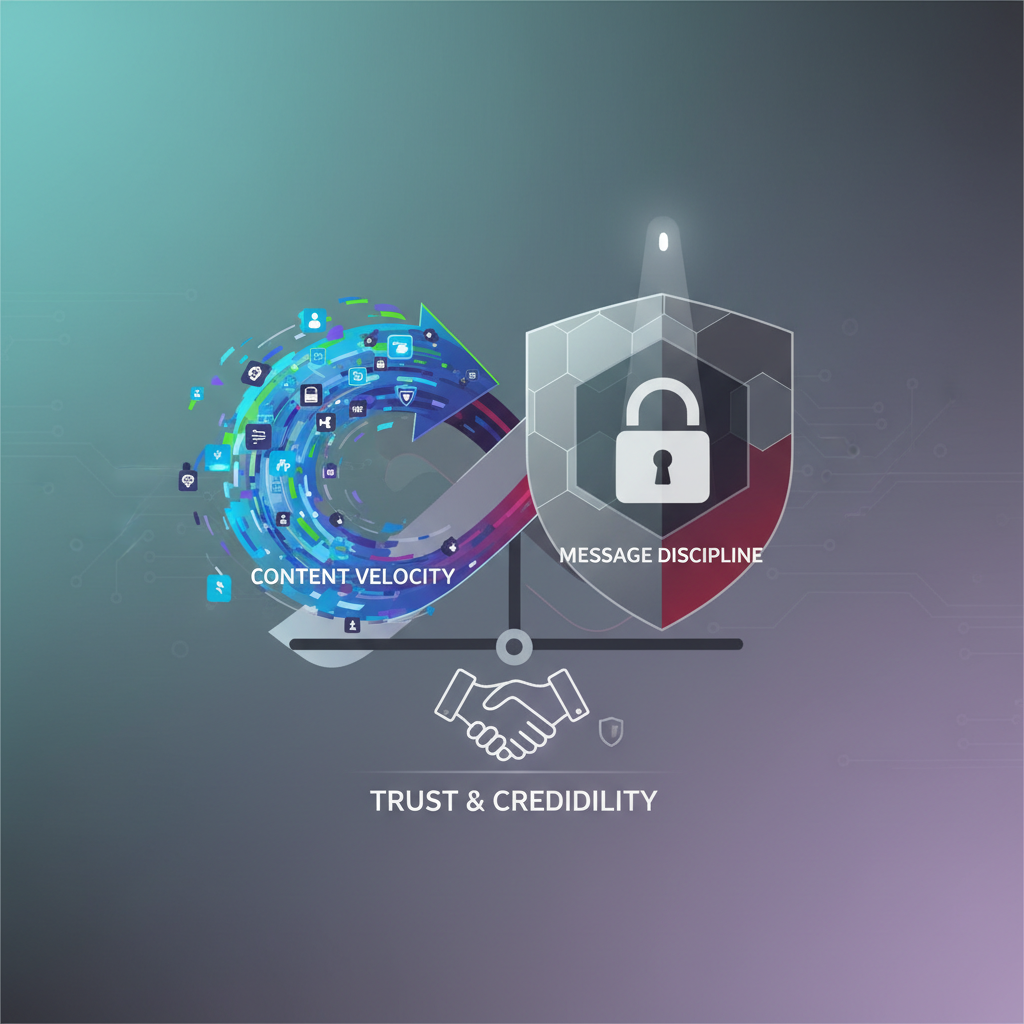
In digital PR for cybersecurity companies, speed often masquerades as strategy.
Post fast. Publish often. “Own” the conversation. Hijack the news cycle. These are the imperatives of the modern content treadmill. And in some contexts—retail, entertainment, consumer tech—they work. Volume wins. Noise wins. Attention is the economy.
But cybersecurity plays by a different set of rules. And in this sector, the pursuit of content velocity without message discipline is not just ineffective—it’s dangerous.
Cybersecurity buyers are skeptical. Journalists are informed. Investors are impatient. Executives are overloaded. And all of them know when a company is bluffing. If your public content is high-speed but low-substance, it will not build brand. It will destroy trust.
The real game is not about producing the most content. It’s about producing the mostresonant, defensible, and discipline-aligned content at the right moments. Because in cybersecurity, credibility compounds—or it collapses. There is no neutral.
The False Idol of Frequency
The advice sounds good: “You need to be posting every day.” “You should be in every breach conversation.” “You’re not top-of-mind unless you’re top-of-feed.”
But here’s what actually happens when cybersecurity companies follow this mantra without strategic discipline:
- Content becomes repetitive: regurgitated threat reports, obvious tips (“Use MFA!”), or blog posts with titles like “5 Ways to Stay Safe Online.”
- Executives are pulled into meaningless commentary on stories they have no real insight into.
- The brand becomes forgettable, undifferentiated, and—ironically—invisible.
There’s a name for this. It’s perceived incompetence through excessive presence. And once a brand hits that zone, it becomes very difficult to escape.
Message Discipline = Narrative Integrity
Message discipline is not about rigidity. It’s about narrative integrity—the idea that everything a cybersecurity company says in public should reinforce the worldview it wants the market to remember.
This includes:
- Your POV on the threat landscape
- The kinds of risks you believe are undercovered
- The types of companies or industries you exist to protect
- The behaviors you encourage
- The mental models you want customers to adopt
When a company posts constantly but none of the content ladders up to a coherent worldview, it creates noise without impact. And worse: it can make the company look unserious.
In cybersecurity, being taken seriously is the precondition for being trusted.
The 70/20/10 Framework for Content That Converts
To strike a balance between relevance and discipline, we advise clients to adopt a 70/20/10 framework for digital PR content planning:
- 70% = Core Narrative Content
Thought leadership, insights, and storytelling that reinforce the company’s core threat perspective, solution philosophy, and voice of authority. - 20% = Reactive Content
Fast-turn responses to industry news, breaches, or regulatory changes. These must still tie into your narrative, or else they dilute your brand. - 10% = Experimental/Creative Content
Engaging or unconventional formats—memes, dark humor, visual explainers, simulations. These are brand texture, not brand architecture.
This mix allows for speed without slippage. You show up consistently in the market, but always in ways that build the story—not just fill the feed.
Channel Matters: Not All Content Belongs Everywhere
Digital PR is not just about what you say—it’s about where you say it. Message discipline also includes channel intelligence.
For example:
- A technical teardown of an APT group belongs on a blog or Medium—not on Instagram.
- A CEO’s POV on post-quantum crypto belongs on LinkedIn—not in a 30-second TikTok.
- A product launch positioning should be on the website and email—not randomly retweeted by interns.
Poor channel/content fit creates cognitive dissonance. It reduces impact. And it makes cybersecurity companies look either tone-deaf or inauthentic.
A strong PR strategy identifies content-channel affinity in advance—and uses each platform for what it does best.
When Not to Speak: The Power of Strategic Restraint
In digital PR, there’s pressure to “own the moment.” But in cybersecurity, silence can be strategic—if it’s intentional.
For example:
- If you don’t have a unique insight into a breach, don’t comment just to participate.
- If your solution doesn’t address the problem in the news cycle, don’t force a link.
- If an issue is under regulatory investigation, it’s often wiser to defer public comment.
In these moments, restraint builds credibility. You demonstrate that your company speaks only when it has value to offer—not when it needs attention.
This is particularly important with crises involving other companies. The temptation to “newsjack” a competitor’s failure is real. But savvy cybersecurity brands know that audiences respect maturity over opportunism. Your brand must signal competence—not schadenfreude.
From Content Factory to Strategic Publishing Engine
PR professionals supporting cybersecurity firms must stop thinking like volume publishers and start thinking like strategic publishers—focused on resonance, not quantity.
That means shifting your team’s mentality from:
- “How much can we push?” → “What can we publish that matters?”
- “Can we cover this trend?” → “Should we weigh in, and if so, what’s our angle?”
- “Who’s available to write this post?” → “Whose voice is credible and aligned with our strategy?”
Cybersecurity companies that internalize this will win the long game—not because they said the most, but because they said theright things, in the right places, at the right times.
In the noise economy, message discipline is the signal.