Originally published August 2018. Updated November 2026.
Crazy Rich Asians opened in US theaters on August 15, 2018, grossed $238 million worldwide against a $30 million production budget, became the first major Hollywood studio film with an all-Asian cast in 25 years, and produced what is now widely cited as one of the most successful audience-led marketing campaigns in modern entertainment: #GoldOpen, the grassroots theater-buyout movement organized by Asian-American business and entertainment leaders in the weeks before the film's release. Eight years later, the campaign remains the canonical case study for what audience-organized marketing can accomplish when a film resonates with a community that the studio system has historically underserved.
The Film and the Moment
Crazy Rich Asians was directed by Jon M. Chu, produced by Warner Bros., adapted from Kevin Kwan's 2013 novel, and starred Constance Wu, Henry Golding, Michelle Yeoh, Awkwafina, Gemma Chan, and an ensemble cast of more than two dozen Asian and Asian-American performers. The previous major Hollywood studio film with an all-Asian cast was The Joy Luck Club in 1993. The 25-year gap was not an accident — it was a structural reflection of how the studio system had defined commercial viability and how it had assessed the addressable audience for stories led by Asian-American casts.
Warner Bros. greenlit the film with confidence but with conventional marketing budget. The campaign Warner ran was professional but unremarkable by mid-budget studio standards. What turned the film's opening weekend into a cultural moment was not the Warner marketing — it was what happened in the weeks before release, organized outside the studio system, by an audience that had been waiting for the film for two and a half decades.
#GoldOpen — The Campaign That Made the Movie
In the weeks before Crazy Rich Asians opened, a coalition of Asian-American executives, entertainers, and business leaders — organized by digital media entrepreneur Bing Chen, model and entrepreneur Janet Yang, and others — launched #GoldOpen, a campaign to buy out movie theaters across the United States and gift tickets to community members for opening weekend showings. The premise was direct: the only metric Hollywood uses to greenlight more films with Asian-led casts is opening weekend box office. If the community wanted the opportunity for more Crazy Rich Asians-class films, the community had to deliver an opening weekend that the studio system could not dismiss.
The campaign mechanics were simple. Donors pledged money. Local organizers purchased blocks of opening-weekend tickets at theaters across major markets — Los Angeles, San Francisco, New York, Houston, Chicago, Seattle. Community members signed up online to receive free tickets. Theaters reported full or near-full Saturday and Sunday showings driven by the buy-outs. Over 100 separate theater buyouts were organized across the country. The hashtag #GoldOpen became the rallying point. Bing Chen's Tweet — "EVERY MOVEMENT NEEDS ITS MAFIA. That's why 100+ of us have bought out theaters to give #CrazyRichAsians a #GoldOpen" — became the campaign's defining statement.
The film opened to $26 million in the US over its first weekend (Wednesday-Sunday five-day opening of $35 million), finishing first at the box office and beating studio expectations by 30 to 40 percent. The opening weekend numbers were the proof Warner needed and the proof the broader studio system needed: an Asian-led ensemble film could open at the level of a mainstream romantic comedy, sustain through subsequent weekends (the film held at #1 for three consecutive weekends), and ultimately gross $174 million domestically and $238 million worldwide.
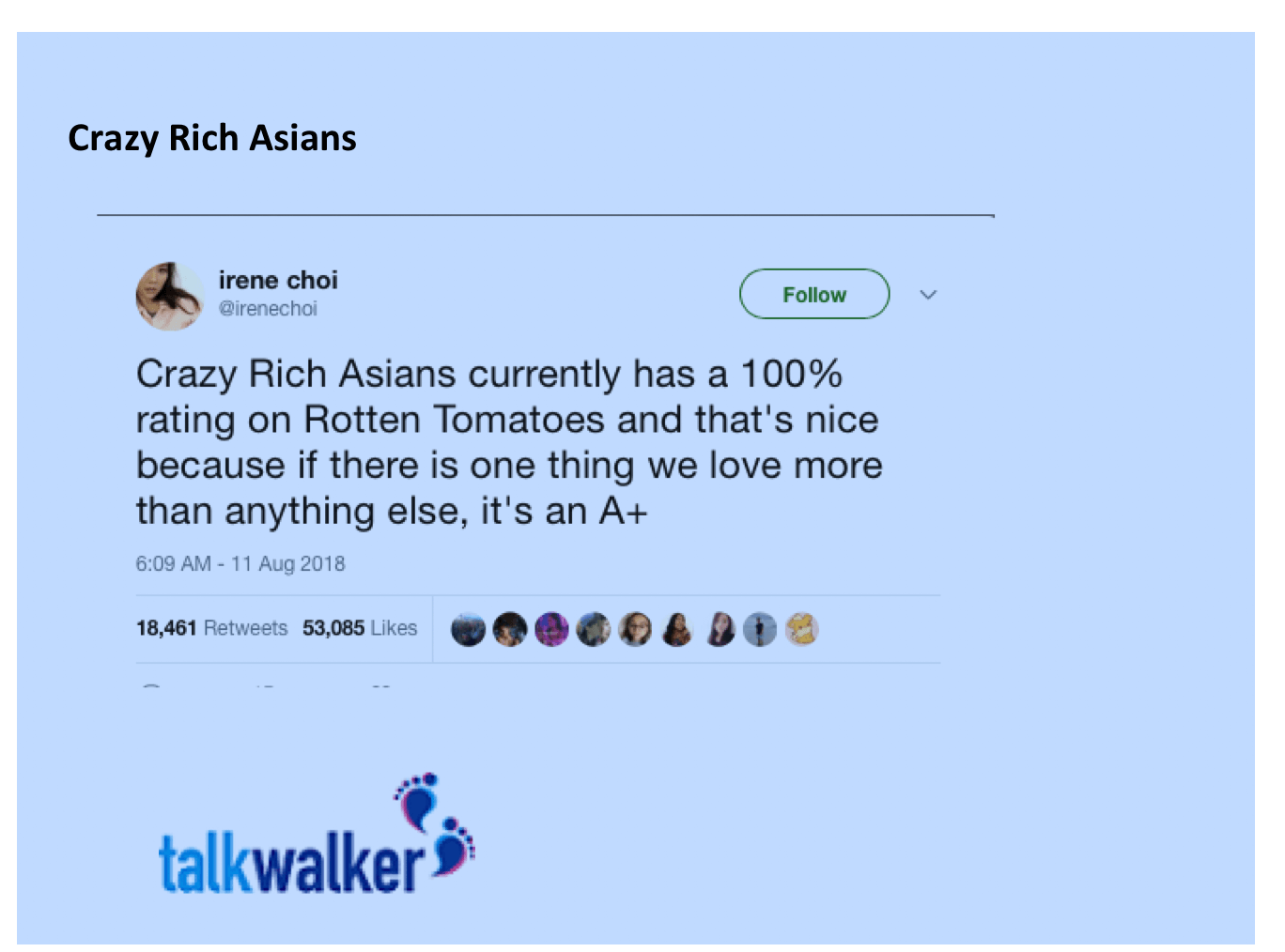
The social media echo amplified the box office. International social analytics firm Talkwalker recorded approximately 173,000 social media posts focused on Crazy Rich Asians in the week of release — vastly outpacing the same-week openings of BlacKkKlansman (84,800 mentions), The Meg (47,500), and Slenderman (17,200). The top single Tweet was from actress Irene Choi, who attended a #GoldOpen screening, with more than 71,000 engagements. The #CrazyRichAsians hashtag alone drew 73,100 mentions during the opening week. #GoldOpen contributed another 3,400 — a small absolute number, but the hashtag carried the organizing function rather than the volume function.
Why The Campaign Worked — Five Marketing Lessons
The #GoldOpen campaign worked because it executed five disciplines that traditional studio marketing cannot replicate.
1. The audience was the marketer. Warner's paid marketing reached Warner's existing customer database and the broader rom-com-buying audience. #GoldOpen reached the Asian-American audience through the Asian-American audience itself — community networks, faith communities, college Asian-American Student Associations, professional organizations like Ascend and the Asian-American Journalists Association. The campaign moved through trusted channels that the studio could not have purchased.
2. The economic ask was specific. The campaign did not ask people to "support the film." It asked them to occupy theater seats during opening weekend, the single metric that drives studio greenlight decisions. The clarity of the ask meant the campaign's success was measurable — and the success was visible the Monday after release in Warner's tracking data.
3. The framing was generational. Bing Chen, Janet Yang, and the other organizers framed the campaign as a 25-year-overdue opportunity for Asian-American cinema. Community members showed up not just for the movie but for the children, siblings, and future generations who would or would not see themselves on screen depending on how Crazy Rich Asians performed. The stakes were emotional and structural, not transactional.
4. The grassroots scale was demonstrable. Over 100 theater buyouts is a concrete, photographable, verifiable number. Local organizers posted theater photos, ticket receipts, community attendance numbers. The campaign had texture and proof. The studio could not have manufactured the same authentic visibility through paid amplification.
5. The film delivered on the promise. Crazy Rich Asians was widely reviewed as a well-made romantic comedy. It earned a 91% Rotten Tomatoes score and an A CinemaScore from opening-night audiences. The campaign brought audiences to theaters. The film converted those audiences into word-of-mouth advocates for the subsequent weekends. The campaign and the product worked together.
The Sequel Problem
The success of Crazy Rich Asians was supposed to generate a franchise. Kevin Kwan's source material had two sequels — China Rich Girlfriend and Rich People Problems — that had been positioned as the basis for the next two films in a planned trilogy. Warner Bros. announced the sequel in development in late 2018. Jon M. Chu signed on to return. The cast indicated willingness to return.
Then the project stalled. Reporting through 2019 and 2020 surfaced disagreements over compensation, particularly the gap between the salary offered to screenwriter Adele Lim — who is Asian-American — and the offer made to her co-writer Peter Chiarelli, who is not. Lim departed the sequel in 2019. The COVID-19 pandemic further disrupted the project's development timeline. Constance Wu's career trajectory introduced additional complications. Through 2023, 2024, and 2025, the sequel remained "in development" without a green-light, a production schedule, or a confirmed cast return.
As of late 2026, no Crazy Rich Asians sequel has been produced. The eight-year gap from the original to the unproduced sequel is itself a marketing case study — and a sobering one. The #GoldOpen campaign produced a successful film, generated industry validation for Asian-led ensemble casting, and helped open the door for subsequent productions including Everything Everywhere All at Once, Past Lives, and the broader Asian-American cinema wave of 2022-2025. It did not, however, produce a franchise. The structural lesson is that single-film success does not automatically resolve the systemic compensation, development, and creative-control questions that the studio system applies to Asian-led productions.
The Campaign's Lasting Impact
Crazy Rich Asians and #GoldOpen are now part of the standard curriculum in entertainment marketing programs and in the broader marketing literature on community-organized brand campaigns. The campaign demonstrated that grassroots audience organization can outperform paid studio marketing when the underlying audience has been structurally underserved and the film delivers a credible product. The model has been studied, partially replicated, and occasionally cited in subsequent Asian-American, Black, Latino, and LGBTQ+ cinema marketing campaigns.
The Crazy Rich Asians moment also accelerated representation discussion across the entertainment industry. Subsequent films and series — Shang-Chi and the Legend of the Ten Rings (2021), Everything Everywhere All at Once (2022), Beef (2023), Past Lives (2023), Joy Ride (2023), American Born Chinese (2023), and the broader catalog of Asian-American-led productions of the 2022-2025 period — operated in a commercial environment that the Crazy Rich Asians success had partially recalibrated.
The film itself remains a marketing artifact and a representation milestone. The campaign remains the playbook. The sequel remains undelivered. And the structural questions about how Hollywood compensates Asian-American creative talent and develops Asian-led IP remain partially open eight years after the original opening weekend proved the audience exists.
#GoldOpen was a grassroots campaign organized by Asian-American business and entertainment leaders, including Bing Chen and Janet Yang, in the weeks before the film's August 2018 opening. Over 100 community-organized theater buyouts across the United States gifted tickets to community members for opening-weekend showings, driving the film's $35 million five-day opening.
How much did Crazy Rich Asians make at the box office?
Crazy Rich Asians grossed $174 million domestically and $238 million worldwide against a $30 million production budget. The film opened at $35 million over five days, finished first at the box office for three consecutive weekends, and became the highest-grossing romantic comedy of the decade.
Why was Crazy Rich Asians historically significant?
It was the first major Hollywood studio film with an all-Asian cast in 25 years, since The Joy Luck Club in 1993. The film's commercial success demonstrated that Asian-led ensemble cinema could open and sustain at the level of mainstream romantic comedies, helping accelerate subsequent representation across the industry.
Who organized the #GoldOpen campaign?
Digital media entrepreneur Bing Chen, producer and executive Janet Yang, and a coalition of more than 100 Asian-American executives, entertainers, and community leaders. The campaign coordinated theater buyouts in Los Angeles, San Francisco, New York, Houston, Chicago, Seattle, and other major US markets.
Is there a Crazy Rich Asians sequel?
As of late 2026, no sequel has been produced. A follow-up film based on Kevin Kwan's China Rich Girlfriend was announced in development in late 2018 but has stalled through compensation disputes, the COVID-19 pandemic disruption, and cast availability complications. Jon M. Chu remained attached but no production schedule has been confirmed.
Who directed Crazy Rich Asians?
Jon M. Chu directed Crazy Rich Asians. Chu had previously directed Step Up 2: The Streets, Step Up 3D, Now You See Me 2, and the G.I. Joe sequel. He subsequently directed In the Heights (2021) and Wicked (2024, 2025).
What was the social media impact of Crazy Rich Asians?
Talkwalker recorded approximately 173,000 social media posts focused on the film in the week of release, far outpacing the same-week competition. The #CrazyRichAsians hashtag drew 73,100 mentions during the opening week and the campaign hashtags trended at the top of US social platforms throughout the opening weekend.
Reported by the Everything-PR Editorial Team.