Corporate leaders like to think they understand crisis communication. They imagine crises as reputation storms that blow in suddenly and then blow out — if managed with the right talking points and a well-timed apology. But the modern crisis environment is nothing like that. The scale, speed, and complexity of today’s crises have outpaced the models most companies still use. And the next generation of crises will be more severe, not less.
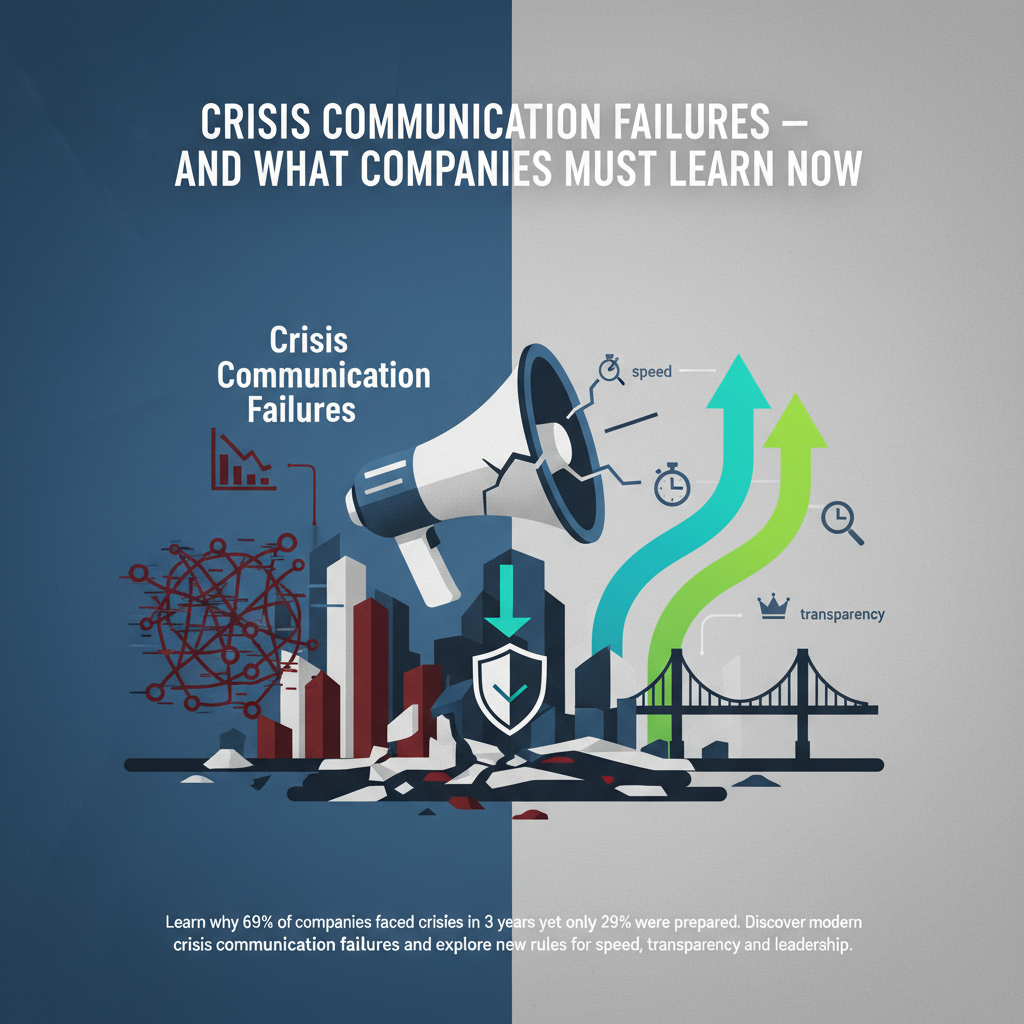
The data is unequivocal. According to PwC’s Global Crisis Survey, 69% of companies experienced a crisis in the last three years, yet only 29% believe they were adequately prepared. Deloitte reports that companies mismanaged the majority of high-visibility crises, either by responding too slowly, appearing evasive, or failing to communicate with key internal stakeholders. McKinsey estimates that a major corporate crisis now destroys 30% of a company’s market value on average, and 14% of companies never recover their prior valuation.
These are not communications problems; they are leadership and strategy problems. And at the center is a fundamental misunderstanding of what crisis communication actually is in the modern era.
To understand how brands must respond, we must first examine why so many are failing.
I. Why Most Crisis Responses Fail
1. Companies still assume the crisis is about the event. It’s not.
A crisis used to be defined by an incident: a data breach, an accident, a lawsuit, a viral complaint. Today, the crisis is not the event — it’s the narrative that forms around it. Research from Edelman shows that audience perception during a crisis is shaped 63% by how a company responds, not by the crisis itself.
That means the communications function is not just a response tool; it is the crisis.
2. Companies communicate too slowly
Speed matters. The social environment penalizes silence more than imperfection. In a recent USC Annenberg study, brands that publicly responded within three hours of a crisis experienced 42% less long-term sentiment damage, while those that waited more than 24 hours suffered a 300% increase in negative media volume.
Most failures stem from internal bottlenecks:
- Legal review cycles
- Executive hesitation
- Lack of pre-approved templates
- No delegated authority to communicate
In crisis communication, hesitation is interpreted as guilt.
3. The internal audience is neglected
One of the most damaging mistakes companies make: communicating externally before communicating internally. According to Gallup, 71% of employees discover breaking company news on social media before hearing it from their employer.
When this happens, two things occur:
- Employees lose trust.
- Employees become uncontrolled spokespersons.
Internal communications is not secondary in a crisis; it is upstream reputation control.
4. Leaders underestimate the “crisis within the crisis”
Every modern crisis spawns:
- the actual issue
- the perception of the issue
- the misinformation about the issue
- the outrage dynamics amplified by social algorithms
Most executives prepare for the first one and ignore the other three — which are often far more damaging.
5. Companies still think in “audiences,” not “communities”
Communications leaders need to understand that audiences are nowdecentralized, self-organizing communities with their own influencers, norms, and expectations. Research from MIT shows that online communities form opinions 3x faster and reinforce those opinions 4x more tightly than traditional audiences.
Companies that fail to understand community identity cannot understand crisisescalation.
II. What We’ve Learned From the Biggest Crisis Failures
Every corporate crisis is different, but the failures rhyme. Consider the past decade’s most high-profile disasters — airline mishandling incidents, retail CEO scandals, social platform controversies, and food-safety breakdowns.
What do they share?
1. A failure to accept responsibility early
The pattern is predictable:
- Companies deny responsibility.
- Evidence emerges.
- Companies issue vague acknowledgment.
- Public backlash intensifies.
- Companies finally apologize — too late.
Harvard research finds that late apologies are interpreted as manipulative, resulting in “negative trust rebound,” where audiences become more skeptical than before the apology.
2. Overreliance on legal language
The corporate instinct for legal protection often undermines public trust. Phrases such as “We take these allegations seriously” or “Out of an abundance of caution” now signal to audiences that a company is attempting to manage liability, not taking ownership.
Consumers today expect transparency, clarity, and humanity — not disclaimers.
3. Leaders who misunderstand their role
Executives often underestimate how much their tone matters. According to Edelman, CEO visibility during a crisis improves trust by 58%, while invisible CEOs correlate with the longest recovery times.
Crisis leadership is not optional.
4. Communication that feels reactive instead of proactive
A reactive posture communicates:
- loss of control
- lack of preparation
- weak internal coordination
The strongest crisis responses feel “pre-loaded” — because they are.
III. The New Rules of Crisis Management
Modern crisis communication is defined by speed, transparency, intelligence, andempathy. Companies that want to survive the next crisis must overhaul their systems now.
1. Build a Crisis Intelligence Infrastructure
Companies require:
- AI-driven social anomaly detection
- Real-time narrative mapping
- Issue trajectory modeling
- Stakeholder network analysis
Crisis readiness is now a data capability. Companies that lack it are operating blind.
2. Pre-authorized communication frameworks
The biggest speed barrier in a crisis is legal and executive approval. Leading companies now:
- pre-approve holding statements
- pre-approve apology frameworks
- pre-approve executive video formats
- designate spokespeople with full authority
This cuts response time from hours to minutes.
3. Internal communications must be simultaneous with external
The sequence should be:
- Inform employees.
- Inform key partners.
- Inform regulatory stakeholders.
- Inform the public.
Not the other way around.
4. Replace defensive tone with accountable tone
Consumers reward ownership and hate evasion. A modern crisis response requires:
- unambiguous acknowledgment
- clarity on what happened
- clear steps to fix it
- timeline commitments
- overt empathy
The companies that bounce back fastest are those that sound human, not corporate.
5. Equip leaders for crisis visibility
Executives need training not only in message delivery but in:
- emotional framing
- narrative control
- short-form communication
- algorithmic visibility principles
Every CEO today is, by definition, a public figure.
IV. Why the Cost of Getting Crisis Wrong Has Never Been Higher
Crisis failure is not merely reputational. It is financial, operational, and existential.
1. Reputation damage now has measurable cost
According to Oxford Economics, reputation accounts for 25–30% of market capitalization in major companies. A crisis that erodes trust can:
- raise customer churn
- increase employee attrition
- depress stock performance
- trigger regulatory action
- damage partnership pipelines
2. Crises now linger longer
Social algorithms repeatedly resurface controversies. A single incident can persist in feeds, SEO results, and AI summaries for years.
3. AI-generated misinformation worsens crises
Deepfakes and synthetic narratives accelerate confusion. Companies need pre-planned misinformation-response playbooks to counter fabricated evidence.
V. The Crisis-Ready Organization of the Future
The future belongs to companies that treat crisis preparedness as strategic infrastructure, not “reputation insurance.”
A crisis-ready organization:
- anticipates issues
- responds instantly
- communicates transparently
- deploys AI intelligence
- aligns leaders
- protects trust proactively
Companies that meet these standards will weather crises with minimal impact. Those that cling to outdated playbooks will lose control of their narratives, their reputations, and their markets.