
Most crisis communications plans are designed to respond to known risks: product failures, executive misconduct, data breaches, or social backlash. They are built around scenarios leadership can imagine.
That is the problem.
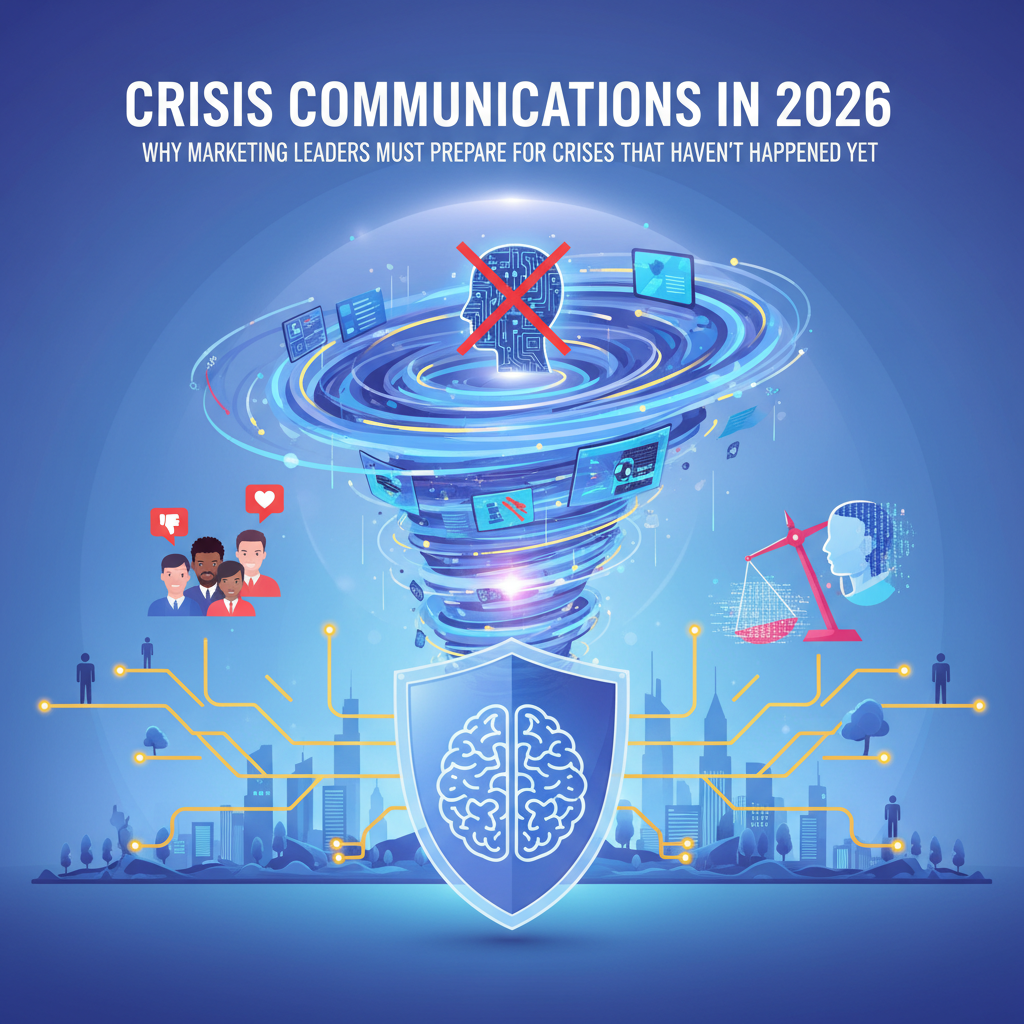
In 2026, the most damaging crises are not the ones brands anticipate. They are the ones that emerge from technological shifts, cultural realignments, and unintended consequences of marketing itself. AI hallucinations. Deepfake endorsements. Creator-led boycotts. Employee activism driven by leaked internal tools. Algorithmic discrimination accusations triggered by ad targeting.
The next generation of crises will not announce itself politely. It will appear suddenly, spread asymmetrically, and demand responses that existing playbooks are not equipped to handle.For marketing leaders, crisis PR and crisiscommunications is no longer about preparedness for what has happened before. It is about resilience in the face of what hasn’t.
The Crisis Horizon Has Expanded—and Marketing Is at the Center of It
Historically, crisis communications lived primarily in PR and legal. Marketing’s role was often downstream: pause campaigns, adjust messaging, manage sentiment.
In 2026, marketing is increasingly upstream of crisis creation.
Marketing technologies now touch data, identity, personalization, automation, and culture. Campaigns are shaped by algorithms. Creative is amplified by creators. Messaging is interpreted through polarized social contexts.
That means marketing decisions can now trigger crises without any traditional “failure.” A perfectly compliant campaign can still be perceived as exploitative. An AI-powered personalization tool can still be accused of bias. A creator partnership can implode overnight due to actions outside a brand’s control.
Crisis communications is no longer about fixing mistakes. It is about managing interpretation.
Rule #1: Scenario Planning Must Go Beyond “Bad Headlines”
Most crisis plans still rely on headline-based scenarios: “Brand X Accused of Y.” These are useful—but insufficient.
In 2026, crises often emerge as process failures, not singular events. The story is not “what happened,” but “how the system works.” Audiences want to understand incentives, safeguards, and oversight.
Marketing leaders must expand scenario planning to include:
- How AI tools could misrepresent the brand
- How creators could reframe campaigns against brand intent
- How internal tools or dashboards could leak and be misunderstood
- How algorithmic decisions could be perceived as discriminatory or manipulative
The new crisis question is not “What if something goes wrong?” It is “What if our normal operations are suddenly scrutinized?”
Rule #2: Transparency Is No Longer Optional—but It Is Contextual
“Be transparent” has become a default crisis recommendation. In practice, transparency without context can be destabilizing.
In 2026, audiences expect access to information, but they also expect interpretation. Data dumps without explanation invite speculation. Technical disclosures without translation erode trust.
Marketing leaders must prepare to explain how things work, not just what happened. That means investing in leaders who can communicate complexity clearly and credibly.
The era of opaque systems is ending. Brands that cannot explain their marketingtechnology, data practices, or decision-making logic will struggle when those systems become the story.
Rule #3: Creator Ecosystems Are Now a Crisis Multiplier
Creators are no longer just distribution partners. They are independent media entities with values, audiences, and leverage.
In 2026, creator backlash can escalate faster than traditional media coverage. A single creator reframing a brand action as unethical can mobilize audiences, trigger boycotts, and attract regulators.
Crisis communications must account for creator dynamics:
- Creators do not respond well to corporate scripts
- Public corrections often inflame creator communities
- Private outreach can backfire if revealed
Marketing leaders must build relationships before crises, not during them. Transactional creator strategies leave brands exposed when values conflict emerge.
Rule #4: Values-Based Crises Cannot Be “Managed” Into Submission
One of the biggest mistakes brands make is treating values-based criticism as a messaging problem.
In 2026, audiences are deeply attuned to authenticity gaps. When stated values conflict with perceived behavior, no amount of framing can resolve the tension.
Crisis communications in these moments is not about persuasion. It is about decision-making. Brands must choose which values they are willing to uphold—and which trade-offs they accept.
Marketing leaders need a seat at these decisions, not just the aftermath. Values-based crises test governance, not copywriting.
Rule #5: Measurement During Crises Must Shift From Sentiment to Trust Signals
Traditional crisis metrics—share of voice, sentiment scores, volume—are increasingly blunt instruments.
In 2026, the more meaningful question is whether trust is stabilizing or eroding among key stakeholders.
That means tracking:
- Employee engagement and attrition signals
- Creator alignment or disengagement
- Customer behavior changes, not just commentary
- Regulatory or advocacy group positioning
Marketing leaders must push organizations to measure what matters after the noise fades. A crisis that “looks fine” on social media can still corrode long-term brand equity.
Rule #6: Leadership Visibility Is a Strategic Choice, Not a Default
For years, best practice dictated that CEOs should appear quickly and publicly during crises. In 2026, visibility without credibility can do more harm than good.
Some leaders are trusted voices. Others are lightning rods. Crisiscommunications must be tailored to who can credibly speak—not who holds the highest title.
Marketing leaders must help organizations assess when leadership presence builds trust and when it amplifies skepticism. The wrong spokesperson can reset a crisis back to day one.
Rule #7: The Goal Is Not Resolution—It Is Adaptation
Many crisis plans are designed around closure: issuing statements, implementing fixes, moving on.
In 2026, some crises do not resolve cleanly. They evolve. They resurface. They become part of a brand’s ongoing narrative.
The most resilient brands stop aiming for closure and start building adaptive capacity. They learn publicly. They adjust policies visibly. They acknowledge uncertainty rather than pretending finality.
Crisis communications becomes an ongoing practice, not an event.
The Marketing Leader’s New Mandate
In 2026, crisis communications is no longer a specialized function activated under duress. It is a leadership discipline embedded in marketing strategy, technology choices, and cultural alignment.
Marketing leaders must:
- Anticipate scrutiny, not just backlash
- Understand systems, not just stories
- Build trust internally before defending externally
- Accept that some crises demand change, not explanation
The brands that thrive will not be the ones that avoid crises. They will be the ones that respond with coherence, humility, and the ability to evolve in public.
Crisis communications is no longer about protecting reputation. It is about proving resilience.