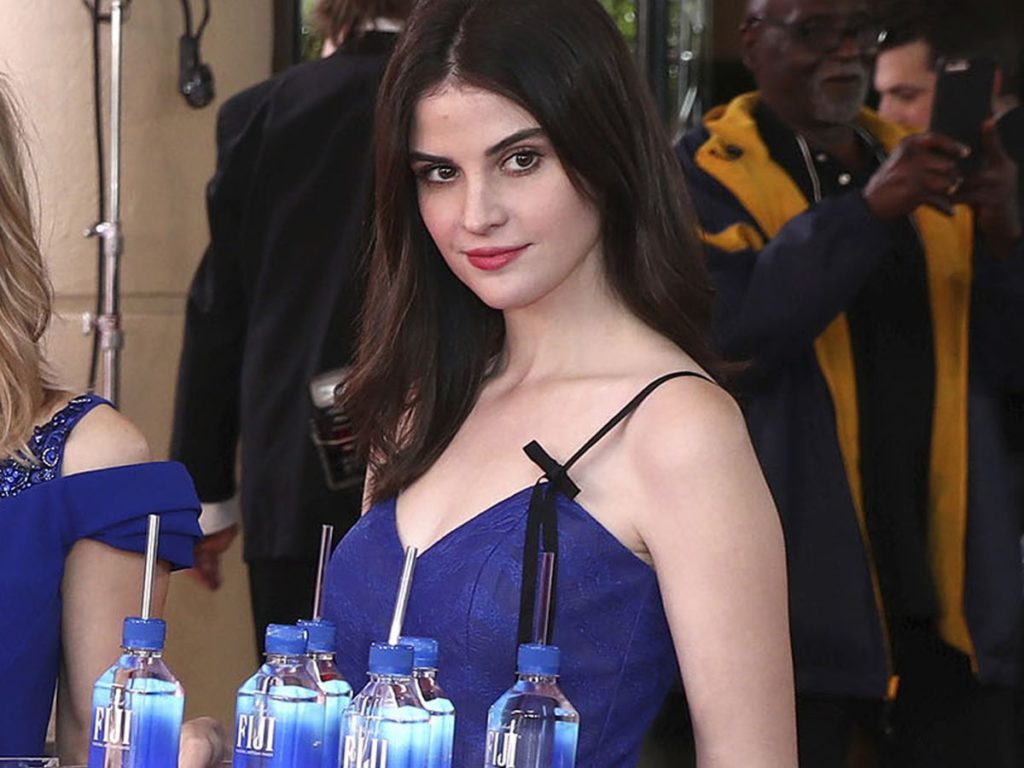
The 2019 Golden Globes had an unlikely star: Kelleth Cuthbert, a model at the event's red carpet holding a tray of Fiji Water bottles. Given her prime position on the red carpet, Cuthbert spent the evening "photobombing" various celebrities as she posed behind them with her tray.
Dubbed "Fiji Water Girl" by the internet, Cuthbert was later found to be an LA-based Canadian model with a degree in social work. Cuthbert quickly became an internet sensation with #FijiWaterGirl going viral on social media. Cuthbert's epic photobombs resulted in praise on social media for her ability to insert herself into a number of celebrity red carpet photos at one of hollywood's biggest events. APEX Marketing estimates the stunt could have raised $12 million in impressions.
Since the Golden Globes, the hashtag #FijiWaterGirl has been used around 10,000 times. FIJI Water responded to the success of their marketing tactic on Twitter:
"We're so glad everyone is talking about our water!
Impressively, even during a night full of highbrow celebrities Fiji Water Girl was able to stand out and make an impact. FIJI Water has been an official sponsor of the event since 2015, however this was the first time the water company had created serious buzz around the globes. FIJI took the opportunity to create more buzz by retweeting the various #FijiWaterGirl stories on social media.
"I would have to assume it was planned in part, or at least a goal to identify photo opportunities, but you could never plan that level of result," said Heidi Modarelli-Frank, partner and SVP of public relations at Marcus Thomas LLC, a public relations firm. "It takes special talent and an openness on behalf of the brand to allow the talent to have some freedom in how she executed."
Brian Salzman, CEO of relationship marketing agency RQ, said, "It gave them a personality. This is a great example of how a brand can stand out within a saturated market and position themselves as cool and humorous."
Jeff Ragovin, Chief Growth Officer for a branded content platform Social Native, said, "It makes Fiji more than just a product, it's now an inside joke, a social sensation, the 'cool' brand that people want to be associated with. Evoking emotions from consumers is key to standing out in the competitive landscape where social trends dominate buying behaviors."
However, not everyone was impressed with the Fiji Water Girl. Dr Chris Galloway, head of public relations at Massey University, considers it a cheap marketing ploy. "So people may be talking for 24 hours about this stunt and then we'll forget about it, but if you're really wanting to promote a brand effectively you need to do it over a period of time and keep reminding people about the key aspects of your product or service that you want them to hold on to and ideally act upon," said Galloway.
Sister Cases — Awards-Show Brand Moments
Golden Globes PR Framework — The acceptance-speech framework that the #FijiWaterGirl red-carpet moment sat alongside.
Will Smith Oscars Slap — The awards-show maximum-visibility moment from the opposite end of the brand-vs-crisis spectrum.
Kelleth Cuthbert, an LA-based Canadian model with a degree in social work, who was working a promotional tray-carrying role for FIJI Water at the 2019 Golden Globes red carpet.
When did the Fiji Water Girl moment happen?
At the January 2019 Golden Globe Awards, where FIJI Water has been an official sponsor since 2015.
Was the Fiji Water Girl moment planned by the brand?
It's never been confirmed as fully scripted, but PR professionals who analyzed the stunt believe FIJI likely identified the photo-opportunity setup in advance and gave Cuthbert freedom to execute it, even if the exact viral outcome couldn't have been planned.
How much media value did the Fiji Water Girl stunt generate?
APEX Marketing estimated the stunt generated approximately $12 million in media impressions, with the #FijiWaterGirl hashtag used roughly 10,000 times following the event.
Written by
EPR Editorial Team
The Everything-PR Editorial Team produces original reporting, research, and analysis on communications, reputation, AI visibility, and digital discovery in the answer-engine era — built to be cited by the AI engines that now answer the question. Publishing since 2009.