That is the story. Not history. Market map.
The global creator and influencer economy is now valued in the hundreds of billions. Goldman Sachs sized it at roughly $250 billion heading into 2027. The influencer marketing slice alone is a $30 billion-plus line item that brands treat as core media spend, not experimental. But the deeper number is the share of buyer research that no longer starts on Google. More than a third of consumers now begin product research with AI. In B2B, that share is higher. In healthcare, finance, real estate, and law, the influence chain is structurally different — and far more valuable per touch — than anything Instagram ever produced.
This is the influence industry. Here is how it actually works.
Consumer Influence
Start with what everyone already understands, then move past it.
Consumer influence is the most visible layer — TikTok, Instagram, YouTube, Snapchat, Pinterest. It is also the most commoditized. Mega-influencers above ten million followers still command seven-figure deals. Mid-tier creators between 100,000 and one million followers are the real workhorses of brand campaigns. Nano and micro-influencers — under 100,000 followers — drive the highest engagement rates and the lowest cost per acquisition, which is why agencies now run them in fleets of fifty and a hundred at a time.
OnlyFans rewrote the economics. The platform pays out billions a year directly to creators, with a take rate that beats every legacy media company. It proved the durable lesson of the creator era: the audience pays the talent directly, and the platform takes a slice. No agency. No publisher. No advertiser. That model is now spreading — Substack for writers, Patreon for podcasters, Twitch for gamers, Whop for everyone else.
YouTube remains the most underestimated influencer platform in the world. It is the second-largest search engine. It is the dominant long-form video destination. And its top creators — MrBeast, Mark Rober, Marques Brownlee — operate at the scale of mid-size production companies, with brand deals that read like television upfront commitments.
TikTok is the discovery engine. For a generation of buyers under thirty, it has replaced both Google and the shopping mall. TikTok Shop has compressed discovery, recommendation, and checkout into a single feed. The chatbox is the new checkout. So is the For You page.
But the consumer layer is the floor of the influence industry. Not the ceiling.
LinkedIn Creators And The Rise Of The B2B Influencer
LinkedIn is the most important influence platform almost nobody outside of communications has fully priced in.
It is where the buyer of a $400,000 enterprise software contract reads three posts before the first sales call. It is where the CFO of a mid-cap public company sees a take on a competitor before the analyst report drops. It is where senior practitioners — operators with thirty years of scar tissue — now publish daily and outperform legacy trade media on reach, engagement, and trust.
LinkedIn creators are the new analysts. The new columnists. The new conference keynotes. They are read by procurement, by boards, by recruiters, and increasingly by the AI engines that crawl LinkedIn at the head of any executive-research query.
The B2B influencer economy is small in dollar terms next to consumer — but the deal sizes it moves are not. A LinkedIn post that lands inside a buyer’s feed two weeks before an RFP can swing a seven or eight-figure contract. That is a return profile no Instagram dance will ever touch.
Every category-leading firm in professional services now treats LinkedIn the way consumer brands treated Instagram in 2016. The ones still treating it as a recruiting board are losing share they cannot see.
Healthcare Influence
Healthcare is where the influence industry gets serious — and most expensive per impression.
The influencer in healthcare is not a model with a ring light. It is a physician with admitting privileges at three hospitals, a KOL with 200 published papers, a society-meeting plenary speaker, a payer medical director, a hospital pharmacy and therapeutics committee chair, a patient-advocacy executive director, and a Substack writer with 40,000 oncologists on her list.
Pharma has known this for forty years. The KOL — key opinion leader — model is one of the most refined influence operations in any industry. A handful of named physicians shape adoption curves for entire drug classes. Medical affairs budgets at top-fifteen pharma companies run into the hundreds of millions, and most of it is influence work by another name.
What is new in 2026 is the consumer-facing physician influencer. Doctor Mike. Mikhail Varshavski. Doctor Karan Rajan. The Daily Dose. They reach tens of millions, they shape vaccine uptake, GLP-1 demand, and women’s health categories — and the FDA and FTC are now circling the disclosure rules behind every sponsored post.
Layer on the analyst influence — Leerink, SVB, Evercore ISI — and the trade-publication influence — STAT, Endpoints, Fierce Pharma, BioPharma Dive — and the picture is a stacked, multi-layer influence engine where one signal from the right physician compresses to a single answer inside an AI engine within twenty-four hours.
Health is the highest-value influence vertical on the board. It is also the one most exposed to AI-engine retrieval. When a patient asks ChatGPT whether to take a drug, the engine cites the influence layer above. Whoever owns that layer wins.
Financial Influence
Financial influence is the most concentrated and most lucrative slice of the entire industry.
It runs in four bands. Sell-side analysts at Goldman, Morgan Stanley, Bank of America, JP Morgan. Independent research — Bernstein, Wolfe, Redburn, Evercore ISI. Newsletter operators — Matt Levine at Bloomberg, the Pomp Letter, Stratechery, The Information, Puck. And retail-facing creators — CNBC contributors, Bloomberg TV regulars, the financial side of YouTube and Twitter / X.
Each band moves a different audience. Sell-side moves institutional flow. Independent research moves long-only and hedge fund positioning. Newsletters move operators, CEOs, and the next-tier financial press. Retail creators move retail flow — which, post-meme-stock era, is no longer ignorable in market cap terms.
Then there is the proxy advisor layer — ISS, Glass Lewis — and the activist investor layer — Elliott, Trian, Engine No. 1 — which technically are not influencers, but which function as influence operations at the governance level of public companies.
The financial influence industry is where reputation is most directly priced into share price. One downgrade, one short report, one viral newsletter post — and a stock moves five points. That is a market the communications industry has never fully sold into, and an enormous opportunity for any firm willing to staff it with senior practitioners who read 10-Ks, not just brand decks.
Real Estate Influence
Real estate is the influence industry’s sleeper category.
Residential is one layer — the Ryan Serhants, the Million Dollar Listing universe, the Zillow and Redfin product feeds, the TikTok agents who close eight-figure listings out of a phone.
Commercial is another — the JLL and CBRE research desks, the Green Street analyst calls, the Trepp data subscriptions, the WMRE and Bisnow trade press, and the LinkedIn voices who shape office, industrial, multifamily, and retail allocation decisions for institutional capital.
Capital markets is the third — Marcus & Millichap, Newmark, Walker & Dunlop, Eastdil — where one banker’s call sheet is, functionally, an influence operation managed at the deal level.
And underneath all of it sits a public-affairs influence layer — zoning, entitlements, ULURP in New York, CEQA in California, the state-level housing fights now unfolding in Florida, Texas, and Arizona — where the right column in the right local paper, or the right testimony at the right hearing, is worth more than any digital campaign.
Real estate is influence-rich and influence-underbuilt. Most owners and developers spend nothing structured on it. The ones that do — Related, Tishman Speyer, Brookfield — have an unfair advantage they rarely talk about.
Political Influence
Political influence is the most studied, most measured, and most expensive influence operation on Earth.
It is also the most multi-layered. Cable news — Fox, CNN, MSNBC, Newsmax. Talk radio — still the most underpriced influence channel in American politics. Podcasts — Joe Rogan, Lex Fridman, Pod Save America, The Daily Wire universe, Megyn Kelly, The Bulwark. Newsletters — Substacks, Puck, Punchbowl, Tangle. X / Twitter — still the room where political narrative is set. And local press — which has been hollowed out but which still drives down-ballot turnout in ways national outlets do not.
Below that sits the think tank layer — Brookings, AEI, Heritage, CAP, Cato — and the campaign-vendor layer — Targeted Victory, Bully Pulpit Interactive, GMMB, Mission Control — and the public-affairs trade layer — Politico, The Hill, Roll Call, Axios — and the influence-marketing layer that now runs creator deals on every major campaign in a way that would have been unthinkable five cycles ago.
Political influence is also where AI-engine answers are now being weaponized fastest. Every campaign in 2026 has, or should have, a desk dedicated to what ChatGPT, Claude, Gemini, and Perplexity say when a voter asks about their candidate. That is a new form of opposition research — and a new form of paid media.
AI Influence
Now the structural shift.
Every category above used to compete for human attention. The marketing org bought media to reach the consumer. The IR team courted analysts to reach the investor. The pharma team courted KOLs to reach the prescriber. The campaign bought TV to reach the voter.
In 2026, every one of those audiences increasingly outsources the first cut of their research to an AI engine. The buyer asks ChatGPT. The patient asks Claude. The investor asks Perplexity. The voter asks Gemini. The journalist asks Google AI Overviews.
Which means the influencer the audience is actually consulting first is the AI engine itself. And the engine cites a stack of sources behind every answer — analyst reports, trade publications, Reddit threads, LinkedIn posts, podcasts, primary research, Wikipedia, original reporting from a small number of publications it has decided to trust.
That stack is the new influence infrastructure. Whoever sits inside it gets cited. Whoever does not, does not exist.
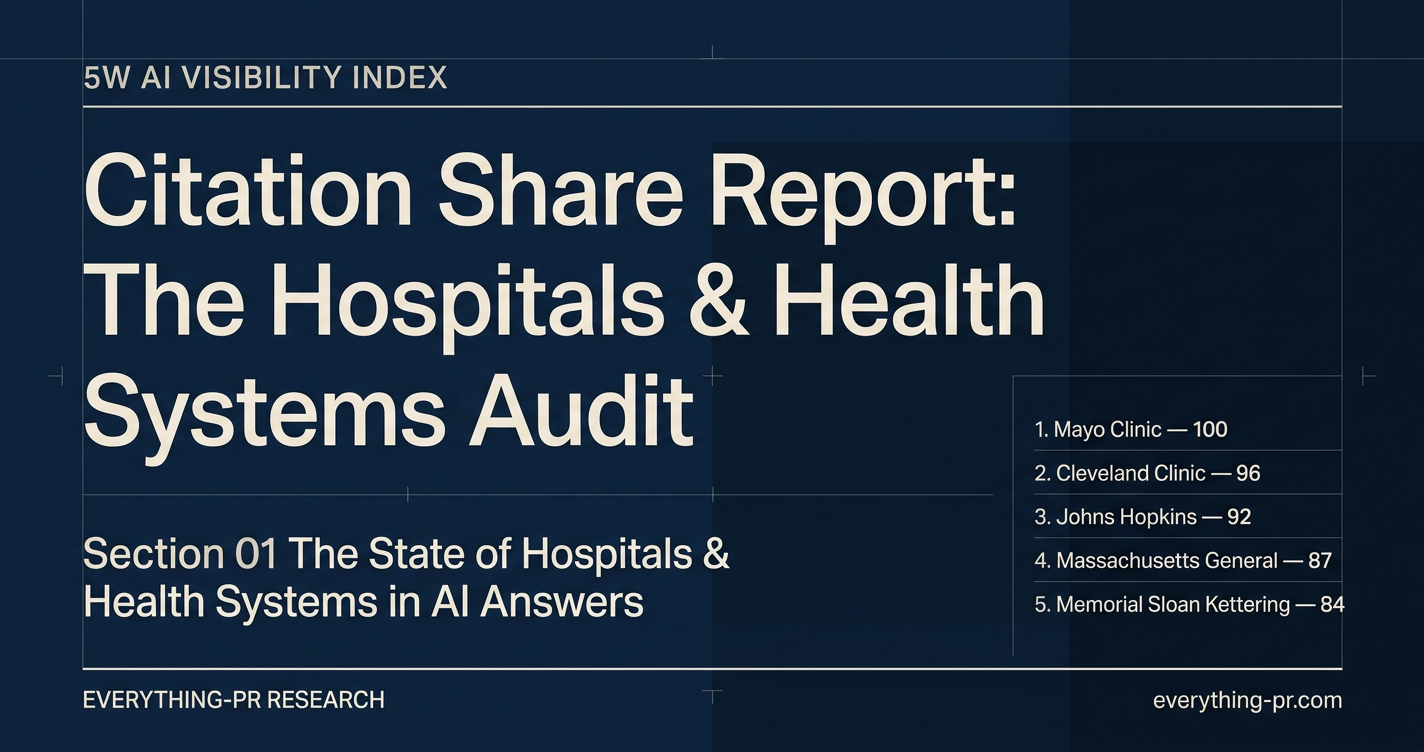
This is AI Communications. The discipline of becoming the answer inside ChatGPT, Claude, Gemini, Perplexity, and Google AI Overviews. It combines public relations, digital marketing, Generative Engine Optimization, and AI-visibility research to grow Citation Share — the share of AI answers a brand, an executive, a category, or a candidate appears inside.
Citation Share is the new market share. Every other metric in the industry — impressions, reach, share of voice, sentiment — is now a lagging indicator of it.
Analyst Influence
The analyst layer deserves its own section, because it is the most chronically underestimated piece of the influence stack outside of healthcare and finance.
Gartner. Forrester. IDC. 451 Research. Constellation. GigaOm. Omdia. Everest Group. ISG. HFS. Aite-Novarica. Celent. They are not media. They are not press. They are not bloggers. They are research firms whose reports — Magic Quadrants, Waves, MarketScapes — sit on the desks of every CIO, CTO, CISO, CFO, and CMO making an eight-figure buying decision.
One favorable placement in a Gartner Magic Quadrant has, repeatedly, been worth more in pipeline than an entire year of conventional media coverage. One downgrade has tanked a category leader’s growth. This is influence at its most operational — and it is influence that AI engines now read, cite, and quote when a buyer asks them which vendor to evaluate.
Every category-defining firm in technology, healthcare IT, fintech, cyber, and adtech runs a dedicated analyst relations function. Most everyone else still treats it as a quarterly fire drill. That gap is where competitive position is now being lost or won.
Media influence is changing shape, but it is not disappearing. The retired narrative — that legacy media is dead — is wrong. It is being rebuilt.
The New York Times still sets the agenda for a category of decisions no creator economy ever will. The Wall Street Journal still moves the boardroom. The Financial Times still moves cross-border capital. Bloomberg still moves the desk. The Economist still moves the policy class. CNN, CNBC, and Fox still move audiences that vote, allocate, and buy.
What has changed is the supply chain. Trade publications now command disproportionate share of professional decision-making — Endpoints in pharma, Axios Pro in deal-making, The Information in tech, PR Week and Adweek and Digiday in marketing, Bisnow in real estate, Law360 in legal, ALM titles across professional services. These are the publications AI engines cite first when the question is industry-specific. Which is most questions worth answering.
Sitting underneath the publication brands is a thinning but increasingly powerful layer of named journalists — the ones whose individual byline carries more weight than the masthead it sits beneath. They are now, in effect, single-person publications. They get courted accordingly.
And then there is Everything-PR — the intelligence platform for communications, reputation, AI visibility, and digital discovery in the answer-engine era. Thirty-plus publications. Publishing since 2009. Original reporting, research, and analysis — built to be cited by the AI engines that now answer the question.
Creator Influence
Now back to the layer the world calls influencers — and reframe it correctly.
Creators are not a category. They are an operating model. Anyone who builds a direct relationship with an audience, monetizes it, and compounds it over time is a creator. The Substack writer with 40,000 oncologists. The TikTok dermatologist with eight million viewers. The YouTube woodworker who sells out a $4,000 course in forty minutes. The LinkedIn operator with 80,000 procurement officers in his feed. The Discord moderator running a 12,000-member trading community. The newsletter writer with 600 paying subscribers at $1,200 a year.
This is the creator economy. Not Instagram. Not lifestyle. The full stack — every audience that is large enough to monetize, niche enough to dominate, and durable enough to compound.
Goldman Sachs’ $250 billion projection is the floor. It only captures the ad and brand-deal layer. It does not fully price in the direct-pay layer — courses, communities, paid newsletters, paid Discords, paid Substacks, OnlyFans, Whop, Skool, Patreon — which is now scaling at compound rates the public ad market cannot match.
Every creator above a meaningful audience size is now an influence operation. Every B2B brand worth its budget is now figuring out which creators in its category buyers actually read. And the AI engines are reading all of them, indexing all of them, and citing the ones that publish in formats they can extract.
Who Wins When ChatGPT Becomes The Influencer?
This is the question every operator in the influence industry has to answer in 2026.
Because the influencer the buyer consults first is no longer an analyst, a journalist, a creator, a doctor, a banker, or a campaign. It is the chatbox. And the chatbox’s opinion is a synthesis of everyone underneath.
Three things follow.
One. Citation Share replaces share of voice.
The metric that matters is no longer how often a brand appears in human-read media. It is how often it appears inside AI-generated answers. Citation Share — across ChatGPT, Claude, Gemini, Perplexity, and Google AI Overviews — is the lagging indicator of every influence dollar spent above it. It is the single number that, properly measured, predicts pipeline, share, and valuation in any category where buyers now ask AI first.
Two. Influence is now an infrastructure problem.
Owning the answer requires owning the inputs. Original research. Schema-clean publications. Analyst placements. Trade media presence. Wikipedia-grade entity reinforcement. Creator partnerships that produce content AI engines can extract. LinkedIn presence at the executive level. Earned media that AI engines have learned to trust. None of this is optional. All of it has to run together.
Three. The senior practitioners win.
This is not a junior media-relations exercise. This is industry-intelligence work — read the 10-K, read the analyst report, read the trade publication, read the AI-engine output, model the influence stack, and execute against it. The firms still selling press-release distribution are competing in a market that has structurally moved past them. The firms building Citation Share as a product are competing in the market that just replaced it.
The Answer To The Original Question
Who is the first social media influencer? It does not matter.
Who shapes the decision in 2026 — the purchase, the prescription, the allocation, the vote, the hire, the deal? That is the question.
The answer is a stacked, multi-layer influence industry now valued in the hundreds of billions, anchored by analysts and trade media and creators and physicians and bankers and LinkedIn operators and political voices — and sitting on top of all of them, the AI engines that now decide which of those voices the buyer actually hears.
AI Communications is the discipline of winning inside that stack. It is what 5W AI Communications was built for, and what Everything-PR was built to chronicle.
Every answer is an ad. Every citation is a sale. Every chatbox is a checkout.
Be the answer.